 HYGO News
 Q: Fed raised rates by 75 basis points? WH: part of transition to stable & steady growth
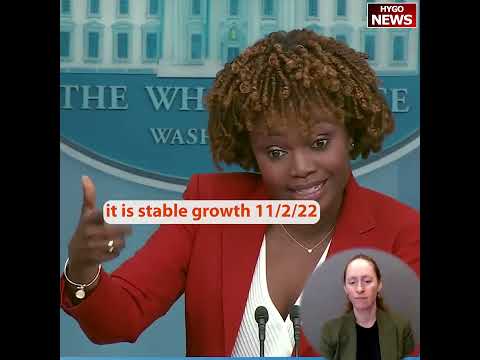
Fed Raises Rates by 75 Basis Points — Fourth Consecutive Mega-Hike; KJP Rebrands It as “Part of Our Transition to Stable and Steady Growth”
On 11/2/2022, the Federal Reserve announced its fourth consecutive 75-basis-point interest rate increase — the most aggressive tightening cycle in four decades — bringing the federal funds rate to 3.75-4.00%. A reporter asked White House Press Secretary Karine Jean-Pierre for the administration’s reaction. KJP laughed that breaking news “happens to me all the time up here,” then rebranded the aggressive rate hike as “part of our transition to stable and more stable and steady growth” — framing the Fed’s emergency inflation-fighting measures as part of a deliberate White House economic plan rather than a correction forced by the inflationary crisis Biden’s spending policies had helped create.
”This Happens to Me All the Time”
The reporter noted that the Fed decision had just been announced. “The news just broke — the Fed did raise rates by the 75 basis points. Just following up to see if you did want to share anything now that the news is out,” the reporter said, drawing laughter from the room.
“This happens to me all the time up here,” KJP said with a laugh — acknowledging the recurring challenge of addressing breaking economic news from the podium without prepared talking points.
The lighthearted tone was at odds with the gravity of the announcement. The fourth consecutive 75-basis-point hike was historically extraordinary. Before 2022, the Fed had not raised rates by 75 basis points in a single meeting since 1994. In 2022, they did it four times consecutively — in June, July, September, and November — reflecting the severity of an inflation crisis that required the most aggressive monetary tightening in a generation.
”Part of Our Transition”
KJP’s substantive response deployed the administration’s favorite economic euphemism. “This is part of our transition — this is part of our transition to stable and more — a stable and steady growth,” KJP said, stumbling through the formulation. “Stable and steady growth with lower inflation. This is the kind of economy that delivers for working families.”
The “transition” framework had been the White House’s go-to description of economic deceleration since Biden declared in October that the economy was moving from “historically strong” to “more stable” growth. Applying it to the Fed’s emergency rate hikes took the euphemism to a new level.
The Fed was not engineering a “transition to stable growth.” It was fighting the worst inflation in 40 years by deliberately slowing the economy — raising borrowing costs to reduce consumer spending, cool the labor market, and bring prices down. The Fed’s own communications described the rate hikes as necessary to restore “price stability” — an implicit acknowledgment that prices were unstable, which is the opposite of “stable and steady growth.”
KJP’s framing treated the rate hikes as part of a Biden economic plan. In reality, they were the Fed’s response to a crisis that Biden’s fiscal policies — particularly the $1.9 trillion American Rescue Plan — had helped create. The Fed was cleaning up a mess; the White House was describing the cleanup as the plan.
The Impact on Working Families
KJP’s claim that aggressive rate hikes delivered an economy that “delivers for working families” was contradicted by the rate hikes’ actual effects on working families:
Mortgage rates: The 30-year fixed mortgage rate had surged from approximately 3.0% in January 2022 to above 7.0% by November — more than doubling in less than a year. A family buying a $400,000 home at 3% would pay approximately $1,686 per month; at 7%, the same home cost approximately $2,661 per month — a $975 increase, or nearly $12,000 per year in additional housing costs. Millions of first-time buyers were effectively priced out of the housing market.
Credit cards: Credit card interest rates, already high, climbed further with each Fed hike. Families carrying revolving debt — disproportionately lower-income Americans — faced increasing costs for existing balances.
Auto loans: The average new car loan rate rose from approximately 4.5% to above 7%, adding hundreds of dollars per month to vehicle payments at a time when new car prices had already increased substantially due to supply chain constraints.
Business lending: Higher rates increased borrowing costs for small businesses, potentially leading to reduced hiring, slower expansion, and in some cases, layoffs — all of which affected working families.
The rate hikes may have been necessary to fight inflation, but describing them as “delivering for working families” was Orwellian. The hikes were deliberately designed to make borrowing more expensive, cool consumer spending, and slow economic growth — outcomes that harmed working families in the near term, even if they were necessary to prevent greater long-term damage from sustained high inflation.
”We Respect Their Independence”
KJP deployed the standard disclaimer about Fed independence. “Our view is that the federal — the Fed is an independent agency, and we respect their independence,” KJP said.
The independence claim was technically correct — the White House did not direct specific Fed rate decisions. But the administration’s relationship with the Fed was more complicated than the “independence” formulation suggested. Biden had publicly supported the Fed’s tightening campaign, reappointed Jerome Powell as Fed Chair, and encouraged the Fed to “act independently” on inflation — all signals that the White House wanted rates to rise.
At the same time, the administration’s fiscal policies were working at cross-purposes with the Fed’s monetary policy. The Fed was raising rates to reduce demand and slow spending. Biden was simultaneously signing new spending legislation (the IRA), pushing student loan forgiveness, and running fiscal deficits that added demand to the economy. The Fed was stepping on the brake while the administration was stepping on the gas — making the Fed’s job harder and requiring even more aggressive rate hikes than might otherwise have been necessary.
The Fourth of Four
The November rate hike was the fourth consecutive 75-basis-point increase, bringing the total rate increase in 2022 to 375 basis points — 3.75 percentage points. The cumulative effect was extraordinary:
The federal funds rate had risen from near zero (0.00-0.25%) in March 2022 to 3.75-4.00% in November — the fastest tightening cycle since the early 1980s when Paul Volcker raised rates to combat the last major inflation crisis. The comparison to Volcker was ominous: Volcker’s rate hikes triggered the severe recession of 1981-1982, with unemployment reaching 10.8%.
The Fed signaled that more rate increases were coming. Markets expected rates to reach 5.0% or higher in early 2023, meaning the tightening cycle was far from over. The risk of recession — already forecast at 100% by Bloomberg Economics — remained elevated.
Key Takeaways
- The Fed raised rates by 75 basis points for the fourth consecutive time — the most aggressive tightening cycle in 40 years — bringing rates to 3.75-4.00%.
- KJP rebranded the emergency inflation-fighting measure as “part of our transition to stable and steady growth” — framing the Fed’s crisis response as a deliberate White House plan.
- She claimed the economy “delivers for working families” while mortgage rates doubled to 7%, credit card rates surged, and millions of first-time homebuyers were priced out.
- The administration claimed to “respect Fed independence” while its fiscal policies — new spending, student loan forgiveness, deficits — worked at cross-purposes with the Fed’s tightening.
- The federal funds rate rose from near zero to 3.75-4.00% in eight months — the fastest increase since the Volcker era that triggered a severe recession.
Transcript Highlights
The following is transcribed from the video audio (unverified — AI-generated from audio).
- The news just broke — the Fed did raise rates by the 75 basis points. Just following up to see if you want to share anything.
- This happens to me all the time up here.
- The Fed is an independent agency, and we respect their independence.
- This is part of our transition to stable and more stable and steady growth.
- Stable and steady growth with lower inflation. This is the kind of economy that delivers for working families.
- I’m not going to go into any specifics — any more details from here.
Full transcript: 144 words transcribed via Whisper AI.