 HYGO News
 Q: economist 180 tariff plan outsmarted everybody, Trump: best question; Rubio & Rwanda & Congo
Q: economist 180 tariff plan outsmarted everybody, Trump: best question; Rubio & Rwanda & Congo
A leading global economist reportedly reversed his position on Trump’s tariff plan, acknowledging that the plan may have “outsmarted everybody.” When a reporter asked Trump about the reversal, the president’s reaction was immediate: “This is the best question I’ve ever been asked.” Separately, Treasury Secretary Bessent outlined the July 4 target for the One Big Beautiful Bill signing and detailed the bill’s full suite of tax cuts, while Secretary of State Rubio presided over the signing of the historic Rwanda-Congo peace agreement that the Trump administration had brokered. Deputy Attorney General Todd Blanche highlighted the Supreme Court’s “trans books case” ruling that restores parents’ rights to opt their children out of gender ideology education.
”The Best Question I’ve Ever Been Asked”
The reporter’s question set up the moment. “Mr. President, a leading global economist just at a 180 and says your tariff plan may have outsmarted everybody with it. What is your message to—”
Trump’s reaction was immediate. “I love this. I love this question. This is the favorite. This is the best question I’ve ever been asked because I’ve been going through abuse for years on this.”
“Abuse for years” captures Trump’s experience on the tariff question. Mainstream economic commentary throughout his first term and the 2024 campaign consistently argued that his tariff plans would harm American consumers, generate inflation, trigger retaliation, and damage the economy. That commentary was the dominant framing in academic economics, in most business journalism, and in multilateral economic institutions.
The “180” — a reversal of position — suggests that at least some economists who were hostile to the tariff plan have revised their assessments as the plan’s actual effects have emerged.
”Hundreds Of Billions Of Dollars”
Trump continued. “Because as you know, we’re taking in hundreds of billions of dollars. No inflation whatsoever.”
The two claims are the administration’s core tariff argument. Revenue: the tariffs are generating substantial revenue for the federal government, reducing the deficit and providing fiscal space for other priorities. Inflation: despite predictions that tariffs would drive consumer prices higher, inflation has moderated rather than accelerated.
If both claims are accurate, the tariff plan has produced fiscal benefits without the consumer cost that critics had predicted. That combination would indeed constitute “outsmarting everybody” — achieving the fiscal and strategic benefits of tariffs without the consumer costs.
”They Should Go Back To Business School”
The reporter pressed. “But Mr. President, what is your message to critics who think your tariff plan will cause a recession?”
Trump: “I think they should go back to business school. It’s so obvious. It’s so obvious. I mean, we’re taking in billions and billions of dollars from China and a lot of other countries.”
“Go back to business school” is the characteristic Trump dismissal. Professional economists, in Trump’s framing, lack the practical business understanding that would have predicted the tariff plan’s success. Their academic models produced wrong predictions. The reality has diverged from the models.
The specific economic mechanism Trump implicitly invokes is the asymmetry between American and foreign markets. The United States is a destination market — foreign producers want access. Tariffs on imports effectively force foreign producers to either absorb the cost (reducing their profit margins) or pass it on to American consumers. In many cases, foreign producers absorb much of the cost rather than risk losing American market share.
If absorption is dominant — which recent evidence suggests — then tariffs generate revenue without producing substantial consumer-price effects. That is the outcome Trump is describing.
Bessent On The One Big Beautiful Bill
Treasury Secretary Scott Bessent then took over the substantive policy update. “The one big beautiful bill, it is the continuation of the 2017 Tax Guts and Job Act. We’re going to bring back full-expensing, which is new, which is really going to provide great impetus to the economy.”
The framing — continuation of the 2017 Tax Cuts and Jobs Act — addresses the question of how the bill fits with the prior Trump-era tax framework. The 2017 Act included provisions that were scheduled to expire. The One Big Beautiful Bill extends those provisions while adding new ones.
Full expensing is the addition Bessent highlighted. Full expensing allows businesses to deduct the full cost of capital investment in the year of the investment, rather than depreciating over years. The change matters for capital-intensive businesses — manufacturing, energy, infrastructure — because it reduces the effective tax cost of investment. Companies that would have delayed capital projects, in the absence of full expensing, are incentivized to invest sooner.
”Something There For Everyone”
Bessent ran through the bill’s provisions. “But it’s also going to include President Trump’s campaign promises of no tax on tips, no tax on overtime, reduced taxes on seniors, deductibility of American-made cars. It’s something there for everyone.”
“Something for everyone” is the political pitch. The bill is not narrowly tailored to benefit one constituency. It benefits service workers (through tip tax elimination), overtime-earning workers including first responders (through overtime tax elimination), seniors (through Social Security tax reduction), and car buyers who purchase American-made vehicles (through deductibility).
That breadth is deliberate. Voters across multiple demographic categories can find specific benefits that affect them directly. The administration is betting that broad reach will translate into broad political support.
”Border Security In There”
Bessent added one more element. “And also, there’s border security in there. We are going to fix the FAA. This is a tremendous bill.”
Border security provisions — the $46 billion Noem had detailed, including wall construction, personnel increases, and surveillance technology — are included in the bill. FAA modernization — the $12.5 billion Duffy had described for air traffic control — is included.
The bill’s comprehensive scope crosses multiple policy areas. Tax policy, border security, aviation safety, energy policy, education policy — each is represented by specific provisions. The bill is not focused. It is ambitious in its scope.
”Narrow Majorities”
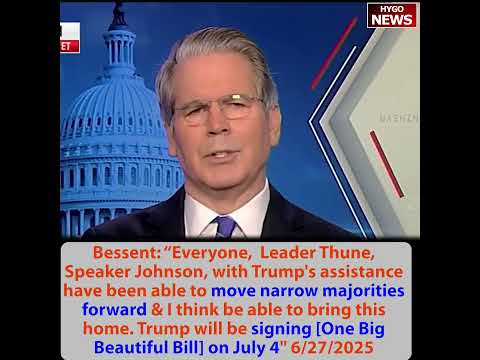
Bessent addressed the political reality. “And I am confident that everyone working together, leader Thune, Speaker Johnson, with President Trump’s assistance, have been able to move narrow majorities forward. And I think we’re going to be able to bring this home.”
“Narrow majorities” captures the current Senate and House margins. Republican control is technically majority, but the margins are thin. Every member’s vote matters. Every dissent from within the Republican caucus must be managed. Senate passage requires discipline from the entire caucus given the 60-vote threshold for most procedures.
“Bring this home” is the expected outcome. Despite the narrow margins, Bessent expresses confidence that the bill will pass. That confidence reflects the administration’s ongoing work to address specific senators’ concerns and the leadership’s ability to build coalition support.
”July 4th”
Bessent confirmed the target. “The President will be signing the bill on July 4th.”
July 4 is Independence Day. Signing the One Big Beautiful Bill on that date is symbolic — the bill represents, in the administration’s framing, the economic equivalent of Independence. Americans gaining economic freedom through reduced taxation, expanded opportunity, and increased take-home pay. The ceremonial resonance of Independence Day is the political framing.
The Rwanda-Congo Signing
The video then captured one of the week’s most substantial diplomatic moments. Secretary of State Rubio presided over the signing of the Rwanda-Congo peace agreement.
“It’s now my honor to invite the parties to sign the peace agreement to be witnessed by Secretary Rubio.”
The agreement’s significance is difficult to overstate. The Rwanda-Congo conflict has been one of the most persistent and bloody regional conflicts in Africa for over a quarter-century. Multiple prior peace efforts had failed. The current agreement, brokered by the Trump administration, represents a genuine diplomatic achievement.
The Agreement’s Provisions
The announcer detailed the agreement’s elements. “The agreement being signed includes provisions on the respect for territorial integrity and the prohibition of hostilities. The disengagement, disarmament and conditional integration of non-state armed groups. The establishment of a joint security coordination mechanism. The facilitation of the return of refugees and internally displaced persons, as well as humanitarian access.”
Each element addresses a specific dimension of the conflict.
Territorial integrity and prohibition of hostilities: The basic framework — each side recognizes the other’s territorial sovereignty and commits to not attacking.
Disengagement, disarmament, and conditional integration of non-state armed groups: The rebel and militia groups that have operated in the border regions must disarm. Those who comply are integrated into regular structures. Those who do not comply are treated as violations of the agreement.
Joint security coordination mechanism: A bilateral structure for managing the border region, addressing disputes, and preventing escalation.
Return of refugees and humanitarian access: The displaced populations — millions of people across both countries — are supposed to be able to return home. Humanitarian access allows aid organizations to reach those who need help.
”Reaffirmation Of Monusco’s Mandate”
The agreement continued. “The reaffirmation of Monusco’s mandate and the establishment of a regional economic integration framework.”
MONUSCO is the United Nations peacekeeping mission in Congo. The mission’s mandate is reaffirmed, which means UN forces continue to operate in the region to support the peace implementation.
The “regional economic integration framework” is the forward-looking provision. Beyond stopping the conflict, the agreement establishes a framework for economic cooperation between Rwanda and Congo. Trade, investment, shared infrastructure — each can develop over time as the security situation stabilizes.
”Immediately Enters Into Force”
The announcer closed. “The agreement also includes an annex with the party signatures. Today, the agreement immediately enters into force. Thank you very much. Congratulations.”
“Immediately enters into force” is the implementation detail. The agreement is not conditional on further ratification. It takes effect on signing. The parties are bound immediately.
Whether the agreement holds is the test that will be conducted over the coming years. Peace agreements often fail. Implementation depends on continued commitment from political leaders, military commanders, and international monitors. The Trump administration’s ability to maintain engagement with the parties over time will be part of what determines whether the signing produces durable peace.
The “Trans Books” Case
Deputy Attorney General Todd Blanche then highlighted another Supreme Court decision from the same day. “Another great decision that came down today, the TransBooks case, which restores parents’ rights to decide their child’s education.”
The “TransBooks case” — referring to Mahmoud v. Taylor or a similar case — addressed whether parents have the right to opt their children out of instruction involving gender ideology materials in public school curricula. The specific facts involved a Maryland school district that had removed the opt-out option previously available to parents who objected to specific books based on religious or moral grounds.
”Restores Parents’ Rights”
Blanche’s framing. “Seems like a basic idea, but it took the Supreme Court to set the record state and we thank them for that. That ruling allows parents to opt out of dangerous trans ideology and make the decisions for their children that they believe is correct. So we thank the Supreme Court for that.”
The political significance is substantial. Parents’ rights — the right to direct their children’s education and moral formation — have been a core conservative priority. When public schools include curriculum that parents find objectionable on religious or moral grounds, the question of whether parents can opt their children out is consequential.
The Supreme Court’s ruling, per Blanche’s characterization, sided with parents’ rights. Parents can opt their children out of curriculum they find objectionable. Schools cannot force exposure over parents’ religious or moral objections.
”Dangerous Trans Ideology”
Blanche’s specific characterization of the content. “Dangerous trans ideology” is the administration’s framing of the specific books and curricula that parents had objected to. The framing treats the content as not merely controversial but actively harmful to children’s development.
Critics of the framing would argue that books representing transgender experience are educational, not dangerous. Proponents of the framing would argue that young children should not be exposed to discussions of gender transition without parental involvement.
The Supreme Court’s ruling resolves the specific legal question — parents have a right to opt out — without resolving the broader debate about whether the content itself is appropriate. Parents can now decide that question for themselves.
Two Major Supreme Court Rulings In One Day
The video captures two major Supreme Court rulings on the same day. The nationwide injunctions case limited the scope of judicial interference with executive branch policy. The parents’ rights case protected parents’ ability to direct their children’s religious and moral education.
Both rulings align with the administration’s policy preferences. Both rulings reinforce the broader constitutional framework the administration has been advocating for. The cumulative effect of a single day’s jurisprudence is substantial.
For the administration, the day represents a validation of Trump’s judicial appointments strategy. The Supreme Court that produced these rulings includes three justices Trump appointed in his first term — Gorsuch, Kavanaugh, and Barrett. Those appointments are producing the jurisprudence conservative voters expected.
Key Takeaways
- Trump on the economist’s “180”: “This is the best question I’ve ever been asked because I’ve been going through abuse for years on this.”
- On tariff critics: “I think they should go back to business school. It’s so obvious. It’s so obvious. We’re taking in billions and billions of dollars.”
- Bessent on July 4 signing: “The President will be signing the bill on July 4th” — combining the 2017 TCJA extension with no tax on tips, overtime, seniors, and American-made cars.
- Rwanda-Congo peace: comprehensive agreement covering territorial integrity, disarmament of non-state groups, refugee return, and regional economic integration — “immediately enters into force.”
- Blanche on the parents’ rights ruling: “Restores parents’ rights to decide their child’s education…allows parents to opt out of dangerous trans ideology.”