 HYGO News
 Q: double Pell Grant for blacks? A: everything at the center of, always equity, always equality
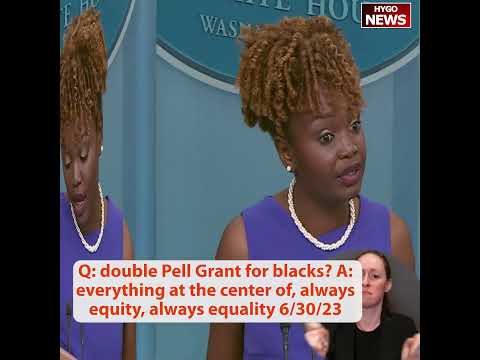
Reporter Asks About Doubling Pell Grants for Black Students — KJP Says “Always Equity, Always Equality”
On June 30, 2023, following the Supreme Court’s twin rulings striking down Biden’s student loan forgiveness program and race-conscious college admissions, a reporter asked White House Press Secretary Karine Jean-Pierre whether the administration would push Congress to double Pell Grants, noting that nearly three out of four students at historically Black colleges and universities qualified for the aid. Jean-Pierre did not directly commit to the proposal but instead spoke broadly about the President’s commitment to equity and equality, citing Biden’s early expansion of Pell Grants and his remarks on affirmative action. The exchange came on a day when the administration was scrambling to address the fallout from the Court striking down the student loan program and the previous day’s ruling against affirmative action.
The Reporter’s Question
The reporter raised the issue in the context of the racial wealth gap and the burden of student loan debt on African Americans, particularly Black women: “Discussion about the racial wealth gap and the burden of student loan debt on African Americans, especially Black women. The United Negro College Fund is asking for the Pell Grants to be doubled, because students at historically Black colleges and universities qualify for that — nearly three out of four of them qualify for that. Is this something the administration is willing to push Congress to do?”
The question was substantive and specific. The United Negro College Fund, one of the most prominent organizations supporting higher education for Black Americans, had publicly called for doubling the maximum Pell Grant award. The rationale was straightforward: since the Supreme Court had just eliminated race-conscious admissions and struck down the broad student loan forgiveness program, alternative pathways to make higher education accessible and affordable for Black students were more urgent than ever.
The statistic cited by the reporter — that nearly 75 percent of HBCU students qualified for Pell Grants — underscored the particular relevance of this proposal to the Black community. Pell Grants are need-based federal aid awarded to undergraduate students with demonstrated financial need, and the high qualification rate at HBCUs reflected the economic challenges faced by many Black students pursuing higher education.
Jean-Pierre’s Response
Jean-Pierre’s answer acknowledged the inequalities but did not commit to the specific proposal of doubling Pell Grants. She said: “One of the things that the President did very early on is to expand the Pell Grant, and especially for African American communities. This is something we understand — the inequalities, right? — that we see in this country that still exist. The President talked about that in his remarks on affirmative action. This is a real thing that communities have to deal with.”
She then pivoted to a broader framing: “And so, this is a President — everything that he has done, every policy, especially as we talk about the economy, at the center of that has always been equity, always been equality.”
The response was long on rhetoric and short on policy commitment. Jean-Pierre cited Biden’s early expansion of the Pell Grant as evidence of his commitment, but the question was specifically about whether the administration would push Congress to double the grants — a much larger step than the incremental increases that had already occurred. By pivoting to the broad themes of “equity” and “equality,” Jean-Pierre avoided the specific ask and left the United Negro College Fund’s proposal unaddressed.
The Context: A Day of Setbacks
The question came on an especially difficult day for the Biden administration’s domestic policy agenda. On June 30, 2023, the Supreme Court struck down Biden’s $400 billion student loan forgiveness program in a 6-3 ruling in Biden v. Nebraska, finding that the President had exceeded his authority under the HEROES Act. The previous day, June 29, the Court had struck down race-conscious admissions in Students for Fair Admissions v. Harvard and Students for Fair Admissions v. University of North Carolina.
The twin rulings created an acute problem for the administration’s approach to racial equity in higher education. The student loan forgiveness program had been framed in part as a tool for closing the racial wealth gap, since Black borrowers disproportionately carried student loan debt and were more likely to have received Pell Grants. The elimination of affirmative action removed another mechanism that colleges had used to promote diversity. With both pillars removed, the question of what the administration would do next to support Black students was not merely rhetorical.
The reporter’s question about doubling Pell Grants represented one of the most concrete alternative proposals available. Unlike student loan forgiveness, which required executive action of questionable legality, or affirmative action, which depended on institutional policies now constrained by the Court, Pell Grant funding was squarely within Congress’s authority and had bipartisan precedent. The administration’s failure to commit to the proposal was notable.
Biden’s Pell Grant Record
Jean-Pierre’s reference to Biden’s early expansion of the Pell Grant was accurate in a limited sense. The Biden administration had increased the maximum Pell Grant award by $900, bringing it to $7,395 for the 2023-2024 academic year. The administration had also worked to simplify the Free Application for Federal Student Aid process to make it easier for students to access the grants.
However, the increases fell short of what advocates had called for. The United Negro College Fund and other organizations had pushed for the maximum grant to be doubled to approximately $14,000, arguing that the current level covered only a fraction of the cost of attendance at most four-year institutions. At many HBCUs, where tuition and fees were lower than at predominantly white institutions, a doubled Pell Grant could cover a substantial portion of costs, potentially reducing the need for student loans that led to the debt burden the reporter had highlighted.
The administration’s reluctance to commit to doubling Pell Grants was likely tied to political reality. Such a proposal would require congressional action, and with Republicans controlling the House of Representatives, the prospects for a significant increase in federal spending on need-based financial aid were slim. But the administration’s failure to even endorse the goal — rather than simply touting past incremental increases — left advocates disappointed.
”Always Equity, Always Equality” as Policy
Jean-Pierre’s closing statement — that everything Biden had done had “always been equity, always been equality” at its center — was characteristic of the administration’s rhetorical approach to racial issues. The administration frequently invoked equity and equality as guiding principles, but critics argued that the gap between the rhetoric and concrete policy outcomes was significant.
On the day of Jean-Pierre’s remarks, the administration’s two most prominent equity-related initiatives in higher education — student loan forgiveness and the defense of affirmative action — had both been struck down by the Supreme Court. The claim that equity was at the center of every policy rang hollow to advocates who were looking for specific commitments rather than broad statements of principle.
The exchange illustrated a recurring tension in the Biden administration’s approach: a willingness to claim credit for being committed to equity while stopping short of the concrete policy actions that would demonstrate that commitment. When presented with a specific, actionable proposal — doubling Pell Grants for the students who needed them most — the response was to talk about equity in the abstract rather than to make a commitment.
Key Takeaways
- A reporter asked whether the administration would push Congress to double Pell Grants, noting that nearly three out of four HBCU students qualify, in the wake of the Supreme Court striking down both student loan forgiveness and affirmative action.
- Jean-Pierre cited Biden’s early expansion of Pell Grants but did not commit to the specific proposal of doubling the maximum award, pivoting instead to broad rhetoric about equity and equality.
- The exchange came on June 30, 2023, the same day the Court struck down Biden’s $400 billion student loan program and one day after it eliminated race-conscious admissions.
- The United Negro College Fund had called for doubling Pell Grants as an alternative mechanism to support Black students, but the administration offered no concrete commitment.
- Jean-Pierre’s statement that equity and equality were “always” at the center of Biden’s policies was criticized by advocates who argued the administration’s rhetoric exceeded its concrete actions on racial equity in education.