 HYGO News
 Trump to Ramaphosa: 'Why Wouldn't You Arrest That Man? He Said Kill the White Farmers, Then Danced!'; 'Nothing Happens to Them' on Farm Killings; Real Reporters Would Cover It, But NBC, ABC, CBS 'Fake News'
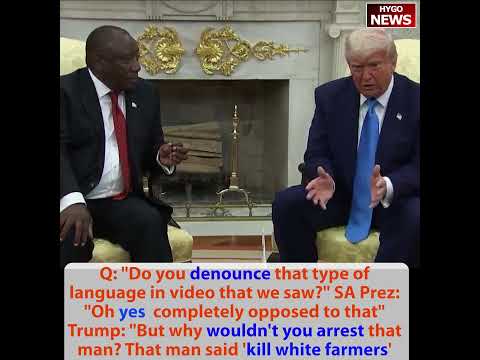
Trump to Ramaphosa: “Why Wouldn’t You Arrest That Man? He Said Kill the White Farmers, Then Danced!”; “Nothing Happens to Them” on Farm Killings; Real Reporters Would Cover It, But NBC, ABC, CBS “Fake News”
After showing the video of EFF leader Julius Malema chanting “Kill the Boer, kill the farmer,” President Trump pushed Ramaphosa further. When a reporter asked if Ramaphosa denounced the video, Ramaphosa said “Oh yes, we’ve always done so. As government, as my own party, we are completely opposed to that.” Trump responded with the obvious follow-up: “But why wouldn’t you arrest that man? That man said, ‘Kill the white farmers, kill the white farmers,’ and then he danced. I’m not sure, but I think if somebody got up in parliament and started saying kill a certain group of people, he would be arrested very quickly.” On the consequences: “That was a stadium that holds 100,000 people, and I hardly saw an empty seat.” On farm killings: “You do allow them to take land. And when they take the land, they kill the white farmer. And when they kill the white farmer, nothing happens to them.” On media coverage: “If we had real reporters, they’d be covering it. But the fake news in this country doesn’t talk about that."
"Oh Yes, We’ve Always Done So”
The exchange began with a reporter asking Ramaphosa about his position on the video Trump had just shown.
“So who denounced that type of language in the video that you saw?” the reporter asked.
Ramaphosa’s response was the diplomatic formulation: “Oh yes, we’ve always done so. As government, as my own party, we are completely opposed to that.”
He cited the historical document: “We in 1955 adopted a document which said South Africa belongs to all who live in it.”
The 1955 document reference was to the Freedom Charter, adopted at the Congress of the People in Kliptown, South Africa, on June 26, 1955. The Freedom Charter had been a founding document of the anti-apartheid struggle, containing principles that would later become foundational to post-apartheid South African politics. Its most famous opening: “South Africa belongs to all who live in it, black and white.”
By citing the Freedom Charter, Ramaphosa was invoking the most sacred document of the ANC’s anti-apartheid tradition. The implicit argument was that the ANC’s founding principles had always rejected racial violence, and therefore Malema’s rhetoric did not represent ANC policy.
However, this framing elided a critical distinction. The Freedom Charter was an ANC document. Julius Malema had been expelled from the ANC. The EFF, which Malema led, operated outside the ANC’s principles. Whether the ANC denounced Malema was not the question — the question was whether the South African state prosecuted his apparent incitement to violence.
”Why Wouldn’t You Arrest?”
Trump immediately identified the gap in Ramaphosa’s answer.
“But why wouldn’t you arrest that man?” Trump asked.
He described Malema’s specific conduct: “That man said, kill the white farmers, kill the white farmers, and then he danced and he’s dancing, dancing, and it’s kill the white farmers.”
He drew the parliamentary analogy: “I think, I’m not sure, but I think if somebody got up in parliament and started saying kill a certain group of people, and he would be arrested very quickly.”
The Trump analogy was sharp. If a U.S. representative stood in Congress and chanted “Kill the [specific group]” repeatedly, they would face immediate legal consequences. At minimum, they would be expelled from Congress; they might face criminal charges for incitement. The suggestion that they could simply continue in office was absurd.
Trump extended the scope: “That man is going all over South Africa, and that’s not a small party. That was a stadium that holds 100,000 people, and I hardly saw an empty seat. That’s a lot of people. That’s a lot of representation.”
The stadium point was critical. If Malema’s rallies were drawing stadium-filling crowds of tens of thousands — and rally attendance was roughly proportional to electoral support — then the EFF was a major political force whose rhetoric was resonating with substantial portions of the South African population.
The “not a small party” framing rejected Ramaphosa’s later characterization. The EFF was the third-largest party in South Africa, with approximately 10% of the national vote. In a multiparty democracy with declining ANC dominance, the EFF’s influence was substantial and growing.
The Crosses: “Dead White Farmers”
Trump referenced the visual evidence he had shown.
“And those crosses,” Trump said, “we have dead white people, dead white farmers, mostly.”
He cited international parallels: “And you take a look at Australia, they’re being inundated and we’re being inundated with people that want to get out.”
He described the economic reality: “Their farm is valueless. It’s valueless. They just want to get out with their life.”
He summarized: “This is a very serious situation.”
The “farm is valueless” framing captured a specific economic dynamic. When the legal framework allowed land expropriation without compensation, and when the rhetorical environment suggested that white farmers would eventually face violence, the market value of farms owned by white South Africans had collapsed. Buyers would not pay meaningful prices for property that could be seized at any time. Sellers could not realize the value of their investments. Generations of accumulated capital were being destroyed by the uncertainty.
The Australia reference was apt. Australia had been receiving substantial numbers of South African emigrants, particularly in the agricultural sector. Australian farming communities had been integrating experienced South African farmers who brought expertise and capital. The United States and Canada were similarly experiencing inflows of South African emigrants.
Ramaphosa’s Defense: “Multi-Party Democracy”
Ramaphosa offered a constitutional defense.
“We have a multi-party democracy in South Africa that allows people to express themselves,” Ramaphosa said, “political parties to adhere to various policies, and in many cases, or in some cases, those policies do not go along with government policy.”
He distinguished his government’s position: “Our government policy is completely, completely against what he was saying, even in the parliament.”
He minimized Malema’s influence: “And they’re a small minority party, which is allowed to exist in terms of our constitution.”
The “multi-party democracy” defense was technically valid but substantively evasive. Democratic systems indeed allow various parties to advocate various policies. However, democratic systems typically do not allow politicians to openly incite violence against specific racial groups. Hate speech laws, incitement laws, and criminal statutes in most democracies would prohibit the conduct Trump had just shown on video.
The “small minority party” framing contradicted the “100,000 people in a stadium” observation. A party whose rallies could fill stadiums was not a small minority party. The EFF’s roughly 10% electoral support made it a significant political force, not a marginal fringe element.
”You Do Allow Them to Take Land”
Trump pressed the land expropriation issue.
“But you do allow them to take land,” Trump said.
He laid out the causal chain: “Do allow them to take land. Nobody can take the land. And then when they take the land, they kill the white farmer.”
He identified the accountability gap: “And when they kill the white farmer, nothing happens to them.”
Ramaphosa denied: “No.”
Trump repeated: “Nothing happens to them.”
The confrontation revealed a fundamental disagreement about what was actually happening in South Africa. The Trump administration’s view, based on reports from white South Africans and various civil society organizations, was that:
- Land expropriation was occurring, sometimes through direct occupation
- Violent attacks on white farmers were occurring in conjunction with expropriation efforts
- Prosecution of farm murders was inadequate, with many cases going unsolved
- The pattern represented systematic persecution, even if not formally genocidal
The Ramaphosa government’s view was that:
- Formal land expropriation was rare and proceeded through legal channels
- Crime in South Africa was general, not racially targeted
- Prosecution of farm murders reflected general criminal justice capacity limits
- The pattern was not racially systematic
These different factual accounts were largely irreconcilable. Either the South African government was in denial about what was happening to white farmers, or the Trump administration and white South African emigrants were exaggerating the situation.
”There Is Criminality”
Ramaphosa tried to reframe the issue.
“There is criminality in our country,” Ramaphosa said. “People who do get killed, unfortunately, through criminal activity, are not only white people. Majority of them are black people.”
The general crime point was true. South Africa had very high crime rates, including murder. The absolute number of black victims of crime exceeded the number of white victims, simply because black South Africans outnumbered white South Africans by roughly 8-to-1.
Trump did not contest this but offered a different analytical frame: “The farmers are not black. I don’t say that’s good or bad. But the farmers are not black.”
He extended the point: “And the people that are being killed in large numbers, and you saw all those gravesites, and those are people that loved ones going, I guess on a Sunday morning they told me, to pay respect to their loved ones that were killed.”
He described the violent nature of the killings: “Their heads chopped off. They died violently.”
Trump’s analytical frame addressed the per-capita and pattern issues that Ramaphosa’s general crime framing elided. While more black South Africans were killed in absolute numbers, the per-capita rate of farm murders was dramatically higher for white farmers. And the pattern of farm murders — often involving torture, mutilation, and methods suggesting specific targeting rather than random robbery — was distinctive.
“Heads chopped off” was a specific reference to several well-documented farm murder cases where white farmers had been beheaded. These were not statistical data points; they were individual families whose members had been murdered in particularly brutal ways. The pattern of exceptional brutality, beyond what would be necessary for simple robbery, supported the racial targeting framing.
”The Fake News Doesn’t Talk About That”
Trump closed with characteristic media criticism.
“You know, I mean, we’re here to talk about it. And I didn’t know we’d get involved here. But I will say this,” Trump said.
He delivered the media indictment: “If the news wasn’t fake, like NBC, which is fake news, totally one of the worst, ABC, NBC, CBS, horrible. But if they weren’t fake news, like this jerk that we have here, if we had real reporters, they’d be covering it.”
He made the specific charge: “But the fake news in this country doesn’t talk about that. They don’t want to talk about it. But now they have to talk about it. But they won’t.”
The “now they have to talk about it” framing captured Trump’s strategic use of the Oval Office visit. By creating a dramatic diplomatic moment — playing videos, confronting Ramaphosa, engaging South African sports celebrities — Trump had generated news coverage that the story would not otherwise have received. Whether American media reported on the substance of the farm murder issue, they would at least report on the fact that the President had raised it.
The prediction that media still “won’t” cover it substantively was also characteristic Trump skepticism. His view was that American media had systematic preferences for stories that fit progressive narratives. A story about black South Africans killing white farmers while the government did nothing did not fit those narratives. Therefore media would cover the meeting itself but would avoid exploring the underlying substance.
Key Takeaways
- Trump to Ramaphosa: “Why wouldn’t you arrest that man? He said ‘kill the white farmers’ and then he danced!”
- Trump’s parliamentary analogy: “If somebody got up in Congress saying kill a certain group, they’d be arrested very quickly.”
- Ramaphosa’s “small minority party” claim rebutted: “Stadium of 100,000 people, hardly an empty seat.”
- Trump’s accountability gap: “You do allow them to take land. When they kill the white farmer, nothing happens to them.”
- Trump on media: “If we had real reporters, they’d be covering it. NBC, ABC, CBS — fake news doesn’t want to talk about it.”