 HYGO News
 Q: Do you acknowledge? KJP: Refuses To Acknowledge Lack Of Transparency From Wh On Classified Docs
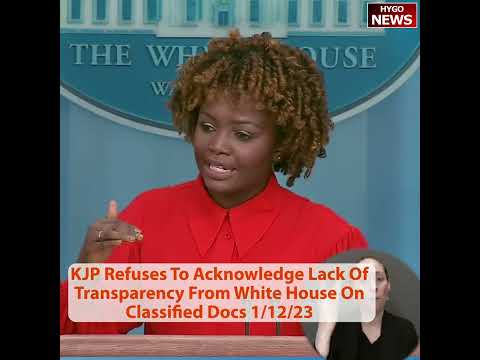
KJP Refuses to Acknowledge Lack of Transparency on Classified Documents — Public Not Informed for Two Months
On 1/12/2023, a reporter pressed White House Press Secretary Karine Jean-Pierre on the administration’s lack of transparency regarding Biden’s classified documents. “Do you acknowledge that the fact that the White House did not reveal this to the public, despite the fact that you’ve known about it for months, undercuts the President’s promise of being transparent with the American people?” the reporter asked. KJP refused to acknowledge a transparency failure: “But here’s the thing, they were transparent. There was transparency in doing what you’re supposed to do when these items were discovered.” When the reporter noted “Not with the American people,” KJP said: “I am here standing in front of you answering these questions, right? The President took two questions this week on this.” She then deflected to DOJ and the Special Counsel.
The Transparency Question
The reporter raised a specific accountability issue. “Do you acknowledge that the fact that the White House did not reveal this to the public, despite the fact that you’ve known about it for months, undercuts the President’s promise of being transparent with the American people?” the reporter asked.
The question had:
Specific timing concern — Months of silence.
Transparency promise — Referenced.
Public right to know — Implied.
Accountability demand — Direct.
Contradiction highlighted — Between promise and action.
The factual basis:
November 2, 2022 — First discovery.
January 9, 2023 — Public disclosure.
Over 2 months — Of silence.
Pre-midterm discovery — Hidden.
Post-election disclosure — Eventually.
The “But They Were Transparent” Defense
KJP’s first response. “But here’s the thing, they were transparent. There was transparency in doing what you’re supposed to do when these items were discovered,” KJP said.
The “they were transparent”:
Redefined transparency — To DOJ only.
Not public transparency — Specifically.
Legal compliance — Claimed.
Political transparency — Avoided.
Definitional gymnastics — Evident.
The “doing what you’re supposed to do”:
DOJ notification — Legal requirement.
Document preservation — Required.
Cooperation with investigation — Standard.
But not public disclosure — Different standard.
Private process — Emphasized.
”Not with the American People”
The reporter pushed back. “Not with the American people,” the reporter said.
The reporter’s distinction:
DOJ transparency — Legal.
Public transparency — Political promise.
Two different things — Conflated by KJP.
American people — Had right to know.
Democratic accountability — Required public disclosure.
This distinction was:
Substantively important — For accountability.
Politically significant — For Biden.
Administratively correct — To distinguish.
Constitutionally relevant — For governance.
Often obscured — By officials.
”I Am Standing in Front of You”
KJP defended current engagement. “I am here standing in front of you answering these questions, right?” KJP said.
The defense:
Current engagement — With press.
After disclosure — Post-fact.
Present transparency — Not retroactive.
Reactive framing — Rather than proactive.
Inadequate response — To question.
Standing in front of reporters:
Didn’t address — Prior silence.
Didn’t excuse — Delayed disclosure.
Didn’t compensate — For months of non-disclosure.
Current openness — After forced by leak.
Damage control — Rather than transparency.
”President Took Two Questions”
KJP cited Biden’s engagement. “The President took two questions this week on this,” KJP said.
The “two questions”:
Limited engagement — From Biden.
After public disclosure — Only.
Not proactive — Communication.
Reactive to coverage — Clearly.
Minimal transparency — Standard.
Two questions:
Quantitatively limited — For major scandal.
Not comprehensive — Engagement.
Political management — Rather than full accountability.
Standard approach — For difficult topics.
Not transparency standard — Biden had promised.
The Interruption Pattern
KJP interrupted the reporter. “You’ve heard, wait, let me just answer,” KJP said.
The interruption:
Prevented clarification — From reporter.
Controlled briefing — Through interruption.
Avoided full questioning — Successfully.
Standard technique — For difficult questions.
Press management — Tactical.
This pattern:
Showed tension — Between parties.
Reporter persistence — Against deflection.
KJP’s difficulty — Acknowledged implicitly.
Substantive engagement — Limited by design.
Format constraints — Used strategically.
”Laid Out Very Clearly”
KJP asserted clarity. “We have laid out very clearly what occurred,” KJP said.
The “laid out clearly” claim:
Subjective assessment — By administration.
Not accepted — By reporters.
Substantive disagreement — About clarity.
Political framing — As resolution.
Accountability avoidance — Through claim.
What had been “laid out”:
Discovery locations — Eventually.
DOJ notification — Confirmed.
Document handling — Described.
Cooperation claimed — Throughout.
Timeline questions — Not fully addressed.
The DOJ/Special Counsel Deflection
KJP deflected to DOJ. “I would just refer you to the Department of Justice, and now as you all know, there’s a special counsel dealing,” KJP said.
The DOJ/Special Counsel deflection:
Standard response — To tough questions.
Legal process — Invoked.
Administrative deference — Claimed.
Substantive avoidance — Enabled.
Political shield — From accountability.
The “special counsel dealing”:
January 12, 2023 — Robert Hur appointed.
Biden documents investigation — Initiated.
Ongoing process — Explained.
Political cover — Provided.
Briefings limited — Going forward.
The Transparency Promise Context
Biden’s transparency promises:
Campaign 2020 — Central theme.
Administration claims — Most transparent ever.
Specific commitments — Various.
Contrast with Trump — Emphasized.
Credibility source — For base.
The specific promises:
Visitor logs — Released.
Tax returns — Disclosed.
Ethics pledges — Made.
Briefing schedule — Maintained.
Freedom of information — Priority claimed.
But:
Classified documents handling — Contradicted.
Two months silence — On discovery.
Pre-midterm concealment — Alleged.
Political timing — Questions raised.
Transparency credibility — Damaged.
The Timeline Problem
The timeline raised specific issues:
November 2, 2022 — Initial discovery.
November 8, 2022 — Midterm elections.
December 20, 2022 — More documents found.
January 9, 2023 — Public first informed.
January 12, 2023 — More announcements.
The specific timeline:
Pre-midterm concealment — Of discovery.
Political timing concerns — Obvious.
Trump DOJ investigation — Ongoing.
Mar-a-Lago contrast — Being drawn.
Political advantage — From contrast lost.
The Political Calculation
The administration’s apparent calculation:
Concealment through midterm — Risk avoidance.
Eventual disclosure — Legally required.
Timing management — Political.
Damage control — Strategic.
Trump contrast — Complicated.
The calculation damaged:
Transparency credibility — Significantly.
Trump contrast — Substantially.
Political positioning — For 2024.
Voter trust — Potentially.
Institutional credibility — Generally.
The Trump Comparison Implications
The Biden documents complicated:
Trump DOJ case — In public perception.
Two-tier justice — Accusations.
Political motivation — Of Trump investigation.
Classified handling — Comparison.
Political advantages — Lost.
Before Biden documents:
Trump looked worse — On documents.
Biden cooperation — Implicit contrast.
DOJ legitimacy — Enhanced.
Political advantage — Clear.
Media narrative — Favorable.
After Biden documents:
Similar issues — Both sides.
Contrast weakened — Substantially.
DOJ legitimacy — Questioned.
Political advantage — Lost.
Media coverage — Balanced.
The Press Response Pattern
The press corps:
Asked sustained questions — On topic.
Pressed for specifics — Consistently.
Rejected deflections — Often.
Built record — For coverage.
Professional persistence — Demonstrated.
Each briefing:
Added to record — Of evasion.
Established pattern — Of deflection.
Frustrated substantive engagement — Predictably.
Generated coverage — Regularly.
Built public awareness — Of issues.
The Credibility Impact
The classified documents issue:
Damaged Biden credibility — On transparency.
Affected administration messaging — Across topics.
Created vulnerability — For 2024.
Weakened Trump contrast — Substantially.
Long-term impact — Significant.
The administration faced:
Continued questioning — For months.
Special Counsel investigation — Year-long.
Hur report — February 2024.
Memory concerns — Highlighted.
Political consequences — Throughout.
The Accountability Gap
KJP’s refusal to acknowledge lack of transparency represented:
Systematic accountability avoidance — Through language.
Redefining transparency — To suit position.
Distinguishing legal from political — Transparency.
Protecting administration — Short-term.
Damaging credibility — Long-term.
The pattern:
Standard for difficult topics — Across administrations.
Particularly problematic — For transparency-claiming one.
Well-recognized — By observers.
Rarely successful — Long-term.
Continued nonetheless — By administration.
The 2024 Implications
The classified documents issue affected 2024:
Biden candidacy complications — Real.
Trump comparison weakened — Substantially.
Voter trust questions — Raised.
Age/competence framing — Included.
Political liability — Significant.
The Hur report would:
Characterize Biden — As “well-meaning, elderly man.”
Highlight memory issues — Problematically.
Not recommend charges — Technically good.
Create political damage — Nonetheless.
Affect 2024 campaign — Substantially.
Key Takeaways
- A reporter asked KJP to acknowledge the administration’s lack of public transparency on classified documents for two months.
- KJP defended: “They were transparent. There was transparency in doing what you’re supposed to do when these items were discovered.”
- The reporter distinguished: “Not with the American people.”
- KJP cited current engagement: “I am here standing in front of you answering these questions.”
- She noted Biden had “took two questions this week on this” — minimal engagement standard.
- KJP deflected to DOJ and the newly-appointed Special Counsel.
- The refusal to acknowledge public transparency failure fit systematic pattern of accountability avoidance.
- The classified documents issue would damage Biden’s transparency credibility significantly for 2024.
Transcript Highlights
The following is transcribed from the video audio (unverified — AI-generated from audio).
- Do you acknowledge that the fact that the White House did not reveal this to the public, despite the fact that you’ve known about it for months, undercuts the President’s promise of being transparent with the American people?
- Here’s the thing, they were transparent. There was transparency in doing what you’re supposed to do when these items were discovered.
- Not with the American people.
- I am here standing in front of you answering these questions, right? The President took two questions this week on this.
- We have laid out very clearly what occurred.
- I would just refer you to the Department of Justice, and now as you all know, there’s a special counsel dealing.
Full transcript: 126 words transcribed via Whisper AI.