 HYGO News
 Q: did joe Biden do anything that benefited? A: Biden led our efforts to fight corruption in Ukraine
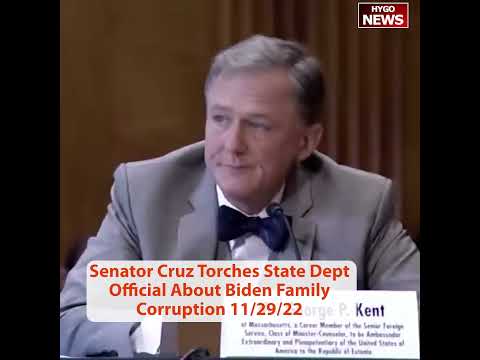
Senator: Did Hunter Biden Have Any Qualification to Be Paid $83,000 a Month by Ukrainian Oligarch — Other Than His Father’s Job? Ambassador Nominee: “I Am Not Familiar With His Resume”
On 12/4/2022, a senator pressed a Biden ambassador nominee on the specific financial facts of Hunter Biden’s Burisma position. “I asked a question — to your knowledge, did Hunter Biden have any qualification to be on that board other than the job his daddy had at the moment?” the senator asked. The nominee, a Ukraine expert, demurred: “I am not familiar with his resume, sir.” The senator then cited the specific payment amount: “$83,000 a month by this Ukrainian oligarch. You’re an expert in Ukraine. Have you ever been paid $83,000 a month?” After establishing that the Ukraine expert had never received that level of compensation, the senator framed the concern: “The concern here is not Hunter Biden’s own problems, but rather it is official corruption from the then Vice President of the United States, Joe Biden, and now the President of the United States, Joe Biden.” When asked again if Biden did anything that benefited the oligarch, the nominee eventually gave the administration’s rehearsed answer: “He did not."
"Did Hunter Biden Have Any Qualification?”
The senator’s opening question established the factual problem with Hunter Biden’s Burisma position. “To your knowledge, did Hunter Biden have any qualification to be on that board other than the job his daddy had at the moment?” the senator asked.
The question had a clear implied answer. Hunter Biden had no Ukrainian energy expertise, no background in Ukrainian business, no education or professional history that would explain his selection for a Burisma board seat. His qualification was his father — then Vice President of the United States with lead responsibility for Ukraine policy.
The nominee’s response was evasive: “I am not familiar with his resume, sir.”
This was an extraordinary response. The nominee was a Ukraine expert being considered for an ambassadorial position related to Eastern European affairs. Hunter Biden’s Burisma role had been one of the most discussed Ukrainian corruption issues of the previous decade. A Ukraine expert claiming unfamiliarity with Hunter Biden’s background was either professionally ignorant or strategically avoiding the question.
The “I am not familiar” dodge allowed the nominee to avoid saying what everyone knew — that Hunter Biden had no qualifications for the Burisma position beyond his family connection.
”$83,000 a Month”
The senator then cited the specific compensation. “He was paid $83,000 a month by this Ukrainian oligarch. You’re an expert in Ukraine. Have you ever been paid $83,000 a month?” the senator asked.
The $83,000 per month figure was Hunter Biden’s approximate compensation from Burisma (roughly $1 million per year divided by 12 months). This was extraordinary compensation for a board position — particularly for a board member with no relevant expertise.
The senator’s comparison was pointed. A Ukraine expert — someone with actual knowledge of Ukrainian affairs — was being asked whether he had ever received that level of compensation. The answer would establish how unusual Hunter Biden’s compensation was.
The nominee deflected: “I’m a public servant, sir. I’ve never served on a corporate board.”
The response avoided the comparison by changing the category. The senator had asked about monthly compensation; the nominee answered about corporate board service. These were different questions with different implications.
”Have You Been Paid $83,000 a Month?”
The senator pressed. “So does that mean no, you haven’t been paid $83,000 a month?” the senator asked.
The nominee was forced to give a direct answer. “I have not been paid $83,000 a month. No, sir,” the nominee said.
This confirmation was important. The nominee was an accomplished expert in Ukrainian affairs — someone the administration considered qualified to serve as U.S. ambassador in the region. This expert had never received $83,000 per month in any capacity.
Hunter Biden, with no Ukrainian expertise, had received this amount monthly from Burisma. The contrast was stark. Actual expertise in Ukrainian affairs did not command this compensation. What did command it? Having the right father.
”Official Corruption”
The senator then framed the larger concern. “So, look, the concern here is not Hunter Biden’s own problems, but rather it is official corruption from the then Vice President of the United States, Joe Biden, and now the President of the United States, Joe Biden,” the senator said.
This framing was important for several reasons:
Shifted focus from Hunter to Joe — The senator was making clear that the concern wasn’t about Hunter Biden’s personal behavior but about Joe Biden’s official actions.
“Official corruption” — Strong language characterizing Biden’s actions as corruption in his official capacity.
Both Vice President and President — The conduct at issue had occurred when Biden was Vice President, but it was relevant to his continuing role as President.
The framing moved the conversation from a family embarrassment story (Hunter Biden’s lucrative sinecure) to a governance concern (Vice President Biden’s official actions benefiting entities paying his son).
”While His Son Was On The Board Making a Million Dollars a Year”
The senator then asked the central question. “While his son was on the board of Burisma making a million dollars a year, did Joe Biden do anything that benefited the corrupt oligarch who was paying his son?” the senator asked.
This was the crucial question. The timeframe was specific: while Hunter was on the Burisma board. The action was specific: anything that benefited the oligarch. The beneficiary was specific: the corrupt oligarch paying Hunter.
If the answer was “yes,” then Biden had used official power to benefit his son’s employer during the period his son was being paid. That would be the definition of official corruption.
If the answer was “no,” then Biden’s actions — including firing the prosecutor investigating Burisma — had to be explained as coincidence or unrelated to the son’s employment.
”Biden Led Our Efforts to Fight Corruption”
The nominee’s first response was the administration’s standard talking point. “Vice President Biden led our efforts to fight corruption in Ukraine,” the nominee said.
This was not a direct answer. The senator had asked whether Biden did anything that benefited the oligarch. The nominee answered by describing Biden as leading anti-corruption efforts.
These could both be true simultaneously. Biden could have been leading anti-corruption efforts while also doing things that benefited Burisma’s oligarch. Anti-corruption rhetoric was compatible with specific actions that benefited specific corrupt entities — particularly if those entities had cultivated personal connections (like paying the Vice President’s son).
The nominee’s response was a classic misdirection. By answering a different question (was Biden leading anti-corruption efforts?) than the one asked (did Biden benefit the oligarch?), the nominee created the impression of defense without actually addressing the charge.
The Repeated Question
The senator asked again, forcing a direct answer. “Let me ask you the question again. Did Vice President Joe Biden do anything that benefited the corrupt oligarch who was paying his son a million dollars a year?” the senator asked.
This time, the nominee had to answer the specific question. “He did not,” the nominee said.
The direct answer was the administration’s official position. Despite the prosecutor being fired after Biden’s ultimatum. Despite the investigation into Burisma being dropped after the prosecutor was fired. Despite the sequence of events that had benefited the oligarch. Despite all this, the administration’s position — and therefore the nominee’s required testimony — was that Biden had done nothing that benefited the oligarch.
The Contradiction with Facts
The “he did not” answer was difficult to reconcile with the documented sequence of events:
Biden threatened to withhold $1 billion unless the prosecutor was fired.
The prosecutor was fired — specifically, the one Biden had named as investigating Burisma.
The Burisma investigation was dropped after the prosecutor’s firing.
Hunter Biden continued receiving approximately $1 million per year from Burisma.
Burisma’s oligarch owner benefited from the end of the investigation.
These were the documented facts. The claim that Biden had done nothing that benefited the oligarch required interpreting these events in a very specific way:
Shokin was going to be fired anyway — Ukrainian parliament removed him for general corruption-related reasons.
Biden’s role was coincidental — His ultimatum happened to align with Ukrainian domestic politics.
The Burisma investigation was dormant — Shokin wasn’t actively investigating, so his removal didn’t affect Burisma.
Hunter’s continued payment was unrelated to his father’s official actions.
Each of these interpretations had some merit. Shokin was widely criticized. Ukrainian politics did remove him. Investigation activity was limited. Hunter’s payments were nominally for board service.
But the interpretations required ignoring the most obvious reading: Biden used official leverage to pressure Ukraine, the pressure resulted in firing the prosecutor investigating his son’s employer, and the firing ended the investigation that might have threatened the company paying his son. The timing, sequence, and direct causal chain were all documented. The administration’s “he did not” answer required viewing the whole sequence as a series of unfortunate coincidences.
Key Takeaways
- A senator pressed a Biden ambassador nominee on Hunter Biden’s $83,000/month Burisma compensation despite having no Ukrainian qualifications.
- The nominee, himself a Ukraine expert, had never been paid $83,000/month in any capacity.
- The senator framed the concern as “official corruption” from Joe Biden, not just Hunter Biden’s personal situation.
- When asked if Biden did anything that benefited the oligarch paying his son, the nominee initially deflected to “Biden led our efforts to fight corruption.”
- After the question was repeated, the nominee gave the administration’s official answer: “He did not.”
Transcript Highlights
The following is transcribed from the video audio (unverified — AI-generated from audio).
- Did Hunter Biden have any qualification to be on that board other than the job his daddy had at the moment? — I am not familiar with his resume, sir.
- He was paid $83,000 a month by this Ukrainian oligarch. Have you ever been paid $83,000 a month? — I have not been paid $83,000 a month. No, sir.
- The concern here is not Hunter Biden’s own problems, but rather it is official corruption from the then Vice President of the United States.
- Did Joe Biden do anything that benefited the corrupt oligarch who was paying his son?
- Vice President Biden led our efforts to fight corruption in Ukraine.
- Let me ask you the question again. Did Vice President Joe Biden do anything that benefited the corrupt oligarch who was paying his son a million dollars a year? — He did not.
Full transcript: 209 words transcribed via Whisper AI.