 HYGO News
 Q: Corrupt oligarch paying Biden son a million dollars a year? A: 'not allow him to answer question'
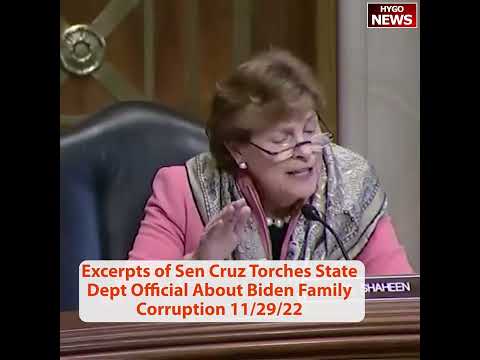
Senator Cruz Pushes Biden Ambassador Nominee on Hunter-Burisma Question — Committee Chair Refuses to Allow Answer; Cruz: “Why Are You Covering for the Vice President?”
On 12/4/2022, during a Senate confirmation hearing for a Biden ambassador nominee, Senator Ted Cruz (R-TX) pressed the nominee with a direct question about the Hunter Biden-Burisma situation: “The prosecutor that is investigating the corrupt oligarch who’s paying his son a million dollars a year — did getting that prosecutor fired benefit that oligarch?” The committee chair (Senator Van Hollen, D-MD) intervened to prevent the nominee from answering. Cruz persisted: “Why are you covering for the Vice President? Do you not want to answer that question?” The unusual spectacle of a committee chair blocking a nominee from answering a senator’s question drew attention to what Cruz characterized as Democratic protection of Joe Biden from accountability questions even in formal Senate hearings where ambassadorial nominees would normally be expected to provide direct testimony.
The Question
Cruz’s question referenced the well-established facts about Hunter Biden’s role at Burisma. “The prosecutor that is investigating the corrupt oligarch who’s paying his son a million dollars a year — did getting that prosecutor fired benefit that oligarch?” Cruz asked.
The question was structured as a yes-or-no inquiry about specific facts:
The prosecutor who was fired — Viktor Shokin, Ukraine’s Prosecutor General The corrupt oligarch — Mykola Zlochevsky, owner of Burisma Holdings Paying Biden’s son — Hunter Biden was receiving approximately $1 million per year from Burisma Did firing benefit the oligarch — Did Shokin’s removal help Zlochevsky and his company?
The answer to the underlying question was factually clear. Before Shokin was fired, he was investigating Burisma. After Shokin was fired, the Burisma investigation was dropped. The sequence of events benefited the company that was paying Hunter Biden. This was not a matter of partisan interpretation — it was a direct factual consequence of the events.
Cruz was asking the nominee, who would be representing U.S. interests as an ambassador, to acknowledge this factual reality under oath.
The Committee Chair’s Intervention
Senator Chris Van Hollen, the committee chair (apparently referenced as “Senator Van Halen” in the transcript), intervened before the nominee could answer. Cruz asked: “Are you going to allow him to answer the question, Madam Chairman?”
Van Hollen’s response: “I’m not going to allow him to answer the question.”
This was an unusual intervention. Committee chairs typically allow witnesses to answer senators’ questions, even when those questions are politically uncomfortable. The principle that witnesses should provide testimony rather than have testimony blocked by committee chairs is fundamental to congressional oversight.
Van Hollen’s decision to block the answer was a political choice. He was protecting the Biden administration from having a nominee provide testimony that might confirm the Hunter Biden-Burisma connection. But the blocking itself became news. Cruz could highlight the blocking as evidence that Democrats were shielding the administration from accountability.
”Why Are You Covering for the Vice President?”
Cruz pressed directly on the political motivation. “Why are you covering for the Vice President? Do you not want to answer that question?” Cruz said.
The “covering for the Vice President” framing was politically potent. Cruz was characterizing Van Hollen’s action not as procedural committee management but as active political protection for Joe Biden. The accusation was that Van Hollen was prioritizing Biden’s political interests over the Senate’s oversight function.
The phrasing suggested several political implications:
Biden had something to hide — Otherwise, there would be no need for “covering.”
The nominee might provide damaging testimony — Otherwise, blocking the answer wouldn’t be necessary.
Democrats were protecting Biden at institutional cost — Blocking testimony undermined normal Senate procedure.
The Hunter Biden-Burisma connection was politically sensitive — Otherwise, it wouldn’t require this level of protection.
”He Said That the Vice President Has Nothing to Benefit the Oligarch”
Van Hollen’s response was itself problematic. “He said that the Vice President has nothing to benefit the oligarch,” Van Hollen said.
This was a curious framing. If the nominee had already addressed the question — saying Biden had done nothing to benefit the oligarch — then allowing Cruz’s direct question wouldn’t have produced new information. But Van Hollen’s characterization was different from the nominee actually answering Cruz’s specific question about whether the firing benefited the oligarch.
Cruz’s question was narrow: did getting the prosecutor fired benefit the oligarch? That’s a factual question about consequences, not about Biden’s intentions. The firing either did or didn’t benefit Burisma — the answer was about events, not about Biden’s motivations.
Van Hollen was shifting the question from “did the firing benefit the oligarch” (a factual consequence question) to “did Biden do anything to benefit the oligarch” (a question about intent). These were different questions with potentially different answers. By substituting one question for the other, Van Hollen was avoiding the factual consequence that Cruz was asking about.
”Uncomfortable Positions”
Van Hollen criticized Cruz’s approach. “I think it’s unfortunate for you, Senator Cruz, to put in position that are uncomfortable the nominees to be our ambassadors,” Van Hollen said.
The “uncomfortable positions” framing suggested that senators shouldn’t ask nominees questions that might be politically awkward for the administration. This was an unusual institutional position. Senators regularly put nominees in “uncomfortable positions” during confirmation hearings — that’s part of the confirmation process. Nominees are supposed to demonstrate they can handle difficult questions and provide truthful answers even when the answers might not please everyone.
By framing Cruz’s question as inappropriate because it created discomfort, Van Hollen was effectively arguing that difficult questions shouldn’t be asked. This was contrary to the Senate’s oversight function.
”His Sworn Testimony”
Cruz pressed the legal significance. “Okay, this is his sworn testimony. I appreciate that. I understand that you want to cover for the Vice President. And he already answered that he is going to raise those concerns anytime he has responsibility. Was his testimony true or false that Biden did nothing to benefit the oligarch?” Cruz said.
The “sworn testimony” point was important. Ambassadorial nominees provide testimony under oath. Their statements carry legal weight. If the nominee had testified that Biden did nothing to benefit the oligarch, Cruz wanted to know whether that testimony was accurate.
If the firing of Shokin did benefit Burisma (and therefore Zlochevsky), then any testimony claiming Biden did nothing to benefit the oligarch was potentially false — since Biden’s ultimatum had led to the firing that benefited the oligarch.
Cruz was essentially asking the nominee to confirm or deny whether his prior sworn testimony was accurate in light of the documented facts. This was a legitimate confirmation hearing question — whether a nominee’s testimony was consistent with established facts.
”I Don’t Know Who His Testimony Was”
Van Hollen deflected again. “I don’t know who his testimony was. Let him answer the question. Why are you afraid of him answering the question? I’m not. I just want to move on. But you won’t let him answer,” the exchange continued.
Van Hollen’s “I don’t know who his testimony was” was odd phrasing. The chair should have been tracking what the nominee had said. Claiming ignorance of the nominee’s own testimony was either a dodge or an admission that the committee wasn’t carefully tracking statements made during its own hearing.
”Will You Allow Him to Answer the Yes-No Question?”
Cruz eventually extracted permission. “I asked a yes-no question. Will you allow him to answer the yes-no question?” Cruz said.
Van Hollen finally relented. “Yes, you can answer yes or no,” the chair said.
The partial victory was significant. Cruz had won the right to have his specific question answered — but only after extended procedural wrangling that had been more about the blocking than about the substance of the answer. The political message was clear: Democrats had tried to prevent testimony that might embarrass the administration, and had only allowed it after extensive public pressure.
”The Prosecutor Did Nothing to Investigate”
The nominee’s eventual answer was revealing. “The prosecutor who was fired by the Ukrainian parliament did nothing to investigate,” the nominee said.
This answer was technically responsive to a different question than Cruz had asked. Cruz had asked whether firing the prosecutor benefited the oligarch. The nominee answered that the prosecutor hadn’t been doing anything anyway.
If the prosecutor was doing nothing to investigate, then firing him wouldn’t have benefited the oligarch in the sense of stopping an active investigation. This was the administration’s standard defense of the Shokin firing — that he was a bad prosecutor who wasn’t really investigating anything important, so his removal was anti-corruption rather than pro-Burisma.
But the defense had limitations. Whether Shokin was actively investigating Burisma or merely had an open file, his removal still benefited the target of the investigation. And the timing — Shokin was fired specifically after Biden’s ultimatum, which specifically referenced him as the prosecutor investigating Burisma — was hard to reconcile with pure anti-corruption motivation.
The Institutional Significance
The exchange was notable beyond the specific Hunter Biden question. The committee chair blocking a senator’s question to a witness was unusual enough to be worth noting. The chair’s continuing to block even after the senator persisted made the dynamic more dramatic. The eventual grudging permission to answer only after public pressure suggested political protection that the chair was reluctant to fully abandon.
For Cruz, the exchange was politically useful. He had:
- Asked a factually significant question
- Exposed the chair’s willingness to block answers
- Generated a media-worthy confrontation
- Established the Hunter Biden-Burisma connection as a continuing political topic
For Van Hollen, the exchange was more mixed. He had:
- Protected the administration from problematic testimony (initially)
- But drew attention to that protection
- And eventually had to relent anyway
- Making his initial blocking appear as pure political protection
Key Takeaways
- Senator Ted Cruz asked a Biden ambassador nominee a direct question: did firing the Ukrainian prosecutor who was investigating Burisma benefit the oligarch paying Hunter Biden $1 million per year?
- Committee chair Senator Chris Van Hollen intervened to prevent the nominee from answering: “I’m not going to allow him to answer the question.”
- Cruz characterized this as “covering for the Vice President” and repeatedly asked why Van Hollen wouldn’t allow the answer.
- Van Hollen defended the nominee by saying Biden “has nothing to benefit the oligarch” — but this differed from Cruz’s specific question about consequences.
- Van Hollen eventually relented and allowed a yes-or-no answer, but the blocking itself became the news.
Transcript Highlights
The following is transcribed from the video audio (unverified — AI-generated from audio).
- The prosecutor that is investigating the corrupt oligarch who’s paying his son a million dollars a year — did getting that prosecutor fired benefit that oligarch?
- Are you going to allow him to answer the question, Madam Chairman? — I’m not going to allow him to answer the question.
- Why are you covering for the Vice President? Do you not want to answer that question?
- I think it’s unfortunate for you, Senator Cruz, to put in position that are uncomfortable the nominees to be our ambassadors.
- Will you allow him to answer the yes-no question? — Yes, you can answer yes or no.
- The prosecutor who was fired by the Ukrainian parliament did nothing to investigate.
Full transcript: 224 words transcribed via Whisper AI.