 HYGO News
 Q: Codify discrimination? faith-based can't deny services to gay couples A: strong protections
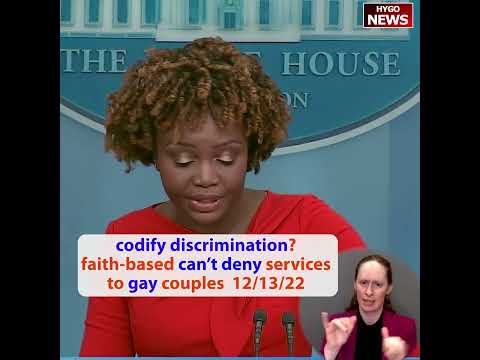
Reporter to KJP on Respect for Marriage Act: Bill “Codifies Discrimination” by Letting Faith-Based Organizations Deny Services to Gay Couples
On 12/13/2022, a reporter pressed White House Press Secretary Karine Jean-Pierre on a provision of the Respect for Marriage Act that critics argued codified anti-LGBTQ+ discrimination. “What’s actually in the bill, if you read, is something that codifies discrimination. There’s a section here that speaks to the ability of non-profit religious organizations, faith-based social agencies, educational institutions, employees of those organizations to deny services, accommodations, facilities, goods, advantages, privileges to gay couples. So how is that not codifying discrimination?” the reporter asked. KJP defended the bill’s religious liberty provisions: “We believe that the RFMA contains strong protections for houses of worship and religious non-profits.” She then pivoted back to “bicarmal” (bicameral) bipartisan support as the justification — her third use of “bicarmal” instead of “bicameral” in the briefing.
The Respect for Marriage Act
The Respect for Marriage Act (RFMA) was signed by President Biden on December 13, 2022. The legislation:
Codified federal recognition of same-sex marriages — Responding to concerns about potential Supreme Court action.
Repealed Defense of Marriage Act — Which had prevented federal recognition.
Required states to recognize marriages — From other states where performed.
Included religious liberty protections — To gain Republican support.
Passed with bipartisan majorities — Both House and Senate.
The bill represented a response to concerns after Dobbs v. Jackson that other substantive due process cases might be revisited, including Obergefell v. Hodges (same-sex marriage). Congressional Democrats had pushed to codify protections in federal law rather than relying solely on court precedent.
The Religious Liberty Provisions
To gain Republican support, the bill included provisions protecting religious organizations. These provisions were what the reporter was asking about:
Non-profit religious organizations — Protected from being forced to participate in same-sex marriages.
Faith-based social agencies — Protected religious agencies providing services.
Educational institutions — Religious schools with marriage-related policies.
Employees of religious organizations — Individual protections in religious contexts.
Various services — That could be denied based on religious beliefs.
These protections had been included specifically to address religious liberty concerns that had blocked earlier versions of the bill. Without them, Republican senators wouldn’t have voted for the legislation, and the bill would have failed.
The Reporter’s Challenge
The reporter’s question was pointed. “What’s actually in the bill, if you read, is something that codifies discrimination,” the reporter said.
The “if you read” framing was a challenge to the administration’s celebratory messaging. The administration had been celebrating the bill as a civil rights achievement. The reporter was challenging that framing by pointing to specific bill text that enabled religious exemptions.
The reporter enumerated what could be denied:
Services — Religious organizations could decline to provide services. Accommodations — Including venues and facilities. Facilities — Buildings used for religious purposes. Goods — Items religious organizations sold or provided. Advantages — Benefits religious organizations offered. Privileges — Various religious organization privileges.
These denials could target “gay couples” specifically, the reporter noted.
The cumulative effect, the reporter argued, was that the bill didn’t fully prevent discrimination against same-sex couples — it just ensured federal recognition of their marriages. In many practical contexts, religious organizations could still refuse to engage with same-sex married couples.
The “How Is That Not Codifying Discrimination” Question
The reporter’s question was direct. “So how is that not codifying discrimination?” the reporter asked.
This was a substantive legal and ethical question:
If discrimination is denying services based on sexual orientation — Then the bill’s religious exemptions codified exactly that.
If codifying means “putting into law” — Then the bill put religious exemptions into federal law.
If faith-based organizations could deny services — Then the bill allowed them to discriminate.
Therefore, the bill codified discrimination — Against same-sex couples in religious contexts.
The logic was straightforward. The administration’s framing — that the bill protected marriage equality — sidestepped the fact that the bill also protected religious organizations’ ability to refuse to engage with same-sex couples.
”Strong Protections for Houses of Worship”
KJP’s defense emphasized religious liberty. “I know there’s questions about religious liberty and so we believe that the RFMA contains strong protections for houses of worship and religious non-profits,” KJP said.
The framing was significant. KJP was defending the religious liberty provisions as features, not bugs. The administration’s position was that:
Religious protections were good — Not compromises of civil rights.
Strong protections existed — For religious organizations.
The bill balanced interests — Rather than prioritizing one over another.
Both sides got what they wanted — Religious liberty AND marriage equality.
This was a distinct framing from “the bill has limitations but does what it can.” KJP was positively endorsing the religious exemptions, not apologizing for them.
The Civil Rights Framing Tension
The administration’s framing had a tension. The bill was being celebrated as a civil rights achievement while simultaneously including provisions that limited civil rights applications. These two framings were in tension:
As civil rights achievement — The bill protected equal rights for same-sex couples.
As balanced legislation — The bill allowed discrimination by religious organizations.
Celebratory framing — Emphasized what the bill did for same-sex couples.
Defensive framing — Emphasized protections for religious organizations.
The administration’s messaging alternated between these framings depending on the audience. For LGBTQ+ rights supporters, the civil rights frame dominated. For religious conservatives (and Republicans needed for passage), the religious liberty frame dominated.
This alternation required careful management. Being too enthusiastic about one frame could alienate the other constituency. KJP’s defense of religious protections in response to LGBTQ+ concerns showed the complexity.
The “Well Litigated” Deflection
KJP pivoted to the legislative process. “This question was well litigated throughout the legislative process where it passed with both chambers of bipartisan support and I think that matters, right?” KJP said.
The “well litigated” framing had several purposes:
Claimed democratic legitimacy — Process had addressed concerns.
Implied consensus — Both sides had agreed on the bill.
Reduced further debate — Closure on the question.
Transferred to process — Away from substance.
But the “well litigated” framing wasn’t responsive. The reporter hadn’t asked whether the bill had been properly debated — that was about process. The reporter had asked whether the bill codified discrimination — that was about substance.
A bill can be democratically debated and still codify discrimination. Democratic process doesn’t resolve substantive ethical questions about whether provisions are discriminatory. “Well litigated” didn’t address the specific concern.
The “Bicarmal” Mispronunciation
KJP concluded with her notable verbal stumble. “Bicarmal bipartisan support was had for this piece of legislation,” KJP said.
“Bicarmal” was a mispronunciation of “bicameral” — referring to both chambers of Congress. This was the third time in this briefing KJP had mispronounced the word. Earlier in the same briefing, she had said “bicarbonate” twice.
The variation in mispronunciations was interesting:
“Bicarbonate” — The chemical word, said twice earlier. “Bicarmal” — A different approximation, said now.
Both attempts were wrong. KJP apparently remembered that the word started with “bi-” and was related to legislative chambers, but couldn’t consistently land on the correct “bicameral.” Each attempt produced a different approximation.
This pattern suggested:
Phonetic memory without precise recall — KJP approximated the sound.
Multiple error modes — Producing different wrong versions.
No self-correction — She didn’t notice the error.
Consistent problem — Within the same briefing.
The Religious Exemption Pattern
The Respect for Marriage Act’s religious exemption provisions fit a broader pattern in civil rights legislation. Many bills balanced rights with exemptions:
Americans with Disabilities Act — With religious exemptions. Civil Rights Act — With religious exceptions. Various state LGBT laws — With religious carve-outs. Anti-discrimination laws generally — With various exceptions.
These exemptions were politically necessary for passage but substantively limited the laws’ reach. LGBT rights advocates regularly argued that such exemptions meant the laws didn’t fully protect against discrimination.
The administration’s celebration of the RFMA as a civil rights achievement — while defending its religious exemptions as appropriate protections — was the politically standard approach. Full acknowledgment of the bill’s limitations would have diminished the celebration.
The Critics’ Perspective
LGBT rights organizations had expressed concerns about the bill’s religious exemptions:
Some supported the bill despite exemptions — As necessary for passage.
Some opposed the bill because of exemptions — As codifying discrimination.
Some supported with reservations — Acknowledging limitations.
Some celebrated different aspects — Federal marriage recognition.
The divergence of opinion reflected the bill’s complicated nature. For some advocates, the bill was a meaningful protection that justified its compromises. For others, the bill’s acceptance of religious exemption set bad precedent.
The reporter’s question reflected the critics’ perspective. Whether or not KJP agreed with this perspective, it was a substantive view held by legitimate LGBT rights voices that the administration should have been prepared to address.
The 303 Creative Case Context
The exchange was particularly important given the pending 303 Creative case at the Supreme Court. The Court had heard oral arguments days earlier on whether a web designer could refuse to create same-sex wedding websites despite state anti-discrimination law.
The RFMA’s religious exemptions and the 303 Creative case occupied related territory:
Both addressed religious objections to same-sex marriage Both involved commercial or service contexts Both would shape practical LGBT rights Both balanced religious liberty against civil rights
The Court eventually ruled in favor of the web designer in June 2023. The ruling confirmed that commercial speakers had significant First Amendment protections against being compelled to produce content for same-sex weddings.
The RFMA’s religious exemptions and the 303 Creative ruling together created a legal landscape where same-sex marriages were federally recognized but religious and creative objections could still limit practical access to services.
Key Takeaways
- A reporter challenged the celebration of the Respect for Marriage Act by citing specific bill provisions that allowed faith-based organizations to deny services to gay couples.
- The reporter itemized what could be denied: services, accommodations, facilities, goods, advantages, and privileges to gay couples.
- KJP defended the religious exemptions as “strong protections for houses of worship and religious non-profits.”
- She pivoted to the “well litigated” legislative process and bipartisan support.
- KJP mispronounced “bicameral” as “bicarmal” — her third verbal error on this word during the briefing (earlier attempts were “bicarbonate”).
- The exchange highlighted the tension between the administration’s celebratory civil rights framing and the bill’s actual religious exemption provisions.
Transcript Highlights
The following is transcribed from the video audio (unverified — AI-generated from audio).
- What’s actually in the bill, if you read, is something that codifies discrimination.
- There’s a section here that speaks to the ability of non-profit religious organizations, faith-based social agencies, educational institutions, employees of those organizations to deny services, accommodations, facilities, goods, advantages, privileges to gay couples.
- So how is that not codifying discrimination?
- We believe that the RFMA contains strong protections for houses of worship and religious non-profits.
- This question was well litigated throughout the legislative process where it passed with both chambers of bipartisan support.
- Bicarmal bipartisan support was had for this piece of legislation.
Full transcript: 136 words transcribed via Whisper AI.