 HYGO News
 Trump Contradicts China: 'They Had a Meeting This Morning'; Norway PM 'Salutes' Peace Efforts; '5,000 Young People a Week' Dying
Trump Contradicts China: “They Had a Meeting This Morning”; Norway PM “Salutes” Peace Efforts; “5,000 Young People a Week” Dying
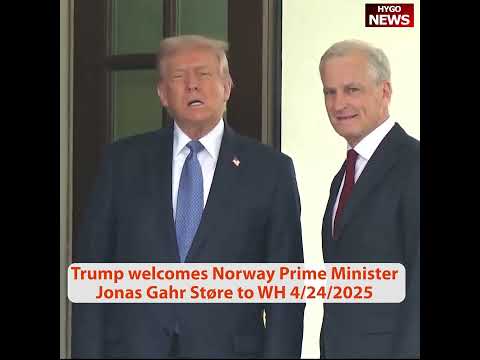
President Trump directly contradicted China’s claim that trade talks were “fake news” during a joint appearance with Norwegian PM Jonas Gahr Store in April 2025. “Well, they had a meeting this morning,” Trump said. “We may reveal it later, but they had meetings this morning, and we’ve been meeting with China.” Norway’s PM praised the administration’s Ukraine peace efforts: “I salute President Trump for taking very important initiatives to get this conflict toward an end. We need a ceasefire, save lives, and move toward something more secure for Europe.” Trump escalated his urgency on Ukraine casualties: “We have about 5,000 young people a week. I used to say 2,500. I say 5,000. Ridiculous war.” He confirmed a private deadline: “I have my own deadline. After that, we’re going to have a very much different attitude."
"They Had a Meeting This Morning”
A reporter challenged Trump on China’s public denials.
“Can you clarify with whom the U.S. is speaking with China?” the reporter asked. “They’re saying it’s fake news that trade talks are happening.”
Trump’s response was matter-of-fact: “Well, they had a meeting this morning, so I can’t tell you. It doesn’t matter who ‘they’ is.”
He added: “We may reveal it later, but they had meetings this morning, and we’ve been meeting with China.”
He jabbed the reporter: “So I think you have your reporting wrong.”
The exchange revealed a dynamic that defined the U.S.-China tariff standoff. China’s public position was that no negotiations were taking place — a face-saving posture designed to project strength and avoid the appearance of capitulating to American pressure. Trump’s response — casually confirming that meetings had occurred that very morning — exposed the gap between China’s public statements and its private actions.
The contradiction was devastating to China’s negotiating position. Beijing had been telling its domestic audience and the global media that it would not negotiate under tariff pressure. Trump had just told the world that China was, in fact, negotiating — that morning. The revelation undermined China’s credibility and demonstrated that the tariffs were working exactly as intended: creating enough economic pressure that China had to come to the table even while publicly denying it was there.
Norway PM “Salutes” Trump
PM Jonas Gahr Store provided a European endorsement of the administration’s peace efforts.
“I salute President Trump for having been taking very important initiatives to get this conflict toward an end which both parties deserve,” Store said.
He outlined the priorities: “We need to have a ceasefire, save lives, and move toward something which is more secure for Europe, for the people concerned.”
He expressed urgency: “And I look forward to going into some details, because we are at the critical moment.”
The Norwegian endorsement was particularly significant because Norway was not a country typically associated with the Trump political orbit. Norway was a NATO member with a social democratic tradition, and its prime minister’s public praise of Trump’s peace efforts represented a recognition that transcended political ideology.
Store’s statement that “both parties deserve” an end to the conflict was diplomatically balanced but practically aligned with the administration’s position. By acknowledging that both Russia and Ukraine deserved peace, Store was implicitly accepting the framework that a negotiated settlement — not a Ukrainian military victory — was the path to ending the war.
”5,000 Young People a Week”
Trump delivered his most graphic assessment of the human cost of the Ukraine war.
“We are thinking very strongly that they both want peace, but they have to get to the table,” Trump said. “We’re waiting a long time. They have to get them to the table, and I think we’re going to get peace.”
He stated the human cost: “We want to save 5,000 young people. I used to say 2,500. I say 5,000. We have, Mr. Prime Minister, we have about 5,000 young people a week.”
He described his evolution on the issue: “I started out because I didn’t like all the money that we were paying, and then I realized how many people were dying. And that’s by far the more important element right now.”
He expressed hope: “I’m saying we can save thousands of people. I don’t like that it takes long at all, but I think they both want to make peace. I do believe so.”
He acknowledged the obstacles: “There’s a lot of hatred there. There’s a lot of very bad blood, a lot of distrust, but I think we’re going to — I hope we’re going to get there for the sake of a lot of young people.”
The revision from “2,500” to “5,000” casualties per week reflected either updated intelligence or Trump’s recognition that earlier estimates had been conservative. At 5,000 per week, the war was killing roughly 260,000 people per year — a pace that placed it among the deadliest conflicts of the 21st century.
Trump’s admission that he had initially been motivated by the financial cost — “I didn’t like all the money we were paying” — before being moved by the human cost was a rare moment of personal evolution stated publicly. The transition from a fiscal objection to a humanitarian one made the peace effort more compelling and more urgent.
”I Have My Own Deadline”
A reporter asked about a deadline for peace talks.
“Do you have a deadline for when the parties will have to decide?” the reporter asked.
Trump confirmed: “I have my own deadline.”
He reiterated the urgency: “I have my own deadline, and we want it to be fast, and the Prime Minister is helping us. He wants it to be fast too.”
He broadened the support: “And I think everybody at this time in NATO — they want to see this thing happen.”
He stated the consequence: “So we have a deadline, and after that we’re going to have a very much different attitude.”
He closed with cautious optimism: “But I think it has a very good chance of getting done.”
The “very much different attitude” was the most significant phrase. Trump was signaling that if both parties failed to reach agreement by his private deadline, the United States would change its approach — potentially withdrawing from mediation entirely, as Secretary Rubio had threatened, or taking more dramatic steps to force a resolution.
”I Want to Go Skiing”
The lighter moment came when a Norwegian reporter invited Trump to visit.
“We’ll all go together,” Trump said. “I want to go skiing. I love Norway.”
When asked why, Trump was simple: “It’s beautiful. And beautiful people.”
The exchange — a president discussing nuclear-armed geopolitics one moment and Norwegian skiing the next — captured Trump’s ability to shift between gravity and levity without losing either tone. The compliment to Norway’s beauty and people was genuine and diplomatic, strengthening the personal rapport with PM Store.
Key Takeaways
- Trump contradicted China’s “fake news” claim: “They had a meeting this morning. We’ve been meeting with China.”
- Norway’s PM Store: “I salute President Trump for taking very important initiatives. We need a ceasefire and something more secure for Europe.”
- Trump escalated casualty estimates: “About 5,000 young people a week. I used to say 2,500. Ridiculous war.”
- He confirmed a private peace deadline: “I have my own deadline. After that, we’re going to have a very much different attitude.”
- Trump’s evolution: “I started out because I didn’t like the money we were paying, then I realized how many people were dying. That’s the more important element.”