 HYGO News
 China Says U.S. Called First; Trump: 'Study Your Files'; 'We Were Losing $1T a Year -- Now Nothing'; Perdue Sworn In; Victory Day Declared
China Says U.S. Called First; Trump: “Study Your Files”; “We Were Losing $1T a Year — Now Nothing”; Perdue Sworn In; Victory Day Declared
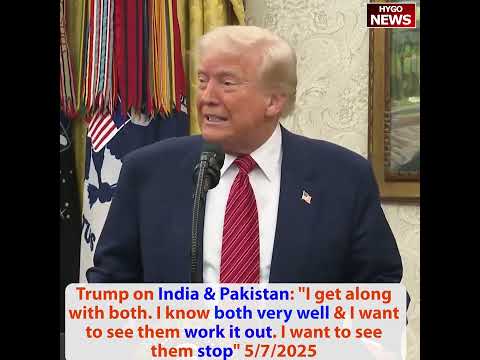
President Trump addressed multiple fronts in a packed May 2025 Oval Office session. When told China claimed the U.S. initiated trade talks, Trump responded: “They said we initiated? They ought to go back and study their files.” Asked about pulling back tariffs to bring China to the table: “No.” On the Switzerland talks: “We were losing a trillion dollars a year. Now we’re not losing anything. That’s the way I look at it.” He swore in David Perdue as Ambassador to China: “I know this man personally. He loves this country. I’m glad to be your man in China.” On India-Pakistan: “I get along with both. I want to see them stop.” Trump also signed a proclamation declaring May 8 as “Victory Day for World War II."
"Study Your Files”
A reporter relayed China’s claim about who initiated the talks.
“China said the U.S. initiated the trade talks this week, and that its position hasn’t changed,” the reporter said. “Are you still confident you can reach a deal?”
Trump’s response was dismissive: “They said we initiated? Well, I think they ought to go back and study their files.”
The exchange captured the face-saving dynamics of the U.S.-China negotiation. Both sides needed to appear strong domestically. China could not admit it had come to the table under pressure — it needed to portray the talks as an American initiative. Trump could not accept that characterization — he needed to maintain the narrative that American leverage was forcing China to negotiate.
The “study your files” retort suggested that the communication trail would reveal a different story than China’s public claim. Without identifying specific calls or contacts, Trump implied that the evidence of who reached out to whom was documented and did not support China’s version.
”Not Pulling Back Tariffs”
A reporter tested the hardest question.
“Are you open to pulling back your tariffs in order to get China to the negotiating table?”
Trump’s answer was one word: “No.”
The single-word denial was the most definitive statement Trump could make. Tariffs would not be reduced as a precondition for talks. Tariff reduction would be the result of talks — the reward for Chinese concessions, not the price of Chinese participation. The distinction was the entire negotiating framework: America set the terms, China accepted them or faced continued exclusion from the world’s largest consumer market.
”$1 Trillion — Now Nothing”
A reporter asked about expectations for the Switzerland meeting.
“What do you hope to come out of the talks with China?”
“We’ll see,” Trump said. “I mean, look, we were losing a trillion dollars a year. Now we’re not losing anything. That’s the way I look at it.”
He elaborated: “We were losing with China on trade a trillion dollars a year, more actually — 1.1. But let’s say a trillion. We’re losing now, nothing. That’s not bad.”
The “now nothing” assessment was Trump’s way of saying that even without a deal, the tariff situation was acceptable. At 145%, Chinese goods were effectively blocked from the American market. The trade deficit with China had collapsed to near zero because trade itself had collapsed. From a pure deficit perspective, the problem was solved.
This was Trump’s ultimate leverage. He didn’t need a deal. The status quo — no Chinese imports, no trade deficit — was acceptable to him. China, whose economy depended on exports, was the party under pressure. Every day without a deal was a day Chinese factories sat idle.
David Perdue: Ambassador to China
Newly sworn-in Ambassador David Perdue delivered brief, personal remarks.
“I’m humbled to be in this office today,” Perdue said. “I love what you’ve done with this office. I like the Declaration of Independence.”
He made his commitment: “I want the world to know that I know this man personally. He loves this country, and I’m glad to be your man in China.”
Rubio administered the oath: “I, David Perdue, do solemnly swear that I will support and defend the Constitution of the United States against all enemies, foreign and domestic…”
Perdue — a former senator from Georgia with extensive business experience in Asia — was being deployed to Beijing at the most consequential moment in U.S.-China relations in decades. His appointment signaled that the administration was preparing for a sustained diplomatic engagement with China, not just a tariff standoff.
India-Pakistan
Trump addressed the escalating India-Pakistan crisis.
“What’s your position?” a reporter asked.
“My position is I get along with both,” Trump said. “I know both very well, and I want to see them work it out. I want to see them stop.”
He assessed the dynamic: “They’ve gone tit for tat. So hopefully they can stop now.”
He offered: “I know both countries very well. Good relationships with both. And I want to see it stop. And if I can do anything to help, I will be there.”
The offer to mediate — “if I can do anything to help” — was significant for a conflict between two nuclear-armed nations. Trump’s personal relationships with Modi and Pakistani leadership positioned the United States as a potential broker, though neither side had publicly requested American mediation.
Victory Day
Trump signed a proclamation with historical resonance.
“I’ve just signed a proclamation officially designating tomorrow, May 8th, as Victory Day for World War II,” Trump announced. “Commemorating the 80th anniversary of America’s victory in the Second World War.”
He explained the gap: “All over the globe, our World War II allies are celebrating this week. But the United States has never joined in with the proper celebration of our own.”
He stated America’s role: “The victory was mostly accomplished because of us. We came into that war and we won that war. We had help from great allies, but nobody would say we were not the dominant force.”
He described the tribute: “It was American tanks and ships and trucks and airplanes and service members that vanquished the enemy 80 years ago this week. Without America, the liberation would never have happened.”
He also noted: “And a separate Victory Day for World War I. We’re going to be doing that too.”
The Victory Day proclamation addressed a genuine gap in American commemorative tradition. While VE Day (Victory in Europe Day) was celebrated across the continent, the United States had never established a formal national observance.
Key Takeaways
- China claims U.S. initiated talks; Trump: “They ought to go back and study their files.” Won’t pull back tariffs: “No.”
- On Switzerland: “We were losing $1 trillion a year with China. Now we’re not losing anything. That’s not bad.”
- David Perdue sworn in as Ambassador to China: “I know this man. He loves this country. I’m glad to be your man in China.”
- India-Pakistan: “I get along with both. I want to see them stop. If I can help, I will be there.”
- Trump signed Victory Day proclamation for WWII’s 80th anniversary: “Without America, the liberation would never have happened.”