 HYGO News
 Q: blame bailout or blame universities for high cost? rule is working? A: rule is still in progress
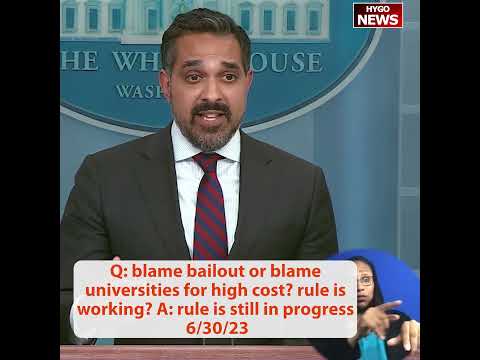
Does Biden Blame Universities for High Education Costs? White House Says Accountability Rule Is Still in Progress
On June 30, 2023, hours after the Supreme Court struck down President Biden’s student loan forgiveness program, a reporter pressed the White House on the fundamental question that loan forgiveness never answered: who is to blame for the runaway cost of higher education, and what is the administration actually doing about it? Deputy NEC Director Bharat Ramamurti’s response revealed that the administration’s plan to hold colleges accountable for skyrocketing prices was still in the proposal stage — not yet implemented, let alone working.
The Affordability Question the White House Could Not Answer
The reporter’s question was direct and got to the heart of the policy debate that loan forgiveness had obscured. While the administration focused on relieving the symptoms of student debt, critics had long argued that neither party was addressing the underlying disease: the relentless increase in the cost of college itself.
The reporter asked: “I wanted to get at that affordability issue. So does the President then blame universities for that affordability issue? And do you really think that that rule is working, that you talked about?”
The question had two sharp edges. First, it asked whether the administration was willing to name universities as the cause of the problem rather than vaguely gesturing at “affordability.” Second, it challenged the administration’s earlier claims about a regulatory approach to controlling costs by asking bluntly whether it was working.
Ramamurti Admits the Rule Does Not Yet Exist
Ramamurti’s response was telling in its honesty. Rather than claiming the administration had made progress on college affordability, he acknowledged that the proposed accountability rule was still in development.
“Well, the rule is still in progress. It’s going to be proposed and then ultimately put in place. But I think when it is in place, it’s definitely going to go after the worst performers in this space, the colleges and universities that are charging the most and delivering the worst results,” Ramamurti said.
The admission was significant for several reasons. The Biden administration had been in office for over two and a half years by June 2023. During that time, it had managed to develop, launch, and defend in court a $400 billion loan forgiveness program. Yet the complementary policy to address the root cause of student debt — holding colleges accountable for high costs and poor outcomes — had not even been formally proposed, let alone implemented.
Ramamurti’s description of the rule targeting “the worst performers” suggested a narrowly focused approach. Rather than addressing the systemic factors driving tuition increases across all of higher education, the rule appeared designed to go after a subset of institutions with the worst cost-to-outcome ratios. This would likely affect for-profit colleges and low-performing institutions disproportionately while leaving the broader tuition inflation problem untouched.
The Structural Problem Behind Student Debt
The exchange highlighted a fundamental tension in the student loan debate. Loan forgiveness and income-driven repayment reforms address the burden on current borrowers but do nothing to reduce costs for future students. As long as tuition continues to rise, each graduating class will face the same or greater debt loads, creating a perpetual cycle of borrowing and demand for relief.
Higher education costs had risen dramatically for decades, far outpacing inflation and wage growth. The average cost of tuition and fees at public four-year institutions more than tripled in inflation-adjusted terms between 1980 and 2023. Multiple factors contributed to this trend, including reduced state funding for public universities, the expansion of administrative staff and campus amenities, the availability of federal student loans that allowed institutions to raise prices with confidence that students could borrow to cover the increases, and the prestige competition among institutions that drove spending on research facilities, athletic programs, and recruitment.
Critics of loan forgiveness argued that it actually exacerbated the problem by creating a moral hazard: if borrowers expected their loans to eventually be forgiven, they had less incentive to choose affordable institutions, and institutions had less pressure to control costs. This critique applied regardless of which party was in power and formed the basis of the reporter’s challenge that “both parties are really beholden to the Wall Street beneficiaries of these runaway interest rates and these runaway debts.”
What the Proposed Accountability Rule Would Do
While Ramamurti did not provide specifics during the briefing, the administration’s broader policy documents outlined a framework for holding colleges accountable. The proposed approach would establish metrics for evaluating institutional performance, including graduation rates, post-graduation earnings, and debt-to-income ratios for graduates. Institutions that fell below certain thresholds could face consequences ranging from increased oversight to loss of eligibility for federal financial aid.
The concept of outcome-based accountability in higher education was not new. The Obama administration had attempted a similar approach with its “College Scorecard,” which published data on institutional performance but stopped short of tying that data to financial consequences. The Trump administration largely abandoned the regulatory approach in favor of market-based solutions. The Biden administration’s proposed rule represented a return to the accountability framework but with stronger enforcement mechanisms.
The fact that this rule was still in the proposal stage in mid-2023, however, meant that any impact on college affordability was years away at best. The contrast with the urgency of the loan forgiveness program — which had been announced, implemented, and litigated within a single year — raised questions about the administration’s priorities.
The Supreme Court Ruling That Prompted the Question
The reporter’s question came in the immediate aftermath of the Supreme Court’s decision in Biden v. Nebraska, which invalidated the $400 billion loan forgiveness program in a 6-3 ruling. The Court held that the administration had exceeded its authority under the HEROES Act, applying the major questions doctrine to conclude that such sweeping economic action required explicit congressional authorization.
The ruling left the administration’s student loan policy in a fundamentally weakened position. The signature relief program was gone, the alternative SAVE repayment plan offered meaningful but more modest benefits, and the college accountability rule that was supposed to address root causes had not yet been proposed. The reporter’s question captured this vulnerability perfectly: with forgiveness struck down, what was the administration actually accomplishing on education affordability?
Key Takeaways
- A reporter asked whether President Biden blamed universities for the high cost of education and whether the administration’s proposed accountability rule was actually working.
- White House official Bharat Ramamurti admitted the college accountability rule was “still in progress” and had not yet been formally proposed, let alone implemented, after two and a half years of the Biden presidency.
- The exchange exposed a gap in the administration’s student loan strategy: it had prioritized debt relief for current borrowers while the complementary policy to address the root cause of rising education costs lagged far behind.
- Ramamurti said the proposed rule would target “the worst performers” charging the most and delivering the worst results, suggesting a narrowly focused approach rather than a systemic reform of higher education pricing.
- The question highlighted a bipartisan failure on education affordability, with critics arguing that loan forgiveness without cost controls creates a moral hazard that encourages continued tuition inflation.