 HYGO News
 Q: Biden worried or regret Docs?A: Biden takes very seriously
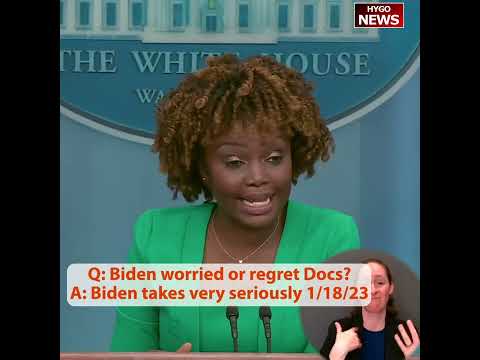
Reporter Asks: Is Biden Worried or Does He Regret the Classified Documents Situation? KJP Deflects With “Takes Very Seriously” Template
In January 2023, a reporter asked White House Press Secretary Karine Jean-Pierre directly about President Biden’s personal feelings regarding the classified documents situation. “How the president is feeling. Is he worried about those documents that were found or is he somehow regret to what he have done with those documents being found at his property? Is he worried about that?” the reporter asked. KJP’s response deflected even to this emotional/personal question: “First, I’m going to repeat what I just said moments ago. He takes this very seriously when it comes to classified documents, when it comes to classified information, he was unaware that the documents were there. You heard that directly from him, from the president twice. He spoke to this just last week. Anything specific dealing with this issue, I would refer to the Department of Justice or the Special Counsel and I’ll leave it there.” The deflection showed the blackout extended even to questions about Biden’s personal reactions.
The Personal/Emotional Question
The reporter’s question was distinctive in its focus. Rather than procedural or factual questions, this asked about Biden’s inner state:
How he’s “feeling” — Emotional state.
“Worried” — Specific concern level.
“Regret” — Retrospective assessment.
Personal reaction — To the situation.
Human dimension — Beyond process.
Such questions were typically softer territory for press secretaries. Conveying the president’s feelings — his concern, his regret, his perspective — was usually standard press secretary function. Administrations regularly shared presidential emotional states on various topics.
The Unusual Deflection Opportunity
A question about Biden’s feelings was an unusual deflection target. Most press secretaries would welcome such opportunities:
Humanize the president — Show his response.
Manage narrative — About the situation.
Generate sympathy — Through emotional acknowledgment.
Express appropriate remorse — If any applied.
Control messaging — About Biden’s take.
Instead of using this as an opportunity to shape the narrative about Biden’s personal response, KJP deflected. This was notable because it abandoned territory most administrations would actively occupy.
”First, I’m Going to Repeat”
KJP’s response started with acknowledgment of repetition. “First, I’m going to repeat what I just said moments ago,” KJP said.
The opening indicated:
Repetition coming — Same content again.
Prior answer invoked — Without new content.
Topic management — Treating question as redundant.
Pressure recognition — Acknowledging asked before.
Template response — Rather than custom answer.
By framing the response as repetition, KJP was signaling that the specific question — about feelings — wouldn’t get a specific answer. The template response would be redeployed regardless of question nuance.
”He Takes This Very Seriously”
KJP deployed her standard line. “He takes this very seriously when it comes to classified documents, when it comes to classified information,” KJP said.
The “takes very seriously” line:
Standard template — Used repeatedly.
Generic content — Applicable to any question.
Character claim — About Biden’s attitude.
Process avoidance — Not addressing specifics.
Emotional substitute — Rather than actual feelings.
“Takes very seriously” had become KJP’s default characterization. But it wasn’t an answer to whether Biden was worried or regretful. “Taking seriously” and “being worried” and “having regret” were distinct emotional states. KJP was substituting the generic for the specific.
”He Was Unaware That the Documents Were There”
KJP included the administration’s core factual claim. “He was unaware that the documents were there. You heard that directly from him, from the president twice,” KJP said.
The unawareness claim:
Biden’s position — Didn’t know documents existed.
Repeated twice — Claim reinforcement.
From Biden directly — Personal attribution.
Defense implication — Reducing culpability.
Factual assertion — Without evidence offered.
The unawareness claim was central to Biden’s public position. He hadn’t known the documents were at his home or office — they had been there unknowingly since his Vice Presidency. Whether this was true or accurate would be matters for investigation, but it was the consistent administration line.
The Answered-Feelings Gap
The “unaware” claim didn’t answer the reporter’s question. The reporter had asked about feelings — worry, regret — not about knowledge. Even accepting that Biden hadn’t known documents were there:
Upon learning — What did he feel?
About the situation — Generally?
About the revelation — Specifically?
About the investigation — Emerging?
About personal responsibility — If any?
Biden’s knowledge state before discovery was separate from his feeling state after discovery. The reporter was asking about the latter; KJP addressed only the former.
”He Spoke to This Just Last Week”
KJP referenced Biden’s prior statements. “He spoke to this just last week,” KJP said.
The reference:
Biden’s public comments — Earlier statements.
Prior coverage — By media.
Administration transparency claim — He did speak.
Detail deflection — Without specifying what.
Past tense — Closing current discussion.
Biden had made brief public comments about the documents situation in the preceding week. These comments had been limited and defensive. Citing them as evidence of engagement was debatable — Biden hadn’t spoken in depth or taken extensive questions.
The Department of Justice Referral
KJP returned to her deflection standard. “Anything specific dealing with this issue, I would refer to the Department of Justice or the Special Counsel,” KJP said.
The referral structure:
DOJ reference — Primary deflection.
Special Counsel — Secondary deflection.
“Anything specific” — Expansive scope.
No alternative answers — Provided.
Silent exit — “I’ll leave it there.”
This was the standard deflection pattern. What was notable was applying it to a question about feelings. Biden’s emotional state wasn’t DOJ territory — DOJ wasn’t investigating Biden’s feelings. But KJP referred even this to the investigation.
”I’ll Leave It There”
KJP closed the topic. “I’ll leave it there,” KJP said.
The closing:
Topic termination — Unilateral.
No further discussion — Permitted.
Press secretary control — Of agenda.
Limited engagement — Acknowledged.
Signal to move on — To reporter.
The “leave it there” phrase was a standard KJP device for ending topic engagement. It signaled that the administration had decided the topic was over, regardless of whether reporters had follow-up questions or alternative framings.
The Feelings Question’s Political Use
Why deflect a question about feelings? Possible reasons:
Avoid emotional commitment — Biden hadn’t authorized specific emotional language.
Limit quote production — Any emotional quote could be used.
Prevent narrative capture — By defining feelings publicly.
Maintain stoic posture — Rather than emotional display.
Pure risk aversion — Any answer had some risk.
The calculation might have been that any specific characterization of Biden’s feelings could be challenged or used against him. If KJP said Biden was worried, that might suggest guilt. If she said he was regretful, that might suggest acknowledgment of wrongdoing. If she said he was confident, that might seem tone-deaf. Non-response avoided all these pitfalls.
The Character Question
The deflection pattern had character dimensions:
Empathic leadership — Usually involves acknowledging feelings.
Accountability — Often requires emotional engagement.
Transparency — About personal response.
Humanity — Of political leadership.
Relatability — Through emotional expression.
Biden’s political brand had long been built partly on emotional authenticity and empathy. Refusing to discuss his feelings on a significant matter was out of character with that brand. Whether the political calculation to deflect outweighed the brand-consistency value was debatable.
The Congressional Parallel
Similar questions would arise in Congressional contexts:
Testimony preparation — Biden’s mental state.
Public statements required — Eventually.
Sworn declarations — If interviewed by investigators.
Interview transcripts — Potentially released.
Political commentary — In Congressional settings.
Eventually, Biden’s feelings about the documents would be explored in various forums. The press briefing deflection was temporary — delaying rather than preventing discussion of this dimension.
The Public Interest Dimension
The public had legitimate interest in Biden’s response:
Accountability — To voters.
Leadership demonstration — In crisis.
Character evaluation — Through response.
Democratic norms — Of presidential transparency.
Future behavior — Suggested by current response.
A president’s emotional and personal response to a major scandal is legitimate public information. How he felt, what he regretted, what he worried about — these things informed public assessment of his fitness for office and character.
The Pattern Extension
This exchange extended the deflection pattern in a specific direction — to personal/emotional questions. Previously the pattern had covered:
Factual investigation questions — DOJ referred.
Procedural questions — Counsel referred.
National security questions — Not discussed.
Now: Personal/emotional questions — Also deflected.
The extension to personal questions meant the blackout was comprehensive. There was no dimension of the classified documents matter that KJP would discuss directly. Every angle hit the same wall.
The Lack of Custom Response
Notable in KJP’s response was the absence of customization:
Same template — For different question types.
Standard deflection — Regardless of question nuance.
Boilerplate delivery — Not tailored.
Automated pattern — Seemingly scripted.
Minimal engagement — With specific content.
The uniformity suggested that administration preparation had produced a single response template that was being deployed regardless of question specifics. This might be defensively effective but was communicatively lazy. The approach didn’t adapt to what reporters were actually asking.
The Emotion Deflection Precedent
KJP’s refusal to discuss Biden’s feelings had precedent-setting implications:
Future personal questions — Could be similarly deflected.
Other emotional topics — Treated like operational secrets.
Character questions — Off-limits.
Presidential humanity — Not for briefing discussion.
Accountability erosion — In personal dimension.
If refusing to discuss presidential feelings became normalized for any sensitive topic, a significant communicative function would be lost. Press secretaries traditionally convey presidential emotional responses to major events. This function was being curtailed.
The Late-January 2023 Context
The exchange occurred in the compressed period following:
Initial document revelation — Early January 2023.
Additional documents found — Mid-January.
Special Counsel appointment — January 12, 2023.
Ongoing searches — By DOJ.
Continuing revelations — Rolling basis.
In this context, every briefing became a venue for questions about the unfolding situation. Administration resistance to discussing any aspect of it created sustained tension in the press-White House relationship.
Key Takeaways
- A reporter asked KJP directly about Biden’s personal feelings regarding the classified documents: was he worried, did he regret the situation?
- KJP deflected even this emotional/personal question with her standard “takes very seriously” template.
- She included the administration’s core factual claim — “he was unaware that the documents were there” — but didn’t address the feelings question.
- She referred “anything specific dealing with this issue” to DOJ or the Special Counsel, then closed the topic: “I’ll leave it there.”
- The blackout extended to personal/emotional questions that typically fall within press secretary responsibility.
- The uniform template response regardless of question nuance suggested administrative commitment to minimal engagement on the topic.
Transcript Highlights
The following is transcribed from the video audio (unverified — AI-generated from audio).
- And one big question on the classified documents, how the president is feeling.
- Is he worried about those documents that were found or is he somehow regret to what he have done with those documents being found at his property?
- First, I’m going to repeat what I just said moments ago. He takes this very seriously when it comes to classified documents, when it comes to classified information.
- He was unaware that the documents were there. You heard that directly from him, from the president twice.
- He spoke to this just last week.
- Anything specific dealing with this issue, I would refer to the Department of Justice or the Special Counsel and I’ll leave it there.
Full transcript: 121 words transcribed via Whisper AI.