 HYGO News
 Q: Biden wasn't aware special counsel but he is aware NOW? A: I'm just not going to go beyond
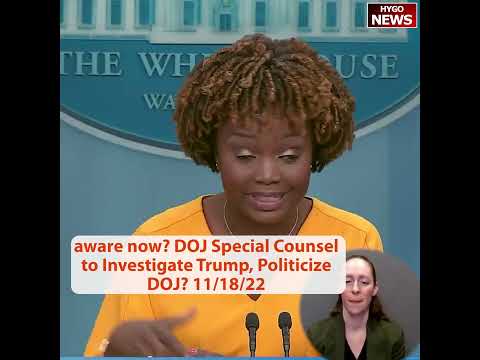
Reporter: Biden Wasn’t Aware of Special Counsel Before, But “I’m Sure He Is Aware Now” — Who Informed Him? KJP: “I’m Assuming It Was a Senior Member of His Staff”
On 11/21/2022, a reporter pressed White House Press Secretary Karine Jean-Pierre on the appointment of Special Counsel Jack Smith to investigate former President Trump. KJP had earlier said Biden wasn’t aware of the special counsel appointment before it was announced. The reporter’s follow-up pointed out the obvious: “Even if the president wasn’t aware ahead of time, I’m sure he is aware now. Can you provide any details about who informed him today, when he learned of the news, how he learned of the news today?” KJP’s response was remarkable for what it revealed about the White House’s information flow: “I’ve not spoken to him before coming out here, so can’t give you details on that. I’m assuming it was a senior member of his staff would most likely have let him know about the news.”
The Special Counsel Context
Attorney General Merrick Garland had appointed Jack Smith as Special Counsel on November 18, 2022, to oversee the Justice Department’s investigations into former President Donald Trump. The appointment was significant because it came just days after Trump had announced his 2024 presidential candidacy and one week after the midterm elections.
The Special Counsel appointment was a major news event. It affected the most sensitive ongoing criminal investigations — into the handling of classified documents found at Mar-a-Lago and into Trump’s involvement in efforts to overturn the 2020 election. It had implications for the 2024 presidential race, for DOJ independence, and for the broader political landscape.
The White House’s initial position had been that Biden was not aware of the Special Counsel appointment before it was publicly announced. This framing was designed to maintain the appearance of DOJ independence — the implication that Garland had made the decision without consulting the White House.
”I’m Sure He Is Aware Now”
The reporter’s follow-up cut to the heart of a different question. Even if Biden hadn’t known about the appointment in advance, he obviously knew about it now — the announcement had been the biggest political news of the day. The reporter wanted to know the practical details of how and when Biden had learned of the news.
“Even if the president wasn’t aware ahead of time, I’m sure he is aware now,” the reporter said. “Can you provide any details about who informed him today, when he learned of the news, how he learned of the news today?”
These were straightforward procedural questions. Any competent White House should have been able to answer them: the chief of staff typically briefs the president on major developments, such briefings typically happen at specific times during the day, and the president typically has specific reactions or responses worth conveying.
KJP’s inability to answer even these basic procedural questions revealed something troubling about the White House’s information flow and her own position within it.
”I’ve Not Spoken to Him”
KJP’s response began with an extraordinary admission. “Again, I’m just not going to go beyond. I know you’re asking me about the president specifically. I’ve not spoken to him before coming out here, so can’t give you details on that.”
This was the same admission from earlier in the same briefing — that KJP had not spoken to the president before her press briefing. The admission was particularly problematic in this context because the Special Counsel appointment was arguably the biggest story of the day. A press secretary should have made speaking with the president about that specific development a priority before conducting a briefing where reporters would obviously ask about it.
The admission revealed a breakdown in basic White House operations. On a day when the Attorney General had announced a Special Counsel to investigate a former president, the press secretary had not spoken with the sitting president before addressing the press. The communications team had apparently not prioritized ensuring KJP could speak authoritatively about how Biden was responding to a major news event.
”I’m Assuming”
KJP’s next sentence made the situation worse. “I’m assuming it was a senior member of his staff would most likely have let him know about the news,” KJP said.
The word “assuming” was damaging. The press secretary should not need to assume how the president learned of major news. She should know. A basic function of any White House is ensuring that the communications team understands the president’s daily information flow so they can accurately represent his reactions and decisions.
KJP’s admission that she was “assuming” Biden had been briefed by “a senior member of his staff” — without specifying which staff member, when, or how — suggested the White House communications operation was fundamentally disconnected from the president’s daily activities. KJP was guessing at basic operational details that should have been known.
The phrase “most likely have let him know” compounded the problem. “Most likely” implied uncertainty — KJP wasn’t even sure that Biden had been formally briefed. She was expressing a probabilistic guess about whether someone had performed the most basic presidential briefing function.
The Information Flow Problem
The exchange exposed a structural problem with how information flowed between the president and his press secretary. In a functional White House:
- Major news breaks
- Senior staff immediately brief the president
- Senior staff brief the press secretary on what the president was told, when, and his reaction
- Press secretary addresses the press with current, accurate information about the president’s response
KJP’s admission showed that this flow had broken down. She was operating from assumptions rather than briefed information. She could not tell reporters how or when Biden had learned about the Special Counsel. She could only guess.
This breakdown had multiple possible explanations. One possibility was that KJP was being deliberately kept out of the loop to maintain plausible deniability — if she didn’t know the details, she couldn’t be forced to reveal them under pressure. Another possibility was that the White House’s communications operation was genuinely dysfunctional. A third possibility was that Biden’s information flow itself was unusual — that he wasn’t receiving traditional briefings on major news events.
None of these explanations reflected well on the administration.
The Plausible Deniability Interpretation
The most charitable interpretation was that KJP was being kept deliberately uninformed to maintain the White House’s public position that Biden had no role in the Special Counsel appointment. By ensuring that the press secretary couldn’t provide details about how Biden learned of the news, the White House could argue that it maintained strict separation between the president and DOJ decision-making.
But this interpretation created its own problems. If KJP was being deliberately kept uninformed for strategic reasons, it meant the White House was prioritizing legal/political cover over press secretary effectiveness. A press secretary who couldn’t answer basic questions about presidential information flow was less effective at her job — and the administration was willing to accept that cost for the benefit of the plausible deniability.
The approach also raised questions about the DOJ independence narrative. If Biden was genuinely uninvolved in the Special Counsel decision, the White House should have been able to describe how he learned about it without compromising that independence. The fact that KJP couldn’t describe even the basic procedural details suggested that either the information flow was being carefully controlled for strategic reasons, or that the administration had something to hide about the internal deliberations.
Key Takeaways
- A reporter pressed KJP on how and when Biden learned of the Special Counsel appointment announced that day.
- KJP admitted she had not spoken to the president before her briefing.
- She said “I’m assuming” a senior staff member had informed Biden, without specifying who, when, or how.
- The exchange exposed a breakdown in information flow between the president and his press secretary on the biggest news story of the day.
- The breakdown could be explained by strategic plausible deniability, operational dysfunction, or unusual presidential information flow — none of which reflected well on the administration.
Transcript Highlights
The following is transcribed from the video audio (unverified — AI-generated from audio).
- Even if the president wasn’t aware ahead of time, I’m sure he is aware now.
- Can you provide any details about who informed him today, when he learned of the news, how he learned of the news today?
- I’m just not going to go beyond.
- I’ve not spoken to him before coming out here, so can’t give you details on that.
- I’m assuming it was a senior member of his staff would most likely have let him know about the news.
- I know you’re asking me about the president specifically.
Full transcript: 107 words transcribed via Whisper AI.