 HYGO News
 Q: Biden still support DC statehood? Student Loan backup, plan B, no Alternative plan?
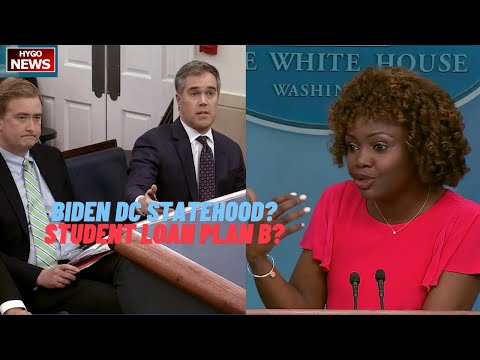
Q: Biden Still Support DC Statehood? Student Loan Backup, Plan B, No Alternative Plan?
On March 2, 2023, White House Press Secretary Karine Jean-Pierre faced sharp questioning from reporters on two major topics: President Biden’s decision to sign a Republican-sponsored resolution blocking new District of Columbia criminal justice laws despite previously opposing it, and the administration’s lack of a backup plan for student loan forgiveness should the Supreme Court strike it down. The briefing highlighted tensions between the White House’s stated positions and its actual policy decisions, with reporters pressing Jean-Pierre on the administration’s credibility.
Biden Reverses Course on D.C. Criminal Code
President Biden announced he was willing to sign a Republican-sponsored resolution that would block new District of Columbia criminal justice laws, a move that stunned many observers given Biden’s stated support for D.C. self-governance and statehood. The resolution targeted a criminal code overhaul approved by the D.C. Council that had been vetoed by Mayor Muriel Bowser, who had concerns about some of the changes. The D.C. Council overrode Bowser’s veto, but the legislation then faced congressional review under the District’s home rule framework.
Thirty-one House Democrats backed the Republican resolution to block the D.C. law, and Biden privately told senators he would sign it, prompting additional Democratic senators to support the measure as well. If signed, it would mark the first time in more than three decades that Congress successfully nullified a D.C. law, infringing on the District’s home rule authority established by a 1973 act.
Jean-Pierre attempted to explain the President’s position: “One thing the president believes in is making sure that the streets in America and communities across the country are safe. That includes D.C.” She also stated: “The D.C. Council put changes forward over the Mayor’s objections, and the President wants to make sure that communities, even in D.C., Americans in D.C., feel safe.”
Reporter Challenges White House Credibility
The most pointed exchange of the briefing came when a reporter confronted Jean-Pierre about the White House’s shifting position. The White House had initially issued a statement saying the President did not support the resolution, but Biden subsequently said he would sign it rather than veto it.
The reporter pressed: “Again, just to be clear, the White House put out a statement saying that the President did not support it, but now for the podium, you’re saying that…” Jean-Pierre clarified that Biden himself had made the decision, prompting the reporter to note: “No, but you heard directly from the President. Just want to make sure that that is clear.”
The questioning escalated when the reporter asked the central credibility question: “Why would the White House say he does not support it, and then he would say he is not vetoing it? Instead, he is signing it, which is to say, why should Americans believe the White House when it says it doesn’t support something if the President is going to sign it, no less?”
Jean-Pierre responded: “I understand the question, Peter. I’m just telling you, at this moment, where we are currently with this piece of legislation that is going to be coming from the Senate, that’s going to be coming to the President’s desk, he will sign it.”
When asked again why Americans should trust the White House’s stated positions, Jean-Pierre offered: “I think what the American people, who I just mentioned to one of your colleagues, I think the American people know who Joe Biden is.” She then paused the reporter’s follow-up: “You have your eyebrows moving and leading in, so I just want to make sure you give me a second to answer. I know, I’m just, you have this, you get really excited, Peter, so I just want to make sure.”
No Plan B for Student Loan Forgiveness
The briefing then pivoted to the administration’s student loan forgiveness program, which was before the Supreme Court. Biden had told reporters the previous day that he was “confident” his administration was “on the right side of the law” but acknowledged he was “not confident about the outcome of the decision.”
The reporter seized on the contradiction: “The President told us on the lawn yesterday, we’re confident, we’re on the right side of the law, but not confident about the outcome of the decision. What is the White House doing, or why is the White House not preparing a plan B to help those who have student loans know what they need to do to prepare themselves if it’s rejected by the court?”
Jean-Pierre replied: “Because we’re confident in our legal authority.” The reporter pushed back: “He just said he’s not confident in the outcome, though, so it doesn’t matter if you’re confident in your authority.”
Jean-Pierre acknowledged the uncertainty: “Of course, who would know how the Supreme Court is going to go? No one knows how the Supreme Court is going to rule.” She then added: “It makes sense because it’s a 6-3 conservative lien right now. It doesn’t mean that we can’t be confident in the merit in our standing, and we are.”
The reporter pressed further: “You’re going to have faith that your argument is the one they, that the law supports, even if you don’t think they will support it and not make an alternative plan.”
Jean-Pierre responded: “What we are saying is that the Solicitor General did an amazing job, we believe, in really defending the program that the President has put forth.”
What Should Student Loan Borrowers Do?
The reporter asked a final, direct question on behalf of Americans with student debt: “I’m asking because we’re hearing from those who have student loans right now who are wondering if this is rejected. They have to make a plan B. So simply put, what is the message to those Americans who have loans right now?”
Jean-Pierre said: “Here’s what they can anticipate from us on our behalf. And they, and many of those millions of boroughs received an email from the Secretary of Education yesterday, basically stating that we have their backs and continue to make sure that we fight for you so that you are not left behind. And that is what this plan is about.”
The answer provided no concrete guidance for borrowers on what to do if the program was struck down, which ultimately happened when the Supreme Court ruled against the Biden administration’s broad student loan forgiveness plan in June 2023.
Additional Context
The March 2, 2023 briefing illustrated a recurring pattern during the Biden administration where the White House’s official statements appeared to contradict the President’s subsequent actions. On the D.C. criminal code issue, the initial White House statement of opposition followed by Biden’s decision to sign the resolution undermined the administration’s credibility and raised questions about internal communication. On student loans, the administration’s refusal to develop a contingency plan left millions of borrowers in limbo, with no clear guidance beyond assurances that the administration “had their backs.”
The D.C. statehood question also remained unaddressed. Despite Biden’s past support for D.C. statehood, his willingness to override the District’s elected representatives on the criminal code issue raised questions about the depth of that commitment.
Key Takeaways
- President Biden reversed course on a D.C. criminal justice bill, agreeing to sign a Republican resolution blocking it despite the White House initially stating he did not support the measure.
- A reporter directly challenged Jean-Pierre’s credibility, asking “why should Americans believe the White House when it says it doesn’t support something if the President is going to sign it, no less?”
- Jean-Pierre justified the D.C. reversal by saying the D.C. Council had acted “over the Mayor’s objections” and that Biden wanted to keep communities safe.
- On student loan forgiveness, the administration admitted Biden was “not confident about the outcome” at the Supreme Court but refused to prepare a Plan B, saying only that they were “confident in our legal authority.”
- The Secretary of Education sent an email to borrowers stating the administration “had their backs,” but no concrete alternative plan was offered.