 HYGO News
 Q: Biden sat very few interviews? A: daily basis, almost every day
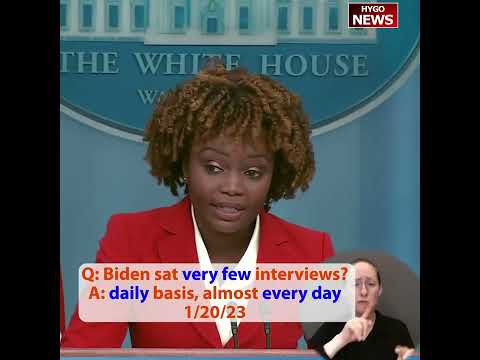
Reporter Challenges KJP on Biden’s Limited Print Interviews — KJP Pivots to “Almost Every Day” Shouted Questions
In January 2023, a reporter directly challenged White House Press Secretary Karine Jean-Pierre about President Biden’s notably limited history of sit-down interviews, particularly with print publications. “He’s sat for very, very few interviews since he took office particularly with print publications. Can you commit to making him more available for one-on-ones with both print and other outlets this year?” the reporter asked. KJP’s response pivoted away from interviews to briefly-shouted press questions: “Here’s what I can tell you the president is going to engage with reporters almost on a daily basis. He did it yesterday. He took questions from your colleagues yesterday when he was in California and he will continue to do that.” The conflation of shouted-question interactions with formal interviews was notable — these were different things serving different purposes.
The Reporter’s Specific Challenge
The reporter’s question was pointed:
“Very, very few interviews” — Documented fact.
Particularly print — Specific deficit.
Since took office — Entire term.
Commit to making him more available — Direct ask.
Print and other outlets — Scope.
The question addressed a documented pattern. Biden had indeed done notably few sit-down interviews, especially with print publications. This was different from all recent modern presidents and had drawn consistent press criticism.
The Biden Interview Record
The historical record supported the reporter’s framing:
Sit-down interviews — Very limited.
Print interviews — Especially rare.
TV appearances — Few.
Unscripted settings — Avoided.
Controlled formats — Preferred.
Compared to predecessors, Biden had given remarkably few extended interviews. Obama, Trump, Bush, and Clinton had all given more interviews in similar timeframes. The Biden pattern was genuinely unusual.
The Print Interview Deficit
The print interview deficit was particularly notable:
Major newspapers — Limited access.
New York Times — Few interviews.
Washington Post — Few interviews.
Wall Street Journal — Limited.
Historical print deference — Lower.
Print interviews traditionally allowed substantive policy discussion. They required preparation and could produce thoughtful coverage. Biden’s limited print interview participation meant fewer opportunities for substantive presidential communication through this channel.
Why Limited Interviews
Reasons for limited interviews included:
Gaffe risk — In unscripted settings.
Age concerns — Managing appearance.
Coverage control — Through avoidance.
Administration discipline — Message management.
Political calculation — Overall.
The most likely reason was risk management. Biden’s verbal patterns could produce problematic moments in extended interviews. Limiting interviews minimized these risks. The political calculation favored limited exposure.
”Almost on a Daily Basis”
KJP’s response pivoted to different type of engagement. “The president is going to engage with reporters almost on a daily basis,” KJP said.
The pivot:
“Engage with reporters” — Broad category.
Daily basis — Frequency claim.
Different from interviews — Conflation.
Shouted questions — Main basis.
Pool spray interactions — Included.
The shift from “interviews” to “engagement” was important. Biden did occasionally take shouted questions from reporters during photo ops or pool sprays. These were not interviews but they were “engagement.”
The California Example
KJP cited specific example. “He did it yesterday. He took questions from your colleagues yesterday when he was in California and he will continue to do that,” KJP said.
The California event:
Previous day — Trip context.
Questions taken — Brief.
Shouted format — Typically.
Limited substance — Usually.
Example usage — By KJP.
California interactions typically involved Biden walking to/from events taking a few questions briefly. These weren’t sustained dialogues. Counting them as equivalent to sit-down interviews stretched definitions.
The Shouted Questions vs. Interviews Distinction
There were key differences:
Depth — Interviews deeper.
Preparation — Different.
Control — Varies.
Format — Completely different.
Substance — Dramatic difference.
Shouted questions during walkway interactions typically produced brief, uninformative responses. Sometimes Biden would ignore questions. Sometimes he’d give short replies. None of this resembled the substantive policy discussion possible in sit-down interviews.
”He Believes That’s Important”
KJP attributed belief to Biden. “He believes that’s important. He believes it’s an opportunity to when he communicates with all of you or answers your question,” KJP said.
The verbal stumbling:
“Believes it’s an opportunity” — Standard framing.
“Communicates with all of you” — Phrasing.
“Or answers your question” — Alternative.
Uncertain construction — Characteristic.
Message discipline — Attempted.
The stumbling through the framing showed KJP working to construct the message. She was trying to frame shouted-question engagement as meaningful communication.
”An Important Vessel to the American People”
KJP used specific framing. “He believes it’s an important kind of you’re an important vessel to the American people,” KJP said.
The “vessel” framing:
Reporter as conduit — To public.
Importance acknowledged — Of press.
Communication channel — Role.
Traditional framing — Of press function.
Respect conveyed — Nominally.
Calling reporters “vessels” was slightly awkward but conveyed standard notion of press serving as channel between president and public. This was traditional framing even if phrased unusually.
”Pushing Out What He Is Doing”
KJP characterized the communication purpose. “Pushing out what he is doing on behalf of the American people,” KJP said.
The framing:
“Pushing out” — Administrative verb.
Biden actions — Subject.
On behalf of people — Legitimizing.
Press as amplifier — Implied.
One-way communication — Emphasized.
The “pushing out” framing was revealing. It suggested the administration viewed press primarily as amplification channel for its messaging rather than as questioners holding accountability. This was administrative perspective, not press perspective.
”That’s the Commitment That I Can Make”
KJP concluded with commitment scope. “That’s the commitment that I can make,” KJP said.
The limitation:
Commitment bounded — To existing pattern.
No new interview access — Offered.
Shouted questions pattern — Continuation.
Actual answer — No formal commitment.
Status quo maintenance — Essentially.
The actual commitment was to continue the current pattern of limited engagement. The reporter had asked for increased interview access. KJP’s commitment was explicitly to the existing limited engagement. This was effectively “no” to the interview request.
The Broader Interview Question
The broader question was about presidential transparency and accountability:
Press function — Accountability.
Public information — About president.
Substantive engagement — With policy.
Voter understanding — Of governance.
Democratic norms — About press access.
Limited interview access affected all of these. The reporter’s question wasn’t just about journalistic access; it was about presidential accountability to public through press.
The Administration’s Calculation
The administration had calculated:
Limited interviews minimize risks — Of gaffes.
Shouted questions adequate — For checkmark.
Public doesn’t require — Extensive access.
Electoral costs low — For limited access.
Messaging control — Through limitation.
Whether this calculation would hold politically was uncertain. Other calculations existed — that voters wanted to see their president engaged in substantive discussion. The administration was making trade-offs.
The Fox News Interview Absence
Notable absences included conservative outlets:
Fox News Sunday — No Biden interviews.
Other Fox programs — Not appearing.
Conservative print — Limited.
Hostile outlets — Avoided.
Friendly outlets preferred — When selected.
Biden’s few interviews had generally been with friendly outlets. This limited his exposure to critical questioning. The pattern was particularly noted by conservative commentators and some mainstream journalists.
The Press Conference Comparison
Press conferences were a different matter:
Formal press conferences — Limited under Biden.
Solo format — Rare.
Joint appearances — More common.
Extended Q&A — Uncommon.
Performance concerns — Likely factor.
Biden had held fewer formal press conferences than predecessors at similar points in their terms. This fit the broader pattern of limited unscripted presidential exposure.
The 2024 Implications
As 2024 approached, interview access mattered:
Campaign requires — More engagement.
Debates expected — With Trump.
Media appearances — Part of campaigns.
Scrutiny intensifying — Pre-election.
Access questions — Continuing.
The question of whether Biden could handle sustained media engagement would matter increasingly. If his team was minimizing interviews in 2023, 2024 campaign would test whether this could continue.
The Historical Context
Historical presidential interview patterns:
Obama — Regular interviews.
Trump — Many interviews.
Bush — Frequent interviews.
Clinton — Extensive media engagement.
Reagan — Regular interviews.
All recent predecessors had given significantly more interviews than Biden. This made the Biden pattern aberrant rather than normal. The question was whether the aberration was sustainable.
The Press Corps Frustration
The press corps had growing frustration:
Limited access — Reported.
Press conferences few — Noted.
Interview requests — Denied.
Alternative sources — Sought.
Coverage patterns — Affected.
The reporter’s question reflected broader press corps concerns. WHCA had been raising access issues. Individual reporters and outlets were complaining. The administration’s response was limited adjustment while maintaining core approach.
The Accountability Gap
Limited interviews created accountability gap:
Substantive questions — Less addressed.
Policy discussion — Limited.
Presidential reasoning — Less visible.
Public understanding — Reduced.
Accountability mechanism — Weakened.
The gap between what was knowable about Biden and what was typically knowable about a president was substantial. Voters had less insight into his thinking and engagement than had been typical for modern presidents.
The KJP Constraint
For KJP, this was difficult position:
Defending the pattern — Required.
Can’t promise — What Biden won’t do.
Must characterize — Limited access favorably.
Face reporter critique — Regularly.
Minimal genuine defense — Available.
KJP had to defend an interview record that was objectively limited. Her defenses were strained — conflating shouted questions with interviews, claiming “daily engagement” for brief encounters. The difficulty of defending the pattern showed in the contorted responses.
Key Takeaways
- A reporter challenged KJP directly: “He’s sat for very, very few interviews since he took office particularly with print publications. Can you commit to making him more available for one-on-ones?”
- KJP pivoted to engagement broadly: “The president is going to engage with reporters almost on a daily basis.”
- She cited shouted questions in California as example, conflating these with formal interviews.
- KJP called press “an important vessel to the American people… pushing out what he is doing on behalf of the American people.”
- The actual commitment was to continue the existing limited engagement pattern: “That’s the commitment that I can make.”
- The exchange highlighted the documented gap between Biden’s interview record and historical presidential norms, particularly for print publications.
Transcript Highlights
The following is transcribed from the video audio (unverified — AI-generated from audio).
- He’s set for very very few interviews since he took office particularly with print publications.
- Can you commit to making him more available for one-on-ones with both print and other outlets this year?
- Here’s what I can tell you the president is going to engage with reporters almost on a daily basis.
- He did it yesterday. He took questions from your colleagues yesterday when he was in California.
- He believes it’s an important kind of you’re an important vessel to the American people right pushing out What he is doing on behalf of the American people.
- He’s he does that almost every day almost every day when he’s in front of all of you He takes a question. That’s the commitment that I can make.
Full transcript: 155 words transcribed via Whisper AI.