 HYGO News
 Q: Biden message to girls in Afghan who can't go to school? A: Ah, Am... Ah, Admin supports girls
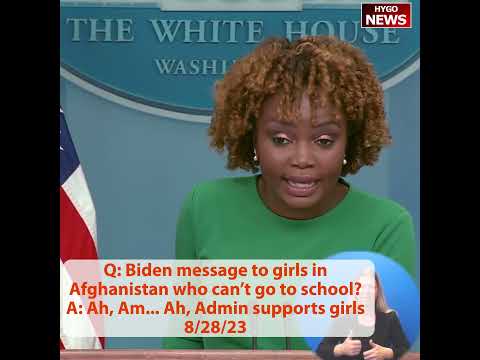
Reporter Asks Biden’s Message to Afghan Girls Banned From School; KJP Stammers Through Empty Answer
On September 1, 2023, a reporter asked White House Press Secretary Karine Jean-Pierre what message the Biden administration had for the millions of girls in Afghanistan who were banned from attending school by the Taliban. The question, framed against the backdrop of the first day of school in the United States, was poignant and direct. Jean-Pierre’s response was a stammering, incoherent series of platitudes that never came close to delivering an actual message to Afghan girls, instead offering only that the administration “certainly supports girls being educated.”
The exchange highlighted the Biden administration’s inability to offer anything substantive regarding the humanitarian crisis in Afghanistan that was a direct consequence of its chaotic withdrawal from the country two years earlier.
The Exchange
The reporter opened with a pointed contrast: “I have a question. First of all, happy first day of school.”
Jean-Pierre responded warmly: “Happy first day of school.”
The reporter then delivered the real question: “But seriously, what is the message that the administration has for the millions of girls in Afghanistan who can’t go to school because the Taliban won’t let them?”
Jean-Pierre’s answer was a cascade of false starts and empty phrases: “So, look, the president has always been very clear about the importance of girls, not just here in America, but globally, being able to live freely and be able to go to school and get the education. And so, and we have been very clear in laying out or, or, and two years ago. That certainly will continue throughout his administration.”
The sentence “we have been very clear in laying out or, or, and two years ago” was grammatically incoherent, trailing off without completing any thought. The reference to “two years ago” appeared to be an attempt to reference the Afghanistan withdrawal but could not be integrated into a meaningful statement.
The reporter, unsatisfied with the non-answer, tried again with an even simpler formulation: “Do you have a message for the girls themselves, I guess?”
Jean-Pierre’s second attempt fared no better: “Well, look, we have — this is — this is a president, this is an administration that certainly supports girls being educated, again, not just here…”
The answer amounted to nothing more than a statement that the administration “supports” girls’ education, an abstraction so general as to be meaningless to the millions of Afghan girls who had been completely cut off from schooling under Taliban rule.
The Taliban’s Ban on Girls’ Education
The reporter’s question addressed one of the most severe human rights crises in the world. Since the Taliban’s return to power in August 2021, following the Biden administration’s withdrawal of U.S. forces from Afghanistan, the Taliban had systematically dismantled girls’ access to education.
In September 2021, the Taliban announced that secondary schools for girls would remain closed indefinitely. In December 2022, the ban was extended to universities, effectively shutting Afghan women and girls out of education at every level beyond the sixth grade. By the time of this press briefing in September 2023, an estimated 1.1 million girls had been barred from secondary education, and hundreds of thousands more had lost access to higher education.
The ban was part of a broader campaign to erase women from Afghan public life. The Taliban had also banned women from most employment, prohibited them from gyms and public parks, required them to cover themselves entirely in public, and restricted their freedom of movement without a male guardian.
International organizations, human rights groups, and foreign governments had condemned the Taliban’s treatment of women and girls in the strongest terms. Yet the Biden administration, which bore direct responsibility for the conditions that allowed the Taliban to return to power, could not even formulate a coherent message to the girls affected.
The Afghanistan Withdrawal and Its Consequences
Jean-Pierre’s inability to deliver a meaningful answer was rooted in the Biden administration’s broader problem with Afghanistan: any serious discussion of the issue inevitably led back to the catastrophic August 2021 withdrawal that had made the Taliban’s return to power possible.
The withdrawal from Afghanistan was one of the most significant foreign policy disasters in modern American history. Over the course of several chaotic weeks in August 2021, the Taliban swept across the country with stunning speed as the Afghan government and military collapsed. The Afghan capital of Kabul fell on August 15, 2021, and desperate scenes of Afghans clinging to departing American military aircraft were broadcast around the world.
The withdrawal culminated in a suicide bombing at Kabul’s Abbey Gate on August 26, 2021, which killed 13 American service members and approximately 170 Afghan civilians. It was the deadliest day for U.S. forces in Afghanistan in over a decade.
Biden had defended the withdrawal as necessary and long overdue, but the execution was universally criticized as chaotic, poorly planned, and needlessly deadly. The administration left behind approximately $7 billion in U.S. military equipment, which fell into Taliban hands, and thousands of Afghan allies who had assisted the U.S. military were left behind despite promises they would be evacuated.
The direct consequence of the withdrawal was the Taliban’s complete seizure of power and the reimposition of their extreme interpretation of Islamic law, including the ban on girls’ education that the reporter was asking about.
The Empty Rhetoric Problem
Jean-Pierre’s response exemplified a recurring problem with the Biden administration’s approach to Afghanistan: the use of supportive-sounding rhetoric in place of actual policy or meaningful action.
Saying that the president “supports girls being educated” cost nothing and meant nothing when the administration had no plan, strategy, or leverage to actually restore educational access for Afghan girls. The Taliban was not influenced by American statements of support. They had watched the most powerful military in the world retreat from their country and had no incentive to modify their policies based on press briefing platitudes.
The administration’s diplomatic tools were also limited. The U.S. had no embassy in Kabul, no formal relationship with the Taliban government, and minimal leverage over their domestic policies. International aid, which had been used as a tool to pressure the Taliban on human rights issues, had proven ineffective, as the Taliban had shown willingness to accept severe economic consequences rather than modify their stance on women’s rights.
Additional Context
The timing of the question on the first day of school in the United States was deliberate and effective. As American children headed back to classrooms, millions of Afghan girls were entering their third year of being denied the right to education, a direct consequence of U.S. policy decisions. The contrast between the joyful American back-to-school ritual and the despair of Afghan families whose daughters had been shut out of education was a powerful framing that Jean-Pierre was unable to address meaningfully.
Two years after the withdrawal, the Biden administration had largely moved on from Afghanistan, rarely mentioning the country in public remarks and offering little in terms of concrete policy to address the humanitarian crisis there. The reporter’s question forced a brief, uncomfortable confrontation with that reality.
Key Takeaways
- Karine Jean-Pierre stammered through an incoherent response when asked what message the Biden administration had for Afghan girls banned from school by the Taliban, offering only that the administration “certainly supports girls being educated.”
- The question was asked on the first day of school in the United States, creating a pointed contrast between American children heading to class and the estimated 1.1 million Afghan girls barred from secondary education.
- Jean-Pierre’s incomplete sentence, “we have been very clear in laying out or, or, and two years ago,” trailed off without conveying any coherent thought.
- The Taliban had systematically banned girls from secondary schools and universities since returning to power following the Biden administration’s August 2021 withdrawal from Afghanistan.
- The administration offered supportive rhetoric without any corresponding policy, strategy, or leverage to actually address the educational crisis facing Afghan women and girls.