 HYGO News
 Q: Biden involved in a cover-up?
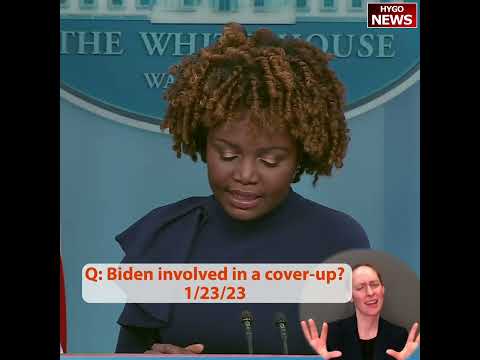
Doocy to KJP: “Is President Biden Involved in a Cover-Up?” — Citing House Oversight Chair’s “Potential Cover-Up” Characterization
In January 2023, Fox News’s Peter Doocy asked White House Press Secretary Karine Jean-Pierre a direct and provocative question about whether President Biden was involved in a cover-up. “The House Oversight Committee Chairman says this document situation has all the makings of a potential cover-up. Is President Biden involved in a cover-up?” Doocy asked, citing GOP Rep. James Comer’s characterization. KJP deflected with the standard template and then addressed Doocy personally: “We have been very clear here from this administration, the president has been very clear, that he takes this very seriously when it comes to classified information, when it comes to classified documents. Peter, and this is, I’m going to be very serious, you asked me kind of a question that everybody laughed at, which was an interesting question to ask, but any other underlying questions that you may have, I would refer you to my colleagues.” The response was notable for KJP’s personal engagement with Doocy rather than substantive response to the cover-up question.
The Comer Characterization
House Oversight Committee Chairman James Comer had made the “cover-up” characterization:
James Comer — R-Kentucky, Chairman.
“Potential cover-up” — Specific language.
Oversight Committee — Major investigative body.
Committee investigation — Planning.
Political framing — Attacking.
Comer’s language was significant. As committee chairman, his framing would shape investigation narrative. “Potential cover-up” suggested systematic concealment rather than administrative lapses. This raised the stakes considerably.
The Reporter’s Direct Question
Doocy’s question was remarkably direct. “Is President Biden involved in a cover-up?” Doocy asked.
The directness:
Yes-or-no framing — Binary.
Direct reference — To cover-up allegation.
Named accuser — Comer.
Committee context — Oversight.
Cover-up charge — Serious.
The question was designed to either extract denial or deflection. Simple denials would be quotable. Deflections would generate their own coverage. This was strategic questioning pattern.
”We Have Been Very Clear”
KJP deployed template. “We have been very clear here from this administration, the president has been very clear, that he takes this very seriously when it comes to classified information, when it comes to classified documents,” KJP said.
The template:
“Very clear” — Characteristic phrase.
“Takes seriously” — Standard formulation.
Repetition — “Information” and “documents.”
No substantive response — To cover-up question.
Template deployment — Automatic.
This was the standard deflection template. Regardless of question type, the “takes seriously” line appeared. The specific cover-up allegation was not addressed directly — neither confirmed nor denied beyond the generic “seriousness” claim.
”Peter, and This Is”
KJP shifted to personal address. “Peter, and this is, I’m going to be very serious,” KJP said.
The personal engagement:
“Peter” — Named reporter.
“I’m going to be very serious” — Framing shift.
Personal tone — Adopted.
Relationship reference — Implied.
Tone shift — From template to personal.
Direct personal address signaled KJP was going to engage with Doocy personally rather than just deliver messaging. “I’m going to be very serious” suggested genuine commentary was coming.
”You Asked Me a Question That Everybody Laughed At”
KJP referenced the earlier exchange. “You asked me kind of a question that everybody laughed at, which was an interesting question to ask,” KJP said.
The reference:
Earlier “four-letter word” question — From same briefing.
“Everybody laughed” — Crowd reaction.
“Interesting question” — Characterization.
Pattern noted — Doocy style.
Meta-commentary — On briefing dynamics.
KJP was calling attention to the pattern of Doocy’s provocative questions. The “everybody laughed” reference suggested Doocy’s style was outside briefing norm and being noticed. This was subtle criticism of his approach.
The Style Criticism
The meta-commentary was strategic:
Delegitimizing questions — As unserious.
Creating peer pressure — Against style.
Avoiding substance — Through style critique.
Protecting administration — From engagement.
Personal dynamic — Between KJP and Doocy.
By characterizing Doocy’s questions as ones that made “everybody laugh,” KJP was implying they weren’t serious journalism. This was tactical delegitimization rather than substantive engagement with the serious cover-up allegation.
”Any Other Underlying Questions”
KJP deferred to colleagues. “Any other underlying questions that you may have, I would refer you to my colleagues,” KJP said.
The referral:
“Underlying questions” — Characterization.
“Refer you to my colleagues” — Deflection destination.
Not answering directly — Choice.
Responsibility shift — To others.
Pattern consistency — With other deflections.
The referral to colleagues was interesting because it wasn’t clear which colleagues were meant. Counsel’s office? Legal team? Biden’s personal lawyers? The ambiguity suggested the referral was less about actual routing than deflection.
The Cover-Up Allegation Reality
Whether there was cover-up had specific meaning:
Legal meaning — Deliberate concealment.
Political meaning — Ordinary obfuscation.
Congressional meaning — Investigatable.
Media meaning — Story frame.
Public meaning — Serious charge.
The “cover-up” charge had legal implications. Deliberate concealment of classified material could be criminal. The charge therefore wasn’t just political framing — it had legal weight if substantiated.
The Comer Investigation Context
Comer’s investigation had specific scope:
House Oversight — Broad jurisdiction.
Biden family matters — Historical focus.
Classified documents — New focus.
Hunter Biden issues — Ongoing.
Political motivation — Mixed with legitimate oversight.
The Oversight Committee under Comer had announced multiple Biden-focused investigations. The classified documents situation was adding to the committee’s workload. Whether the investigations were legitimate oversight or political theater was contested.
The “Makings of Potential Cover-Up”
The specific Comer language was careful:
“Makings of” — Hedged.
“Potential” — Qualified.
Cover-up — Strong term.
Not flat accusation — Yet.
Investigation justification — Purpose.
The hedged framing allowed Comer to suggest serious allegation without making flat accusation. “Makings of potential cover-up” meant less than “cover-up.” This was politically calibrated language.
The Administration’s Alternative Framing
The administration preferred different framing:
Discovery — Rather than concealment.
Cooperation — With investigators.
Transparency — About findings.
Voluntary searches — Allowed.
Accidental nature — Of original issue.
Each administration framing suggested no cover-up. Discovering documents and reporting them was opposite of concealment. This framing had factual basis — Biden’s team had reported the initial find in November.
The Timeline Dispute
Timeline was part of cover-up question:
November 2022 — Initial discovery.
December 2022 — Searches.
January 2023 — Public revelation.
Delay — Before public notification.
Justification — Investigation integrity.
The two-month delay between discovery and public revelation was cover-up question fuel. Administration said it was investigation-appropriate. Critics said it was politically motivated concealment, particularly since the discovery came before midterms.
The Political Weight
The cover-up charge had political weight:
“Cover-up” resonates — Historically.
Watergate echoes — Intended.
Nixon parallels — Suggested.
Political gravity — Significant.
Coverage impact — Substantial.
“Cover-up” was heavy word. Using it invoked historical parallels that raised stakes. Doocy’s invocation of Comer’s framing put that heavy word into the briefing room, forcing administration response.
KJP’s Strategic Choice
KJP had strategic choice:
Direct denial — Possible but risky.
Deflection — Chosen.
Style critique — Added.
Topic shift — Attempted.
Template deployment — Primary.
She chose mostly standard deflection with style critique addition. A strong denial might have been more effective but would have required engagement with the substance. The deflection was safer but left the allegation unaddressed.
The Informal Relationship
KJP and Doocy had informal relationship:
Regular exchanges — Daily.
Known patterns — Each other’s.
Personal comfort — Apparent.
Professional dynamic — Maintained.
Meta-awareness — Of performance.
Both were aware of their recurring dynamic. Their interactions had become briefing features. Each knew the other’s patterns. This familiarity affected specific exchanges but also made them almost theatrical.
The Watergate Precedent
“Cover-up” invoked Watergate:
Nixon administration — Original.
Cover-up crimes — Obstruction.
“What did president know” — Key question.
Political destruction — Followed.
Historical weight — Heavy.
Watergate parallel was what Doocy’s question invoked. Whether Biden situation rose to Watergate level was question. Most observers thought not, but the invocation of “cover-up” was deliberately evocative.
The Administration’s Credibility Crunch
The administration faced credibility pressure:
“No there there” — Contradicted by findings.
Investigation expanding — Despite messaging.
Public skepticism — Growing.
Media framing — Hostile shifting.
Political cost — Accumulating.
Each new development made administration credibility harder to maintain. The “takes seriously” template was wearing thin. Direct denial of cover-up would be stronger response but would require engagement with facts.
The Journalistic Approach Question
Doocy’s approach had tradeoffs:
Attention grabbing — Successful.
Substantive advance — Limited.
Partisan appearance — For Fox audience.
Other reporter relationships — Strained.
Coverage generation — Extensive.
Whether this was good journalism depended on perspective. Fox News’s audience benefited from the framing. Other audiences might prefer substantive Q&A. Doocy was optimizing for Fox while others might optimize differently.
The Political Stakes
The stakes were high for both sides:
For administration — Managing narrative.
For GOP — Establishing investigation legitimacy.
For media — Covering fairly.
For public — Getting information.
For 2024 — Setting stage.
The stakes made these exchanges matter beyond their immediate content. Each briefing was part of larger political battle. The cover-up question was one front in that battle.
Key Takeaways
- Peter Doocy asked KJP directly: “Is President Biden involved in a cover-up?” — citing House Oversight Chair James Comer’s “potential cover-up” characterization.
- KJP deflected with the standard template: “He takes this very seriously when it comes to classified information.”
- She addressed Doocy personally: “Peter, and this is, I’m going to be very serious.”
- KJP referenced Doocy’s earlier “four-letter word” question: “You asked me kind of a question that everybody laughed at, which was an interesting question to ask.”
- She deflected substantive follow-ups: “Any other underlying questions that you may have, I would refer you to my colleagues.”
- The exchange illustrated both Doocy’s confrontational style and KJP’s preference for style-focused pushback over substantive engagement with the cover-up allegation.
Transcript Highlights
The following is transcribed from the video audio (unverified — AI-generated from audio).
- That is what matters to the president. The House Oversight Committee Chairman says this document situation has all the makings of a potential cover-up.
- Is President Biden involved in a cover-up?
- We have been very clear here from this administration, the president has been very clear, that he takes this very seriously when it comes to classified information, when it comes to classified documents.
- Peter, and this is, I’m going to be very serious.
- You asked me kind of a question that everybody laughed at, which was an interesting question to ask.
- Any other underlying questions that you may have, I would refer you to my colleagues.
Full transcript: 108 words transcribed via Whisper AI.