 HYGO News
 Q: Biden dissuading other Dems debt limit negotiations with Republicans
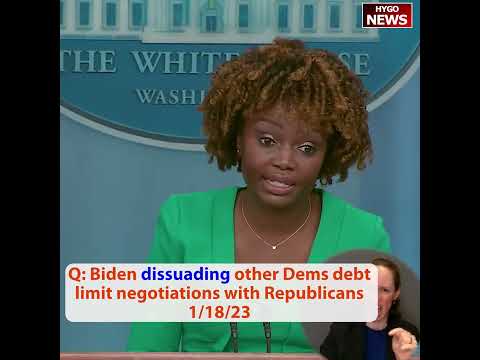
White House on Debt Ceiling: “There Should Not Be Any Negotiations” — KJP Pushes Bipartisan Clean Raise Line
In January 2023, a reporter asked the White House about President Biden’s position on debt ceiling negotiations with Republicans and whether he was actively discouraging other Democrats from engaging in discussions. The White House response was firm: “There should not be any negotiations around here. We should not be stepping around dealing with the debt ceiling. We’ve been incredibly clear here.” The spokesperson emphasized that “in the last administration, the debt ceiling was dealt with three times, three times in a bipartisan way” and that Congress had “constitutional duty” to handle the matter. The exchange highlighted the Biden administration’s “no negotiations” posture as the debt ceiling crisis loomed in early 2023, setting up months of political standoff with Republican House leadership.
The Debt Ceiling Context
January 2023 was the beginning of a major debt ceiling confrontation:
U.S. hit debt ceiling — January 19, 2023.
Extraordinary measures — Treasury began using.
New Republican House — Leadership demanding cuts.
Biden’s firm position — No negotiations.
Economic stakes — Potential default implications.
The debt ceiling — the statutory limit on federal borrowing — had been reached. Treasury was using accounting maneuvers to delay actual default, but without Congressional action, the U.S. would eventually default on obligations. Republicans in the House were demanding spending cuts as price of raising the ceiling.
The Reporter’s Framing
The reporter’s framing suggested active administration opposition to talks. “The White House, the President is dissuading other Democrats on the Hill from engaging in those conversations and those negotiations with Republicans,” the reporter said.
The question elements:
Biden’s active role — In dissuading.
Other Democrats — Being influenced.
Hill conversations — Being discouraged.
Republican negotiations — Off-limits.
Coordinated strategy — Suggested.
This framing suggested that beyond Biden’s public position, he was actively working to prevent any Democratic Hill members from entering negotiations. The question implied sophisticated political management beyond simple stated position.
”Three Times in a Bipartisan Way”
KJP’s response emphasized historical precedent. “What we’ve been very clear about is that in the last administration, the debt ceiling was dealt with three times, three times in a bipartisan way,” KJP said.
The historical reference:
Trump administration — “Last administration.”
Three ceiling raises — Under Trump.
Bipartisan handling — Each time.
Precedent argument — For current approach.
Republican hypocrisy implied — Through contrast.
The factual claim had basis. During the Trump administration, the debt ceiling was raised multiple times with bipartisan support. Democrats had supported these increases despite disagreeing with Trump’s spending. The administration was pointing to this precedent to argue Republicans should do the same now.
The Repetition Pattern
KJP’s repetition of “three times” was notable:
“Three times, three times” — Immediate repetition.
Emphasis function — Rhetorical stress.
Or verbal pattern — Characteristic of KJP.
Same phrase twice — In one sentence.
Possibly automatic — Not consciously emphatic.
The repetition fit KJP’s broader verbal patterns where phrases often got doubled. Whether this was deliberate emphasis or unconscious pattern was unclear, but it was characteristic.
”Constitutional Duty”
KJP elevated the issue to constitutional terms. “It is their constitutional duty for Congress to deal with this issue,” KJP said.
The constitutional framing:
Congress’s role — Under the Constitution.
Duty language — Obligation, not choice.
Not presidential role — Separating branches.
Article I authority — Spending/borrowing.
Responsibility placement — On Congress.
The constitutional argument was that Congress had borrowed the money; Congress needed to deal with the debt ceiling. This wasn’t something for the president to negotiate — it was Congress’s responsibility to fulfill obligations it had created.
”A Hostage, Right? We Should Not Do That”
KJP introduced the hostage metaphor. “A hostage, right? We should not do that,” KJP said.
The hostage framing:
Debt ceiling as weapon — Holding government finances.
Policy demands — As ransom.
Negotiation refusal — Not rewarding hostage-taking.
Democratic norms — Against leveraging default threat.
Pattern establishment — Against future leverage.
The hostage metaphor had become standard Democratic framing for debt ceiling debates. Using default threats to extract policy concessions was characterized as taking the economy hostage. This framing delegitimized the GOP’s negotiating stance as inappropriate leverage rather than legitimate political compromise.
The Position of No Negotiations
KJP’s position was firm. “So just to be clear, Democrats and Republicans in a bipartisan way, reach an understanding, reach an agreement as it relates to the debt limit. The President wouldn’t accept that,” KJP said in characterizing the position.
The framing evolution:
Bipartisan agreement desired — As goal.
Clean raise — Without preconditions.
No negotiations — Over terms.
Not the president’s role — To negotiate.
Congressional obligation — To act.
The administration position was paradoxical in some ways. They wanted bipartisan cooperation but refused negotiation. They wanted an agreement but declined to discuss terms. The position was that Republicans should simply raise the ceiling without getting anything in return — which Republicans had no intention of doing.
”There Should Not Be Any Negotiations”
KJP restated the no-negotiations position. “We’ve been very clear. There should not be any negotiations around here. We should not be stepping around dealing with the debt ceiling,” KJP said.
The repetition emphasis:
“Very clear” — Message consistency.
“No negotiations” — Absolute position.
Direct action expected — Without terms.
Pattern maintenance — Against hostage-taking.
Clear statement — For political record.
The repeated claims of clarity reflected the administration’s commitment to messaging discipline on this topic. Multiple times in short space, “very clear” and “incredibly clear” emphasized the firmness of the position.
”The Basic Duties of Congress”
KJP emphasized Congressional responsibility. “This is an issue that is a constant, the basic, the basic duties of Congress to take care of,” KJP said.
The verbal stumbling:
“A constant” — Incomplete thought.
“The basic” — Abandoned phrase.
“The basic duties” — Retrieved and completed.
Stumbling pattern — Characteristic.
Core message preserved — Despite stumbling.
Despite KJP’s verbal difficulties, the substance came through: dealing with the debt ceiling was Congress’s basic duty, not a bargaining chip. This was the administration’s message-discipline message, whatever the delivery challenges.
The Political Calculation
The administration’s position reflected political calculation:
2011 precedent — Obama negotiated, got bad deal.
Avoiding repeat — Of damaging precedent.
Establishing principle — Against hostage-taking.
Electoral positioning — If default occurred.
Base expectations — Against capitulating.
The 2011 debt ceiling crisis had resulted in a deal that many Democrats felt was unfavorable. The experience had taught Democrats that engaging in negotiations validated using the ceiling as leverage. The Biden administration was trying to avoid that pattern.
The Constitutional Interpretation
The “constitutional duty” framing was debatable:
Congressional responsibility — For borrowing.
But ceiling mechanism — Requires affirmative action.
Default prevention — Requires some action.
Shared responsibility — For avoiding default.
14th Amendment questions — About default legality.
Various constitutional arguments existed about debt ceiling handling. The administration was emphasizing Congressional responsibility to avoid looking like it should negotiate. Other arguments existed — including that the president had constitutional obligation to pay obligations regardless of ceiling — but administration was sticking with the simple “Congress must handle” framing.
The Broader Standoff
The exchange was at the beginning of a months-long debt ceiling confrontation:
January 2023 — Ceiling reached, beginning of crisis.
Extraordinary measures — Extending runway.
Negotiation pressure — Building.
Default deadline — Approaching.
Eventual resolution — Required.
The firmness of the January 2023 position would be tested as months passed. As actual default approached, positions on both sides would evolve. The ultimate resolution — a deal between Biden and Speaker McCarthy — would require significant compromise from the “no negotiations” position.
The Negotiation Position Reality
The “no negotiations” stance was political positioning more than binding policy:
Negotiations were likely — Inevitable.
Stance set starting point — For eventual talks.
Political leverage — From strong stated position.
Public accountability — Frame for talks.
Exit strategy needed — Eventually.
Biden’s ultimate willingness to negotiate would come later. But starting from “no negotiations” established political baseline that strengthened his eventual negotiating position. Starting from willingness to negotiate would have weakened administration leverage.
The Bipartisan History
The bipartisan handling under Trump wasn’t quite as clean as KJP suggested:
2017, 2018, 2019 — Under Trump.
Various dynamics — Each time.
Democrats voted for — Despite Trump.
Republicans had majority — Different dynamic.
Political contexts — Varied.
While technically bipartisan, the Trump-era ceiling raises had occurred under different political circumstances. Divided government with Biden in White House and Republicans in House was structurally different. The precedent argument had merit but simplified the history.
The Hostage Taking Pattern
The “hostage” characterization was accepted on Democratic side:
GOP leverage strategy — Using default threat.
Policy concession demand — As ransom.
Default harm — Affecting wide public.
Asymmetric impact — On base voters.
Normative argument — Against this practice.
But Republicans viewed their position differently. They saw debt ceiling negotiations as legitimate forum for fiscal discipline. The language of “hostage” vs. “leverage” reflected different framings of normal political negotiation.
The 2011 Echo
The 2011 debt ceiling crisis shadowed the 2023 confrontation:
Obama negotiations — With Boehner.
Eventual deal — Budget Control Act.
Sequestration — Follow-on effect.
Political cost — To Obama.
Democratic lesson — Not to negotiate.
Biden, who had been Obama’s Vice President during 2011, likely drew personal lessons from that experience. The firm “no negotiations” posture in 2023 reflected post-2011 Democratic conclusion that engaging validated leverage.
The Markets Context
Debt ceiling confrontations affected markets:
Treasury yields — Reacting to uncertainty.
Stock markets — Volatile around deadlines.
Federal Reserve — Monitoring for instability.
Global financial system — U.S. debt central.
Credit rating — Potential downgrade risk.
The 2011 confrontation had led to the S&P downgrade of U.S. debt. Market participants were watching the 2023 standoff with concern about repeat downgrade risk. Administration’s firm stance reflected awareness of market stakes.
Key Takeaways
- A reporter asked the White House about Biden actively dissuading other Democrats from debt ceiling negotiations with Republicans.
- KJP emphasized: “There should not be any negotiations around here. We should not be stepping around dealing with the debt ceiling.”
- She cited precedent: “The debt ceiling was dealt with three times, three times in a bipartisan way” under the Trump administration.
- KJP framed negotiations as hostage-taking: “A hostage, right? We should not do that.”
- The administration characterized action as Congress’s “constitutional duty” rather than something for the president to negotiate.
- The firm stance in January 2023 marked the start of a months-long standoff that would eventually require significant compromise from both sides.
Transcript Highlights
The following is transcribed from the video audio (unverified — AI-generated from audio).
- The White House, the President is dissuading other Democrats on the Hill from engaging in those conversations and those negotiations with Republicans.
- In the last administration, the debt ceiling was dealt with three times, three times in a bipartisan way.
- It is their constitutional duty for Congress to deal with this issue. A hostage, right? We should not do that.
- Just to be clear, Democrats and Republicans in a bipartisan way, reach an understanding, reach an agreement as it relates to the debt limit. The President wouldn’t accept that.
- There should not be any negotiations around here. We should not be stepping around dealing with the debt ceiling.
- This is an issue that is a constant, the basic, the basic duties of Congress to take care of.
Full transcript: 194 words transcribed via Whisper AI.