 HYGO News
 Q: better than cancel student loan? WH: GOPs don't want give a little bit more breathing room
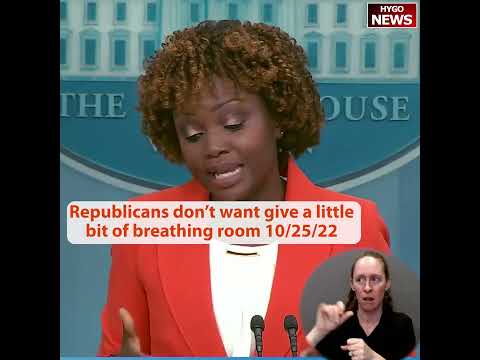
Reporter Asks If There’s “a Better Mechanism” Than Student Loan Cancellation Given Legal Challenges — KJP: “I Actually Disagree With You,” Blames Republicans
On 10/27/2022, Fox News reporter Jacqui Heinrich asked White House Press Secretary Karine Jean-Pierre whether there was “perhaps a better mechanism” to provide student loan relief, given that the program was “caught up now in litigation” and the legal argument that “it can’t be a national emergency because of actions that the administration has taken elsewhere.” KJP replied “I actually disagree with you,” then ignored the substance of the question entirely — pivoting to blame “opponents” who “do not want to give middle-class families a little bit more breathing room.” She called the legal challenges “pure politics” while insisting the president’s program was “not partisan."
"A Better Mechanism?”
Heinrich’s question was constructive, not hostile. She wasn’t arguing against student loan relief — she was asking whether the administration had considered alternative approaches that could survive legal challenges. “I hear what you’re saying on all that. I guess my question is: Is there another — perhaps a better mechanism to do that, because the whole program is caught up now in litigation?” Heinrich asked.
The question was prescient. By late October 2022, the student loan forgiveness program was facing multiple legal challenges. The Eighth Circuit Court of Appeals had already issued a stay blocking debt cancellation. A federal judge in Texas was considering a separate challenge. The legal foundations of the program — Biden’s reliance on the HEROES Act of 2003 to authorize mass debt cancellation — were being questioned by scholars across the political spectrum.
Heinrich identified the specific legal vulnerability: “A lot of this legal argument is that it can’t be a national emergency because of actions that the administration has taken elsewhere.” This referred to the contradiction at the heart of the legal case — Biden had used the COVID-19 national emergency as the basis for the HEROES Act invocation, but the administration had simultaneously been declaring the pandemic “over” and ending emergency measures in other areas. If the pandemic emergency was ending, the legal authority predicated on that emergency was undermined.
A “better mechanism” might have included working with Congress to pass student loan relief through legislation — which would have been constitutionally unassailable — or using regulatory authority to reform income-driven repayment plans (which the administration was separately pursuing). Heinrich was offering the White House an opportunity to discuss alternatives. KJP declined.
”I Actually Disagree With You”
KJP’s response began with a flat contradiction that didn’t address Heinrich’s point. “So I actually disagree with you,” KJP said — though it was unclear what she was disagreeing with. Heinrich had asked a question, not made a debatable assertion. Was KJP disagreeing that there might be a better mechanism? Disagreeing that the program was caught up in litigation? Disagreeing that the legal arguments had merit?
The “I disagree with you” construction was a KJP technique for rejecting a question’s premise without specifying what was wrong with it. By expressing disagreement in general terms, she could avoid engaging with the specific, well-articulated points Heinrich had raised.
”Opponents Who Do Not Want”
KJP then executed her standard pivot from substance to politics. “What is happening is there are opponents out there of the student loan debt relief who do not want to give middle-class families a little bit more breathing room,” KJP said.
“There are opponents out there, many of them are Republicans, who do not want us to make sure — they are upset that we are trying to help those very, very Americans,” KJP continued. “So that is what is happening.”
The framing reduced a constitutional debate to a narrative of villains versus victims. The legal challengers — state attorneys general, legal scholars, individual plaintiffs — were not arguing about whether middle-class families deserved relief. They were arguing about whether the president had the legal authority to spend hundreds of billions of dollars without congressional authorization. These were different questions, but KJP’s response treated them as identical.
The “breathing room” phrase was Biden’s signature description of the student loan program — one he used in virtually every mention of the topic. Its repetition had become almost liturgical, a formula deployed automatically whenever student loans were discussed, regardless of the specific question being asked.
”Pure Politics” vs. Constitutional Questions
KJP dismissed the legal challenges as illegitimate. “This is pure politics that we’re seeing out there,” KJP said. “It is not — and the way the president sees this, this is not partisan.”
The characterization of the lawsuits as “pure politics” was undermined by several facts. The legal arguments were being considered by federal judges — including those appointed by Democratic presidents — who were issuing stays and injunctions based on the merits of the constitutional questions, not on partisan affiliation. The Supreme Court would ultimately hear the case with six justices finding the administration had exceeded its authority — a ruling based on the major questions doctrine and statutory interpretation, not political preference.
Moreover, calling the opposition “pure politics” while defending a program announced in August, launched in October, and targeting 40 million potential voters before a November election was a remarkable inversion. If any aspect of the student loan debate was “pure politics,” it was the timing and scale of the program itself — not the legal challenges to it.
The “Not Partisan” Claim
KJP’s insistence that student loan forgiveness was “not partisan” was difficult to reconcile with reality. The program was conceived, designed, and implemented by a Democratic president without any Republican support. It was opposed by every Republican in Congress. It was challenged in court by Republican attorneys general. And it was marketed as a benefit delivered by Democrats against Republican opposition — the very definition of partisan.
Biden himself had framed the program in explicitly partisan terms at campaign events, contrasting Democratic support for forgiveness with Republican opposition. His White House had published lists of Republican members of Congress who received PPP loan forgiveness specifically to create a partisan contrast. The program was a Democratic campaign promise, implemented by Democratic executive action, defended by Democratic appointees — and KJP was calling it “not partisan.”
The Legal Outcome
Heinrich’s question about finding “a better mechanism” proved prophetic. The Supreme Court struck down Biden’s broad student loan forgiveness program on June 30, 2023, in a 6-3 decision finding that the HEROES Act did not authorize the cancellation Biden attempted. Chief Justice Roberts wrote that “the question here is not whether something should be done; it is who has the authority to do it.”
The administration subsequently pursued student loan relief through narrower regulatory channels — exactly the kind of “better mechanism” Heinrich had suggested. Biden used income-driven repayment plan modifications, targeted forgiveness for specific groups (public service workers, borrowers defrauded by for-profit schools), and other administrative tools that didn’t require the sweeping emergency authority the courts rejected.
Had the administration pursued these alternatives from the beginning — as Heinrich’s question implicitly suggested — it could have delivered substantial relief without the legal vulnerability, the false hope for 40 million borrowers, and the ultimate Supreme Court defeat that left the broad program permanently blocked.
Key Takeaways
- Heinrich asked if there was “a better mechanism” for student loan relief given legal challenges — a constructive question KJP dismissed with “I actually disagree with you.”
- KJP ignored the legal substance and pivoted to blaming “opponents” who “don’t want to give middle-class families breathing room.”
- She called the legal challenges “pure politics” despite courts issuing stays and injunctions based on constitutional merits.
- KJP insisted the program was “not partisan” — despite it being conceived, implemented, and marketed as a Democratic achievement against Republican opposition.
- The Supreme Court ultimately struck down the program, and the administration pursued the narrower approaches Heinrich’s question had implicitly suggested.
Transcript Highlights
The following is transcribed from the video audio (unverified — AI-generated from audio).
- Is there perhaps a better mechanism, because the whole program is caught up in litigation?
- A lot of this legal argument is that it can’t be a national emergency because of actions the administration has taken elsewhere.
- I actually disagree with you. There are opponents who do not want to give middle-class families a little bit more breathing room.
- Many of them are Republicans who are upset that we are trying to help those very, very Americans.
- This is pure politics that we’re seeing out there.
- The way the president sees this, this is not partisan.
Full transcript: 154 words transcribed via Whisper AI.