 HYGO News
 Q: before Midterm Biden promised student loans bailout in 2 weeks? A:16M students should blame GOPs
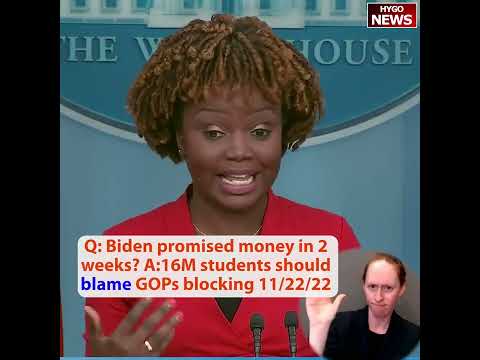
Reporter: Biden Promised Student Loan Relief “In Two Weeks” Before Midterms — “That Has Come and Gone” — 16 Million Borrowers Still Waiting
On 11/22/2022, a reporter confronted White House Press Secretary Karine Jean-Pierre with a broken Biden promise. “The President said back in October that he thought really would go out in two weeks. And of course that has come and gone,” the reporter said, asking for an updated timeline on when student loan relief might actually reach borrowers. KJP’s response avoided the broken promise and pivoted to talking points about the Supreme Court appeal. She confirmed that “about 16 million people who signed up and have been approved to get that loan” — then added the phrase that captured the borrower situation: “But that’s not going to happen.” Sixteen million Americans had been told they would receive debt relief. They had applied. They had been approved. And now the White House was telling them, essentially, that relief “is not going to happen” on any specific timeline.
”The President Said Back in October”
The reporter’s question referenced a specific Biden promise. Before the midterm elections, Biden had told audiences that student loan forgiveness would begin flowing to borrowers “in two weeks.” This was the kind of concrete timeline that voters remember and hold politicians accountable for.
“The President said back in October that he thought really would go out in two weeks. And of course that has come and gone,” the reporter noted.
The “come and gone” phrase was understated but pointed. Biden had made a specific promise with a specific timeline. The timeline had passed. The promise had not been kept. The reporter was asking the White House to account for the broken commitment — either by explaining why the two weeks hadn’t produced the promised results, or by offering an updated timeline that voters could rely on.
Pre-midterm, Biden had every reason to promise quick action on student loans. The program was designed to energize young voters and borrower constituencies ahead of the election. Telling voters that relief would begin “in two weeks” created urgency and confidence that the policy would materialize. Post-midterm, with the election outcome secured, the promise was apparently no longer operational.
The Legal Challenge Context
The student loan forgiveness program had been blocked by federal court rulings even before the two weeks Biden promised expired. The Eighth Circuit Court of Appeals had issued a stay on October 21, 2022 — the same day Biden had been telling audiences that the courts were “on Biden’s side.” A federal judge in Texas had separately ruled against the program on November 10, 2022.
These legal challenges had been predictable. Constitutional scholars across the political spectrum had questioned whether the HEROES Act of 2003 — the statute Biden relied upon — actually authorized the mass cancellation of hundreds of billions of dollars in student debt. The legal vulnerability was widely discussed before the program was announced. Biden and his team had chosen to proceed anyway, calculating that the political benefits of announcement outweighed the risks of eventual legal defeat.
By late November 2022, the legal situation was grim for the administration. Multiple courts had ruled against the program. The administration had appealed to the Supreme Court and asked for expedited review. But the Court had a 6-3 conservative majority, and legal observers across the political spectrum expected the program to be struck down on the merits.
”The Highest Court of the Land”
KJP deflected from the broken promise by invoking the legal process. “We have sent this up to the highest court of the land, the highest court of our nation, to make sure that we move forward quickly with making sure that the student loan relief that the President put forward, his plan, gets to the American people very quickly,” KJP said.
The “highest court of the land, the highest court of our nation” phrasing was unusually repetitive — KJP said the same thing twice in slightly different words, apparently for emphasis. The repetition reflected the administration’s effort to project confidence in the legal process while avoiding acknowledgment that the legal process was likely to fail for them.
“Move forward quickly” was also telling. The administration was asking the Supreme Court for expedited review — meaning the administration itself had concluded that time was critical. The Court typically operates on its own schedule, taking months to decide major cases. Asking for expedited review signaled urgency, but the Court wasn’t obligated to accommodate administration timelines.
”16 Million People Who Signed Up”
KJP confirmed the scale of the affected population. “As we know, there are about 16 million people who signed up and have been approved to get that loan,” KJP said.
The number was significant. Sixteen million Americans had trusted the White House’s promise enough to go through the application process. They had provided personal information, submitted documentation, and received confirmation that their applications had been approved. These were not casual observers — they were people who had taken concrete steps based on the administration’s commitment.
Each of these 16 million borrowers had made financial decisions based on the expected relief. Some had delayed paying down other debts. Some had budgeted for the reduced loan balance. Some had made major purchases they otherwise wouldn’t have. Some had simply counted on the savings to improve their monthly cash flow.
When the relief failed to materialize, these borrowers were left with the consequences of decisions they had made based on promises that weren’t kept.
”But That’s Not Going to Happen”
The phrase that captured the situation came at the end of KJP’s response: “But that’s not going to happen.”
The phrase was in the context of student loan relief being delivered on the timeline Biden had promised. KJP was acknowledging that the two-week timeline was no longer operative. She was signaling that borrowers shouldn’t expect relief anytime soon.
The acknowledgment was remarkable because it was the first time administration communications had clearly conveyed that the promised relief wouldn’t happen on schedule. Throughout October and early November, the White House had projected confidence that relief was imminent. Now, with the legal situation deteriorating and no timeline possible, KJP was admitting that the immediate path forward didn’t exist.
The Broken Promise Pattern
Biden’s broken student loan promise fit a broader pattern of administration promises that didn’t survive contact with reality:
- “The economy is strong as hell” (October 2022) — while Americans experienced 40-year-high inflation
- “Gas prices are down more than a dollar” — from a peak of $5, but still 60% above Inauguration Day
- “The Inflation Reduction Act will reduce the cost of everything” — an unsupported claim about a bill whose inflation impact was “negligible” per the CBO
- “Student loan relief will go out in two weeks” — blocked by courts before the timeline expired
- “We have a comprehensive border plan” — while border encounters reached all-time records
- “No more drilling” / “They should be drilling more” — contradictory statements within four days
Each broken promise produced a similar response from the White House: deflection, pivot to blame opponents, or quiet walking-back without acknowledgment.
The Eventual Outcome
The Supreme Court heard the student loan forgiveness case in February 2023 and ruled 6-3 against the administration in June 2023. The Court found that Biden had exceeded his authority under the HEROES Act and that the program would need congressional authorization to proceed.
The 16 million borrowers KJP mentioned never received the promised relief through the original program. The administration eventually pursued narrower forms of loan relief through other mechanisms — income-driven repayment plan modifications, targeted forgiveness for specific groups, and administrative changes to existing programs. These provided some relief but nothing comparable to the broad forgiveness Biden had promised.
Key Takeaways
- A reporter confronted KJP with Biden’s pre-midterm promise that student loan relief would flow to borrowers “in two weeks” — a timeline that had “come and gone.”
- KJP deflected from the broken promise by invoking the Supreme Court appeal process.
- She confirmed “about 16 million people have signed up and have been approved” — then added “but that’s not going to happen” about the timeline.
- The legal challenges had been predictable, with constitutional scholars questioning whether the HEROES Act authorized mass debt cancellation.
- The Supreme Court ultimately struck down the program 6-3 in June 2023, and the 16 million borrowers never received the promised relief through the original program.
Transcript Highlights
The following is transcribed from the video audio (unverified — AI-generated from audio).
- The President said back in October that he thought really would go out in two weeks. And of course that has come and gone.
- What should people expect in terms of timeline for when these legal challenges will play out?
- We have sent this up to the highest court of the land, the highest court of our nation.
- We move forward quickly with making sure that the student loan relief that the President put forward gets to the American people very quickly.
- There are about 16 million people who signed up and have been approved to get that loan.
- But that’s not going to happen.
Full transcript: 163 words transcribed via Whisper AI.