 HYGO News
 Q: any plans for Biden to address this investigation? A: continue to take questions from all of you
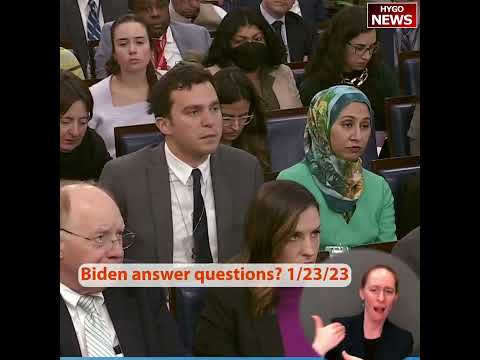
Reporter: Will Biden Address Investigation “More Fully”? KJP: He’ll “Continue to Take Questions From All of You”
In January 2023, a reporter asked White House Press Secretary Karine Jean-Pierre whether President Biden would address the classified documents investigation “more fulsomely” with a detailed comment. “I know the presidents have answered a few questions here and there, but is there any plans for the president to come out and sort of address this investigation in a more fulsome way, give more of a detailed comment? I know you’re referring us to the council’s office, but I’m wondering if we will hear more fully from the president himself on this matter,” the reporter asked. KJP’s response was nothing concrete: “Look, as you just stated in your question to me, the president has addressed this, spoken about this a couple of times, and I don’t have anything to announce right now, but he’s going to continue, again, to take questions from all of you, as he has done these past several months, these two years.” The response confirmed no plans for sustained Biden engagement beyond occasional shouted questions.
The Reporter’s Reasonable Request
The request was reasonable:
More fulsome address — Sought.
Detailed comment — Requested.
Presidential engagement — Expected.
Beyond deflections — Desired.
Natural expectation — For accountability.
Presidential substantial engagement with major scandals was normal expectation. The Biden administration’s approach of brief comments had been notable. Direct request for more engagement was legitimate.
The “Few Questions Here and There”
The reporter characterized Biden’s engagement. “I know the presidents have answered a few questions here and there,” the reporter said.
The characterization:
Limited engagement — Acknowledged.
“Few questions” — Descriptor.
“Here and there” — Sporadic.
Inadequate framing — Implicit.
Current pattern — Described.
The reporter was accurately describing Biden’s engagement as limited. Occasional shouted questions weren’t substantive address of the issue. This gentle characterization was preparing the push for more.
”More Fulsome Way”
The specific request. “Is there any plans for the president to come out and sort of address this investigation in a more fulsome way,” the reporter asked.
The request:
“Come out” — Active engagement.
“Address investigation” — Direct topic.
“Fulsome way” — Extensive.
Formal statement — Suggested.
Public accountability — Expected.
A “fulsome” address would be extended statement or press conference about the situation. This kind of engagement was normal presidential response to major scandals. Biden hadn’t done this.
”Detailed Comment”
More specific request. “Give more of a detailed comment?” the reporter asked.
The specification:
Detail sought — On topic.
Beyond slogans — Requested.
Substance — Expected.
Public explanation — Desired.
Accountability expectations — Set.
“Detailed comment” was specifying what would be adequate. Not just brief acknowledgment, but substantive engagement with the issues. This was clear journalistic request for what should be forthcoming.
The Council Referral Acknowledgment
The reporter acknowledged KJP’s deflection pattern. “I know you’re referring us to the council’s office,” the reporter said.
The acknowledgment:
Pattern recognized — Explicitly.
Previous deflections — Noted.
Reporter adaptation — To pattern.
Specific question — Beyond Counsel.
About Biden personally — Not Counsel.
By acknowledging Counsel referral pattern and specifying that this question was about Biden himself, the reporter was trying to work around the usual deflection. Biden’s own public engagement wasn’t Counsel’s to determine.
”Wondering If We Will Hear More Fully From the President”
The core question. “I’m wondering if we will hear more fully from the president himself on this matter,” the reporter asked.
The question:
From Biden himself — Specific.
More fully — Scope.
On this matter — Topic.
Future engagement — Timeline.
Administration planning — Examined.
This was precise question about Biden’s future engagement plans. It couldn’t be deflected to Counsel — it was about Biden’s own schedule and communication plans.
”You Just Stated in Your Question”
KJP acknowledged the question context. “Look, as you just stated in your question to me, the president has addressed this, spoken about this a couple of times,” KJP said.
The acknowledgment:
Question restated — By KJP.
Biden’s prior engagement — Cited.
“A couple of times” — Limited characterization.
Current engagement level — Accepted.
No expansion — Indicated.
By referencing Biden’s prior “few times” of engagement, KJP was suggesting this level was adequate. The reporter’s implicit critique that it wasn’t adequate was being ignored.
”I Don’t Have Anything to Announce Right Now”
KJP disclosed absence of plans. “And I don’t have anything to announce right now,” KJP said.
The disclosure:
No plans — For fulsome address.
“Right now” — Current status.
Future possibility — Open.
Expectation not managed — For more.
Silence ahead — Likely.
This was effectively admission that Biden wasn’t planning major address of the investigation. The “right now” hedge kept possibilities open but immediate future was silence.
”He’s Going to Continue to Take Questions”
KJP’s offered alternative. “But he’s going to continue, again, to take questions from all of you, as he has done these past several months, these two years,” KJP said.
The alternative:
Question taking — As engagement.
Continuing pattern — Maintained.
“Several months” — Period.
“Two years” — Broader context.
Shouted questions — Mainly.
This was the administration’s theory of engagement — that Biden answering occasional shouted questions constituted adequate public engagement. But shouted questions weren’t substitute for fulsome address.
The Shouted Questions Reality
Shouted questions in practice:
Brief — Typically.
Interruption of other events — Normally.
Limited substantive responses — From Biden.
Often dismissive — Answers.
Not systematic — Coverage.
Biden’s shouted question interactions weren’t substantive engagement with classified documents. They were brief exchanges during other activities. Counting them as engagement was stretching the concept.
The Press Conference Absence
What was missing:
Formal press conferences — Rare.
Specific topic engagement — Limited.
Extended Q&A — Uncommon.
Sit-down interviews — Few.
Substantive addresses — Minimal.
Biden had held fewer press conferences than predecessors. On classified documents specifically, he had held none. This was substantial absence in normal presidential communication.
The Speech Comparison
Comparison with other scandals:
Watergate — Nixon gave speeches.
Iran-Contra — Reagan addressed.
Lewinsky — Clinton addressed.
Russia — Trump addressed.
Classified docs — Biden minimal.
Previous presidents facing major scandals had given substantial speeches or addresses. The Biden approach of minimal engagement was unusual. Whether this approach would work politically was untested.
The 2024 Campaign Implications
For 2024:
Campaign messaging — Will require engagement.
Silence unsustainable — Long-term.
Voter expectations — For transparency.
Opposition advantage — From silence.
Eventual address — Needed.
At some point, Biden would have to address the classified documents situation in his campaign. The question was whether earlier proactive engagement would have been more effective than forced later response.
The Messaging Strategy
The messaging strategy was:
Minimize Biden exposure — On topic.
Maximize deflection — Through spokespeople.
Wait for investigation — To conclude.
Manage through — Daily briefings.
Eventual conclusion — As resolution.
This was coherent strategy but with limits. Voters would notice limited presidential engagement. Campaign dynamics would require adjustment. Eventual address would be needed.
The Biden Comfort Factor
Possible factors in Biden’s limited engagement:
Verbal risk — Of unscripted comments.
Age concerns — About sustained focus.
Legal sensitivity — Of statements.
Political calculation — About exposure.
Personal preference — For limited engagement.
Biden’s team had multiple reasons for limiting his engagement. Each was defensible individually. Together they produced pattern that was politically problematic.
The Comparison Again
The Trump parallel:
Trump engagement — Extensive.
Trump attacks — Many.
Trump version — Visible.
Biden engagement — Limited.
Biden version — Scarce.
Trump had been extensively public about his document situation, often making things worse politically but establishing his version widely. Biden’s minimal engagement left his version less established. Each approach had costs.
The Accountability Gap
The accountability gap:
Major scandal — Classified documents.
Limited presidential address — Unusual.
Spokesperson deflection — Primary.
Public information — Limited.
Normal expectations — Not met.
The normal accountability mechanism of presidential address on major issues wasn’t operating. This was accountability gap that democratic norms usually filled. The administration was not filling it.
The Media Role
Media’s role in accountability:
Pressure for engagement — Consistent.
Criticism of absence — Notable.
Coverage of pattern — Extensive.
Narrative building — Around silence.
Democratic function — Testing limits.
Media was pushing for more engagement but couldn’t force it. The pressure created its own coverage — stories about Biden’s absence rather than his engagement. This was itself political problem.
The Normative Standards
Normative standards suggested:
Presidential accountability — Through communication.
Transparency — With public.
Engagement with media — Regularly.
Direct statements — On major issues.
Democratic responsibility — To voters.
The normative case for more Biden engagement was strong. Democratic norms around presidential accountability typically included substantial communication. Current pattern was below normal standards.
The Defensive Posture
The administration was playing defense:
Responsive not proactive — Mode.
Minimizing exposure — Strategy.
Reactive rather than leading — Communication.
Let events — Dictate timing.
Avoid creating — New material.
This defensive posture had logic but costs. Leaders are expected to lead on crises. Waiting for events to force engagement ceded narrative control.
The 2024 Pivot
Eventually pivot to 2024 would require:
Campaign announcement — At some point.
Public engagement — Extensive.
Address of issues — Including documents.
Voter contact — Multi-modal.
Engagement ramp — From current baseline.
The current limited engagement was unsustainable for campaign. Major pivot would be needed. Whether the administration was prepared for this pivot was unclear.
Key Takeaways
- A reporter asked KJP if Biden would address the classified documents investigation “more fulsomely” with “detailed comment.”
- The reporter acknowledged the Counsel referral pattern and asked specifically about Biden himself.
- KJP confirmed no plans: “I don’t have anything to announce right now.”
- She offered alternative framing: “He’s going to continue, again, to take questions from all of you, as he has done these past several months, these two years.”
- The response characterized occasional shouted questions as adequate engagement — not substitute for fulsome address.
- The pattern of minimal presidential engagement with a major scandal was unusual compared to historical presidential responses to similar situations.
Transcript Highlights
The following is transcribed from the video audio (unverified — AI-generated from audio).
- I know the presidents have answered a few questions here and there, but is there any plans for the president to come out and sort of address this investigation in a more fulsome way, give more of a detailed comment?
- I know you’re referring us to the council’s office, but I’m wondering if we will hear more fully from the president himself on this matter.
- Look, as you just stated in your question to me, the president has addressed this, spoken about this a couple of times.
- I don’t have anything to announce right now.
- But he’s going to continue, again, to take questions from all of you.
- As he has done these past several months, these two years.
Full transcript: 120 words transcribed via Whisper AI.