 HYGO News
 Q: Any message for Newsom? Mel Gibson: Spend less on hair gel; Newsom invited Trump to visit
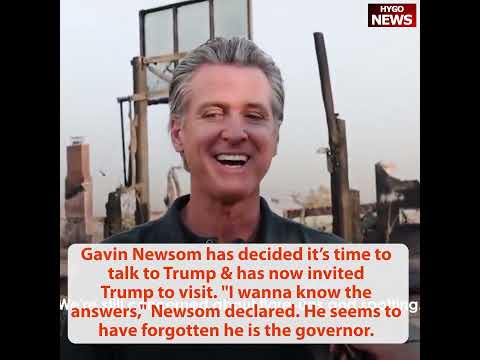
Q: Any message for Newsom? Mel Gibson: Spend less on hair gel; Newsom invited Trump to visit
As the Los Angeles wildfires devastated Southern California in January 2025, two very different figures offered their perspectives on the crisis. Actor Mel Gibson, when asked if he had a message for Governor Newsom, delivered a cutting one-liner: “Spend less on hair gel.” Meanwhile, Governor Newsom himself invited President-elect Trump to visit the fire-ravaged areas, calling for collaboration while simultaneously distancing himself from the local officials whose decisions had contributed to the disaster.
Mel Gibson’s Blunt Message
When a reporter asked Mel Gibson if he had any message for Governor Newsom or Mayor Karen Bass, the actor’s response was immediate and withering. “Spend less on hair gel,” Gibson said, pausing before adding, “That’s it. Yeah. What can I say to them? Not a big admirer of either, but there you go.”
The quip captured the contempt that many Los Angeles residents — including Gibson, whose Malibu-area property was in the fire zone — felt toward the officials they held responsible for the inadequate emergency response. The “hair gel” crack was a pointed reference to Newsom’s polished public image, juxtaposing the governor’s attention to his appearance with the devastation his constituents were experiencing.
When pressed further, Gibson offered a more substantive instruction: “Do the right thing. This is an emergency.” The contrast between the biting humor and the simple, direct call to action encapsulated the frustration of fire victims who felt their leaders had failed them.
Gibson had been among the celebrities affected by the wildfires, and his willingness to publicly criticize Newsom and Bass broke from the typically cautious approach Hollywood figures take toward California’s Democratic leadership. The clip went viral, with the “hair gel” comment becoming one of the most-shared moments of the wildfire coverage.
Newsom Invites Trump to Visit
In a remarkable political pivot, Newsom used a press appearance to invite President-elect Trump to visit the wildfire-ravaged areas. The governor, who had spent much of his political career as a vocal Trump critic, framed the invitation as an effort to move beyond politics and focus on recovery.
“We do all this dance and we have differences of opinion as it relates to all kinds of issues and values, and that’s fair game,” Newsom said. “That dialectic is important. But having this kind of friction when it comes to emergency response with emergency responders, these heroes, 12,000 that are on the front lines right now, taking care of people, making sure people are still alive — we’re still doing emergency maintenance and evacuation.”
Newsom painted a picture of the human toll. “We got kids right now that don’t have money for baby formula and we’re trying to get them the disaster assistance,” he said. “You have folks in hotel rooms that have money only for tonight and don’t know what’s going to happen, have any chance to see their homes here or standing, or it’s here and it’s not standing.”
The governor then explicitly extended the olive branch to Trump. “That’s why I was with the FEMA director today. That’s what the President of the United States and I are talking about, and I’d like to have that conversation with the next President of the United States,” Newsom said. “Let’s turn the page as it relates to the incoming President.”
Newsom’s Call for Collaboration — and Blame-Shifting
Newsom framed his invitation in lofty terms. “I’d like him to have the spirit of the current President and have the backs of people so we can recover,” he said of Trump. “I want him to visit and understand the magnitude of the scope and what happened to the American people that happened to reside here in California.”
The governor then struck a pious note about politicization. “I’m not interested in politicizing an event like this,” Newsom declared. “I don’t like the banality of it. I don’t like the inhumanity of that. I would like people to focus on a collaboration between the executive in Washington, D.C. and in the state of California to help rebuild a community that’s been completely ravaged.”
Critics immediately noted the irony. Newsom’s call to avoid politicization came after he had spent days labeling criticism of his wildfire response as “misinformation” and “disinformation,” a characterization that was itself a form of political deflection. His pivot to inviting Trump — the very politician whose criticism he had been deflecting — was interpreted as an acknowledgment that the political dynamics had shifted against him and that cooperation with the incoming administration was his best path to recovery, both for the state and for his own political prospects.
The invitation also served another purpose: by positioning himself as the one reaching across the aisle, Newsom could reframe the narrative from one of government failure to one of bipartisan cooperation. If Trump accepted the invitation, Newsom could claim credit for bridging the divide. If Trump declined or attached conditions, Newsom could portray him as the one playing politics.
The Broader Accountability Question
The juxtaposition of Gibson’s blunt criticism and Newsom’s diplomatic overture highlighted the diverging narratives of the wildfire crisis. On one side were the residents and victims who blamed the governor and mayor directly for infrastructure failures, budget cuts, and misplaced environmental priorities. On the other was the political establishment, represented by Newsom, which was attempting to reframe the crisis as a natural disaster that transcended political responsibility.
Newsom’s description of the situation on the ground was accurate in its details — people did need baby formula, families were running out of hotel money, 12,000 first responders were working the front lines, and the scope of the devastation was staggering. But his insistence on collaboration and turning the page coexisted uncomfortably with the fact that his administration’s policies had contributed to the conditions that allowed the fires to become so destructive.
The governor’s record on forest management, water infrastructure, and fire department funding all came under scrutiny during the crisis. His celebrated dam removal project, his environmental policies that critics argued weakened fire preparedness, and his administration’s failure to maintain water systems in high-risk fire areas were all part of the context that Newsom was asking the public to set aside in favor of unity.
Key Takeaways
- Mel Gibson, when asked for a message to Newsom, said “Spend less on hair gel,” adding he was “not a big admirer of either” Newsom or Bass.
- Newsom invited Trump to visit the wildfire-ravaged areas, calling for collaboration and saying he wanted the incoming president to “have the backs of people so we can recover.”
- Newsom described the human toll of the crisis, including families who could only afford one night in a hotel and parents who could not buy baby formula.
- The governor declared “I’m not interested in politicizing an event like this” after having spent days labeling criticism of his response as “misinformation.”
- Critics interpreted Newsom’s invitation as a strategic pivot after recognizing that political opposition to Trump during a crisis was a losing strategy.
Transcript Highlights
The following is transcribed from the video audio:
- Mel, any message from you to Governor Newsom or Karen Bass tonight? Spend less on hair gel. That’s it.
- Not a big admirer of either, but there you go. Do the right thing. This is an emergency.
- Having this kind of friction when it comes to emergency response with emergency responders, these heroes, 12,000 that are on the front lines right now.
- We got kids right now that don’t have money for baby formula and we’re trying to get them the disaster assistance.
- Let’s turn the page as it relates to the incoming President. I’d like him to have the spirit of the current President.
- I’m not interested in politicizing an event like this. I don’t like the banality of it. I don’t like the inhumanity of that.
Full transcript: 349 words transcribed via Whisper AI.