 HYGO News
 Q: any concerns sending wrong message on human rights? A: certainly refer you to State Dept
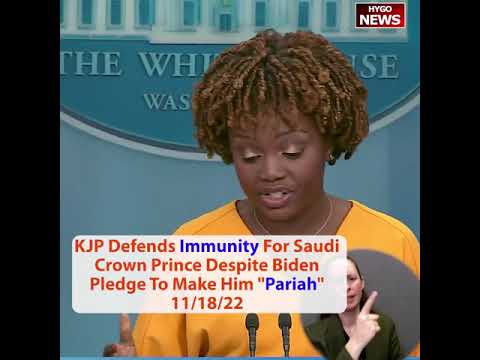
Reporter Asks if Granting MBS Immunity Sends “Wrong Message” on Human Rights and Whether Biden Signed Off — KJP: “Refer You to State Department”
On 11/21/2022, a reporter asked White House Press Secretary Karine Jean-Pierre whether the Biden administration had concerns that granting Mohammed bin Salman sovereign immunity “may be sending the wrong message about his commitment to holding the Saudis accountable on human rights.” The reporter also asked a pointed accountability question: “Can you say whether he signed off on that?” KJP’s response avoided both parts of the question. She recited the procedural facts of the immunity filing, emphasized that the decision “has nothing to do with the merits of this case,” and referred the reporter to the State Department and Department of Justice for “more details.” She never addressed whether Biden had signed off on the decision or whether the White House believed the immunity filing sent the wrong message on human rights.
The Two-Part Question
The reporter’s question was structured to test both substance and accountability. The substance question was about the message: did granting MBS immunity undermine the administration’s claimed commitment to human rights? The accountability question was about the decision: did Biden personally approve the immunity filing?
Both questions deserved answers. The substance question was about the administration’s stated values — Biden had campaigned on holding autocrats accountable, had called Saudi Arabia a “pariah” over the Khashoggi murder, and had claimed human rights were central to his foreign policy. The immunity filing appeared to contradict these stated values, and the reporter was asking whether the administration acknowledged the contradiction.
The accountability question was equally important. If Biden had signed off on the immunity filing, he was personally responsible for the decision and the contradiction it represented. If he hadn’t signed off, the decision had been made at a lower level, which would raise questions about White House oversight of significant diplomatic decisions.
The Procedural Recitation
KJP responded with a recitation of the legal procedure. “So just let me just say at the top, at the request of a federal district court for U.S. government views on whether Mohammed bin Salman enjoys head of state immunity, the Department of Justice at the request of the Department of State informed the court that Prime Minister bin Salman is immune from suit in the U.S. courts while he holds the office of Prime Minister,” KJP said.
The recitation was accurate but contained a critical detail. MBS had been “elevated” to the position of Prime Minister shortly before the immunity question was decided — a move widely interpreted as a specific effort to qualify him for head-of-state immunity. As Crown Prince, MBS might not have had clear immunity claims. As Prime Minister, he arguably did.
The timing of MBS’s appointment as Prime Minister — coincidentally just before the immunity question was decided — suggested the designation was made specifically to facilitate the U.S. immunity finding. The Biden administration was then providing the immunity determination based on this newly-created office.
KJP didn’t address the timing or the apparent coordination between the Saudi elevation and the U.S. immunity determination. She simply recited that Prime Minister bin Salman was immune — treating the procedural outcome as if it had been neutral legal analysis rather than a coordinated diplomatic arrangement.
”At the Request of the Department of State”
The phrasing “at the request of the Department of State” was revealing. KJP was identifying the Department of State as the entity that had asked the Department of Justice to inform the court about MBS’s immunity. This framing placed responsibility with State rather than with the White House.
But this framing obscured how the decision actually worked. The State Department doesn’t make independent foreign policy decisions on questions of this magnitude. A decision to grant a foreign leader immunity from a civil suit over a murder involving an American permanent resident would typically involve consultation at the highest levels of government — including the White House.
By attributing the decision to State’s “request,” KJP was implying that the decision had been made at a sub-cabinet level without White House involvement. This implication was politically convenient — it insulated Biden from personal responsibility — but it strained credibility. Major foreign policy decisions don’t happen without White House input.
”Nothing to Do With the Merits”
KJP’s next sentence was her substantive defense. “It’s nothing to do with the merits of this case. I want to be very clear on this,” KJP said.
The “nothing to do with the merits” framing was a common legal formulation. It was technically true — sovereign immunity determinations are legal questions about whether a court has jurisdiction, not about whether the underlying accusations are true. The immunity finding didn’t resolve whether MBS had ordered Khashoggi’s murder; it only resolved whether he could be sued in U.S. courts for it.
But the “nothing to do with the merits” defense missed the point of the reporter’s question. The question wasn’t whether the immunity finding technically addressed the merits. The question was whether granting immunity sent the wrong message about human rights. These were different questions, and KJP’s answer to the first didn’t address the second.
A functional press secretary response would have acknowledged the legal distinction while also addressing the policy question: does the administration believe that protecting MBS from civil accountability for murder is consistent with its human rights commitments? KJP’s response dodged this question entirely.
”Refer You to the State Department”
KJP’s conclusion returned to the deferral pattern. “But this is something that the State Department and the Department of Justice has more details on, so I would certainly refer you to them,” KJP said.
The deferral was problematic for several reasons:
First, the reporter had asked whether Biden had signed off on the decision. This was a question about the president, not about the State Department. Referring it to State made no sense — the State Department couldn’t address what Biden had or hadn’t personally approved.
Second, the deferral meant no one at the White House was willing to take responsibility for the decision. The State Department would presumably refer questions back to the White House for political issues, and the Department of Justice would refer them to State for foreign policy issues. The round of deferrals ensured that no single official was accountable for the decision.
Third, the deferral suggested that KJP didn’t have the information needed to answer. But on a major foreign policy question that had been public for days, the press secretary should have had briefing materials prepared to address it. The lack of preparation implied either that the White House considered the question not worth briefing on, or that deferral was the planned response regardless of how the question was asked.
The Unanswered Sign-Off Question
The reporter’s specific question about whether Biden signed off went completely unanswered. KJP didn’t confirm that Biden had approved the decision. She didn’t deny that Biden had approved the decision. She didn’t claim that Biden was unaware of the decision. She simply moved on to procedural details without addressing the accountability question.
This non-answer was strategically useful. If KJP had said Biden signed off, he would bear personal responsibility for the decision. If she had said Biden hadn’t signed off, reporters would follow up asking why a major foreign policy decision was made without presidential involvement. Both answers carried risks.
By refusing to answer at all, KJP maintained ambiguity about Biden’s role. The administration could later shape the narrative based on political needs — characterizing Biden as involved when that was useful, and as uninvolved when that was useful. The non-answer preserved flexibility.
Key Takeaways
- A reporter asked KJP if granting MBS immunity sent the “wrong message” on human rights and whether Biden signed off on the decision.
- KJP didn’t address either question substantively, instead reciting procedural facts about the immunity filing.
- She attributed the decision to “at the request of the Department of State” — implying the decision was made at sub-cabinet level without White House involvement.
- She emphasized that the immunity finding had “nothing to do with the merits” — a technical legal point that didn’t address the policy question.
- The question about whether Biden personally signed off went completely unanswered.
Transcript Highlights
The following is transcribed from the video audio (unverified — AI-generated from audio).
- Does the president have any concerns that the administration may be sending the wrong message about his commitment to holding the Saudis accountable on human rights?
- Can you say whether he signed off on that?
- At the request of a federal district court for U.S. government views on whether Mohammed bin Salman enjoys head of state immunity.
- Prime Minister bin Salman is immune from suit in the U.S. courts while he holds the office of Prime Minister.
- It’s nothing to do with the merits of this case. I want to be very clear on this.
- This is something that the State Department and the Department of Justice has more details on, so I would certainly refer you to them.
Full transcript: 146 words transcribed via Whisper AI.