 HYGO News
 Q: another blatant attempt to hide Biden's culpability A: this admin consistently provided updates
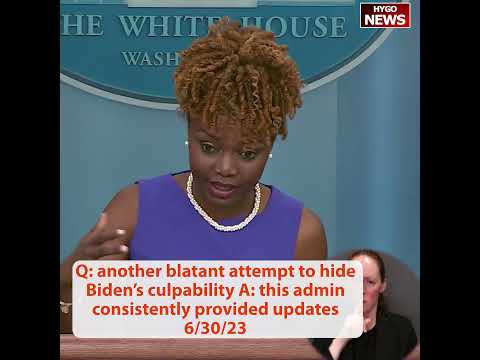
Republican Chairman Accuses Biden of Hiding Afghanistan Culpability — KJP Says Admin “Consistently Provided Updates”
On June 30, 2023, a reporter read White House Press Secretary Karine Jean-Pierre a statement from House Foreign Affairs Chairman Michael McCaul accusing the Biden administration of a “blatant attempt to hide” its culpability in the Afghanistan withdrawal by releasing only 24 of 87 pages of the State Department’s after-action report. Jean-Pierre claimed she had not seen the statement, deferred to the State Department, and insisted that the administration had “consistently provided updates” on the withdrawal. The exchange highlighted the tension between Republican allegations that the administration was engaged in a cover-up and the White House’s claim of transparency — a claim undercut by the fact that nearly three-quarters of the report had been withheld.
McCaul’s Accusation
The reporter presented the accusation directly: “House Foreign Affairs Chairman Michael McCaul released a statement a couple of minutes ago criticizing the administration for only releasing 24 of the 87 pages of the Afghanistan after-action report, and saying, ‘This is another blatant attempt to hide the Biden administration’s culpability in the chaotic and deadly evacuation from Afghanistan.’ Do you have a response to that?”
McCaul’s statement was significant for several reasons. As chairman of the House Foreign Affairs Committee, he was the senior Republican overseeing U.S. foreign policy in the House of Representatives. His accusation was not merely a political attack but a formal assertion by the committee with jurisdiction over the matter that the administration was deliberately suppressing information about one of the most consequential military operations in recent history.
The specific detail that drove the accusation — 24 of 87 pages released — was damning on its own terms. When an administration produces an 87-page review of a catastrophic event and then releases less than 28 percent of it, the burden falls on that administration to explain what is in the withheld pages and why the public cannot see them. McCaul’s use of the phrase “another blatant attempt” suggested this was part of a pattern, not an isolated decision.
Jean-Pierre’s Deflection Strategy
Jean-Pierre’s response deployed three distinct deflection techniques in rapid succession. First, she claimed she had not seen the statement: “I have not seen his statement, since you just said it happened a couple of minutes ago. So I want to be mindful. I don’t like to respond to things I haven’t seen.”
This was a familiar tactic in White House briefings. By stating she had not read McCaul’s statement, Jean-Pierre created grounds to avoid addressing its specific content. However, the reporter had just read the statement’s key passage aloud, so Jean-Pierre had heard the substance of the accusation even if she had not read the written document. The claim of not having “seen” it was technically accurate but functionally irrelevant — she knew what McCaul was alleging.
Second, she deferred to the State Department: “But first, I would say I would refer you to the State Department.” This echoed her earlier deflection on the report’s findings about senior officials being to blame for the chaotic exit. By consistently directing reporters to the State Department rather than addressing the questions at the White House level, Jean-Pierre treated the review as though it belonged to a separate organization rather than being a product of the Biden administration.
Third, she pivoted to a claim of transparency: “This administration has consistently provided updates, information on the withdrawal from Afghanistan. We have provided that information. Anytime that we have been asked, we have done so.”
The Transparency Claim vs. Reality
Jean-Pierre’s assertion that the administration had “consistently provided updates” and responded to every request for information was directly at odds with the central fact driving McCaul’s accusation: the administration had released less than a third of its own report.
If the administration had been committed to transparency, the natural course would have been to release the full 87-page document. Instead, 63 pages were withheld, and the timing of the release — Friday afternoon before a holiday weekend — was the classic Washington maneuver for burying unfavorable news. The combination of withholding most of the report and releasing the remainder at a time designed to minimize media coverage contradicted Jean-Pierre’s claim of consistent transparency.
Moreover, the administration’s track record on Afghanistan information had been the subject of sustained criticism from Republicans and media organizations. Congressional committees had repeatedly sought documents and testimony related to the withdrawal, and the administration had not always been forthcoming. McCaul’s characterization of the partial release as “another” attempt to hide information reflected a history of disputes over access to Afghanistan-related records.
The Report’s Context
The State Department’s after-action review was the most comprehensive internal assessment of the August 2021 withdrawal from Afghanistan. The review found that the State Department had failed to do enough planning before the collapse of the U.S.-backed Afghan government and repeatedly blamed the administrations of both Trump and Biden for their handling of events before and after the departure of U.S. forces from Kabul.
The withdrawal had been one of the most criticized operations in modern American military history. The rapid collapse of the Afghan government in August 2021 led to desperate scenes at Hamid Karzai International Airport, where thousands of Afghans attempted to flee Taliban rule. The U.S. evacuated an estimated 124,000 Afghans, but the process was chaotic and deadly. On August 26, 2021, a suicide bombing at Abbey Gate killed 13 U.S. service members and an estimated 170 Afghan civilians.
The review’s findings that senior administration officials were directly responsible for specific failures — including the inability to determine which Afghans were eligible for evacuation and the issuance of constantly changing guidance — made the decision to withhold most of the document all the more suspicious. If the released pages contained such damaging findings, the question of what was in the withheld pages became even more pressing.
Biden’s Defiance on the Same Day
The exchange about McCaul’s statement came in the context of a briefing dominated by the administration’s refusal to accept responsibility for Afghanistan. Earlier the same day, Biden had been asked directly whether he admitted failure in Afghanistan. His response was defiant: “Remember what I said about Afghanistan? I said Al-Qaeda would not be there. I said it wouldn’t be there. I said we’d get help from the Taliban. What’s happening now? What’s going on? Read your press. I was right.”
Biden’s defiance, Jean-Pierre’s deflections throughout the briefing, and the decision to release only a fraction of the review on a Friday before a holiday all pointed in the same direction: the administration was not interested in accountability for the Afghanistan withdrawal and was actively managing the information environment to minimize the political damage from the State Department’s own findings.
Republicans had accused Biden of not taking responsibility for intelligence failures and for the chaotic execution of the withdrawal. The partial release of the report, combined with the White House’s refusal to engage with its findings during the briefing, provided fresh ammunition for those accusations.
Key Takeaways
- House Foreign Affairs Chairman McCaul accused the Biden administration of a “blatant attempt to hide” its culpability by releasing only 24 of 87 pages of the Afghanistan after-action report.
- Jean-Pierre claimed she had not seen McCaul’s statement, deferred to the State Department, and asserted that the administration had “consistently provided updates” on Afghanistan.
- The transparency claim was undercut by the decision to withhold nearly three-quarters of the report and release the remainder on a Friday afternoon before a holiday weekend.
- The exchange was part of a briefing in which the White House refused to accept responsibility for any aspect of the Afghanistan withdrawal.
- The State Department review found planning failures and blamed senior administration officials for the chaotic evacuation that killed 13 U.S. service members.