 HYGO News
 Q: Already surging last Sept, sustain another new surge? A: additional funding blame GOP
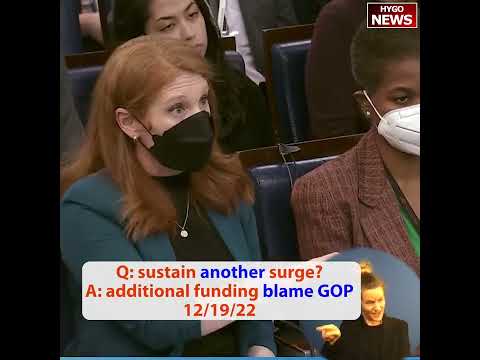
Reporter Traps KJP: You Were Already “Surging Resources” In September — Is the Current Surge On Top of the Previous Surge? How Long Can This Be Sustained?
On 12/19/2022, a reporter caught White House Press Secretary Karine Jean-Pierre with a clever question that exposed the pattern of administration messaging about “surging resources.” “You mentioned surging resources. I had asked you in September specifically about El Paso, and you had said at the time that DHS, the administration was surging resources to the region, working to quickly decompress the area,” the reporter said. “Has that surge of resources been maintained for the last several months? Is that sustainable?… If you’re talking about another surge of resources, is that on top of what had already been done in September? And how long can you keep doing a surge like that?” KJP didn’t answer the sustainability question. She pivoted to the $3.5 billion funding request, again blaming Republicans: “If Republicans in Congress are serious, if they want to help…”
The “Surging Resources” Pattern
The reporter identified a specific administration pattern. The administration had been claiming “surging resources” to the border for months. The reporter was testing whether this meant:
One continuous surge — Sustained since earlier in year.
Multiple distinct surges — Each “new.”
Rhetorical framing — Without operational substance.
Variable deployment — Depending on circumstances.
Undefined scale — Without quantification.
The term “surge” implied:
Increased from baseline — Above normal operations.
Temporary — By definition, surges end.
Intensive — Concentrated effort.
Specific purpose — Defined operational goals.
Measurable — In terms of resources or outcomes.
But administration use of “surging resources” had been vague on all these dimensions.
The September Context
The reporter recalled specific September statements. “I had asked you in September specifically about El Paso, and you had said at the time that DHS, the administration was surging resources to the region, working to quickly decompress the area,” the reporter said.
The September exchange was specific:
Topic — El Paso specifically.
Context — Border pressure at that time.
Administration claim — Surging resources to region.
Goal — “Quickly decompress the area.”
Time frame — September 2022.
Three months later in December 2022, El Paso was declaring a state of emergency. The September “surge” to quickly decompress El Paso clearly hadn’t worked as promised. El Paso’s situation had deteriorated rather than being decompressed.
The Reporter’s Logical Trap
The reporter’s question created a logical trap:
If September surge continued — Why was El Paso worse now?
If September surge ended — Was December surge reaction to failure?
If both happened — Were these actually discrete surges?
If just rhetoric — Was the administration really providing surges at all?
Each possible interpretation was politically difficult:
Continued but ineffective — Administration approach failing.
Ended and needed new one — Administration couldn’t sustain.
Discrete separate surges — Constant crisis.
Rhetorical without substance — Messaging over action.
The reporter wasn’t asking a random question. This was sophisticated journalism that exposed the administration’s vague messaging by testing whether the claims formed a coherent narrative over time.
”Has That Surge Been Maintained?”
The specific question asked about continuity. “Has that surge of resources been maintained for the last several months? Is that sustainable?” the reporter asked.
“Maintained” and “sustainable” were key words:
Maintained — Was the September surge still in effect?
For several months — Requiring sustained deployment.
Sustainable — Could this level of effort continue?
These questions required specific answers:
Yes, maintained — Then why was El Paso worse?
No, not maintained — Then surge was temporary as expected.
Not sure — Suggesting administration didn’t track its own operations.
Depends on definition — Revealing rhetorical fuzziness.
Any honest answer would have been problematic. Maintaining a surge for months stretched definitions. But admitting the surge wasn’t maintained would undermine administration messaging.
”Another Surge of Resources”
The reporter asked about the current claim. “Now if you’re talking about another surge of resources, you know, is that on top of what had already been done in September?” the reporter asked.
The question exposed the sequence:
September — Surge claimed.
Continuing months — Unclear if surge continued.
December — New surge being claimed.
Current situation — Worse than September.
Administration messaging — About new surge.
If the December surge was on top of the September one, administration was promising extraordinary sustained effort. If the December surge was separate, the September surge had apparently ended without solving the problem. Neither interpretation served administration messaging well.
”How Long Can You Keep Doing a Surge?”
The sustainability question was fundamental. “How long can you keep doing a surge like that?” the reporter asked.
Surges by definition are temporary:
Not permanent — Can’t sustain indefinitely.
Resource-intensive — Deplete normal capabilities.
Crisis-focused — For specific emergencies.
Transitional — Should lead to sustainable solutions.
Political signaling — As much as operational.
The fundamental question was whether the administration had a sustainable approach or was relying on indefinite “surges” that weren’t really surges at all. If what was called a “surge” continued for months, it wasn’t actually a surge — it was operational reality being renamed for political purposes.
The Funding Pivot
KJP pivoted to the $3.5 billion. “I mean, that’s one of the reasons we’re asking for additional funding, that $3.5 billion,” KJP said.
The pivot served specific purposes:
Changed subject — From sustainability to funding.
Implied current inadequacy — Need more resources.
Blamed Congress — For not providing.
Made future promises — About what funding would enable.
Avoided direct question — About current status.
But the pivot didn’t actually answer whether the September surge had been maintained. Asking for more funding didn’t speak to whether current resources had been sustained or were adequate.
The Same Talking Points
KJP used familiar talking points. “That’s scale up air and ground transportation capabilities to move migrants from processing to less crowded border patrol sectors, set up additional CBP funding, holding facilities, pardon me, and speed up the processing time so individuals can have their asylum claims heard faster,” KJP said.
These were the same specific elements KJP had described in other briefings:
Transportation scaling — Moving migrants.
CBP facilities — Additional holding.
Asylum processing — Speeding up.
Same talking points repeated suggested:
Limited operational flexibility — In administration messaging.
Fixed framework — Of talking points.
Prepared responses — To questions.
Script-based messaging — Rather than substantive engagement.
Repetition assumption — That audiences would forget previous briefings.
The reporter’s question had been about sustainability and continuity. KJP’s response was the same list of future improvements. The mismatch between question and answer was stark.
The “Pardon Me”
KJP’s “pardon me” in the middle of her response was notable. “Set up additional CBP funding, holding facilities, pardon me,” KJP said.
The “pardon me” suggested she had misspoken — likely saying “CBP funding” when she meant “CBP holding facilities.” The correction was:
Real-time error — Not prepared script issue.
Self-correction — Catching her own mistake.
Verbal difficulty — Under briefing pressure.
Confused terminology — Between funding and facilities.
Composure loss — From difficult question.
Even the corrections in KJP’s delivery suggested she was struggling with the challenging question. Administration talking points couldn’t be smoothly delivered when confronted with the specific logical challenge the reporter had raised.
”If Republicans in Congress Are Serious”
KJP reverted to the familiar framing. “Again, if Republicans in Congress are serious, if they want to help…,” KJP said, trailing off.
The trailing off of the sentence — ending at “if they want to help…” — suggested:
Clip cutoff — Possible.
Thought interruption — By questioner or event.
Exhausted talking points — Having completed message.
Topic shift — Moving on to next reporter.
Mental trailing — Under pressure.
Whatever the cause, the incomplete sentence left the Republican critique without completion. The reporter’s sophisticated question hadn’t been answered, and even the familiar GOP blame framing had been truncated.
The Pattern Exposure
The reporter’s question exposed a pattern in administration messaging:
Monthly “surge” claims — Throughout 2022.
Each crisis met with “surge” — Without detailed accountability.
Previous surges unevaluated — Before new ones claimed.
Operational outcomes unclear — Despite claimed effort.
Political messaging dominant — Over operational transparency.
By asking about the continuity between September and December claims, the reporter was essentially auditing the administration’s pattern of “surge” claims. The audit showed that either:
Claims were connected but ineffective — Surges didn’t work.
Claims were discrete — Surges ended without solving problems.
Claims were rhetorical — Without consistent operational meaning.
Administration couldn’t explain — The relationship between claims.
KJP’s inability to address the question directly confirmed that administration messaging on “surges” was more about political framing than operational reality.
The Substantive Issues
Behind the rhetorical exchange were substantive issues:
Border capacity — Limited by facilities, personnel, processes.
Resource constraints — Federal agencies operating under pressure.
Operational sustainability — Long-term challenges.
Funding uncertainty — Year-to-year appropriations.
Policy uncertainty — Including Title 42 status.
These substantive issues couldn’t be resolved through “surges” alone. The administration needed systemic approaches, not rhetorical surges. But systemic approaches required either:
Policy changes — That were politically difficult.
Congressional action — That administration couldn’t guarantee.
Personnel expansion — Taking years to implement.
Facility construction — Requiring long lead times.
Regional cooperation — With foreign governments.
Each of these faced constraints. The administration’s resort to “surge” claims reflected the difficulty of addressing the substantive issues through available mechanisms.
The Accountability Gap
The exchange highlighted an accountability gap:
Administration claimed — Continuous effective action.
Evidence showed — Continuing challenges.
Reporters asked — How these squared.
Administration deflected — To future funding.
Questions remained — About current status.
Without accountability, administration claims couldn’t be evaluated against reality. Each briefing produced similar claims and similar deflections. The pattern continued because no mechanism forced resolution of the gap between claims and evidence.
Key Takeaways
- A reporter identified the pattern of “surging resources” claims the administration had made since at least September 2022.
- The reporter asked whether the September surge had been maintained, was sustainable, and whether the current “surge” was on top of the previous one.
- The question exposed logical problems: if the September surge had been maintained, why was El Paso worse now? If not maintained, why was the administration using “surge” framing repeatedly?
- KJP didn’t answer the sustainability question.
- She pivoted to the $3.5 billion funding request and the same list of specific elements (transportation, CBP facilities, asylum processing).
- KJP returned to the familiar “if Republicans are serious” framing, with her sentence trailing off.
- The exchange exposed the pattern of administration “surge” claims as more rhetorical than operational.
Transcript Highlights
The following is transcribed from the video audio (unverified — AI-generated from audio).
- You mentioned surging resources. I had asked you in September specifically about El Paso, and you had said at the time that DHS, the administration was surging resources to the region, working to quickly decompress the area.
- Has that surge of resources been maintained for the last several months? Is that sustainable?
- Now if you’re talking about another surge of resources, is that on top of what had already been done in September?
- And how long can you keep doing a surge like that?
- I mean, that’s one of the reasons we’re asking for additional funding, that $3.5 billion.
- Again, if Republicans in Congress are serious, if they want to help…
Full transcript: 175 words transcribed via Whisper AI.