 HYGO News
 Q: Admin hoping court GOP extend Title 42? A: GOP not helping
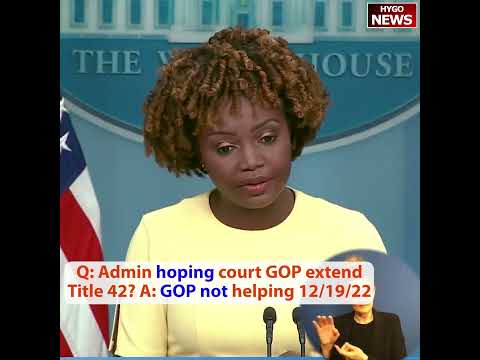
Reporter: Is Biden Admin Secretly Hoping Supreme Court Extends Title 42 to Save Them? KJP: “Not Going to Speculate” — Blames GOP
On 12/19/2022, a reporter asked a pointed question about whether the Biden administration was secretly hoping the Supreme Court would extend Title 42 — effectively rescuing the administration from a challenge it had publicly said it was ready for. “Republican-led states have asked the Supreme Court to intervene and not allow Title 42 to expire on Wednesday, as a different court has said. Is there any reaction to that? And is the administration in some way hoping that the court will intervene and extend Title 42 to help you all out of this situation that is brewing at the border?” the reporter asked. KJP refused to engage with the speculation: “I’m not going to get into any legal determinations or speculations, but we need Congress to give us the funds we’ve requested.” She then pivoted to GOP blame: “If Republican Congress are serious about protecting the border… they should be able to get involved here.”
The Pointed Question
The reporter’s question was unusually direct. Rather than asking about the administration’s public position, the reporter was asking about what the administration was actually thinking privately:
Public position — Administration was prepared for Title 42’s end.
Possible private hope — Court would extend Title 42.
Politically convenient rescue — Would avoid the anticipated surge.
Administration couldn’t say — Wanted Title 42 extended (would contradict public position).
But the reality — Extension might actually benefit the administration.
This was sophisticated political journalism. The reporter was probing whether administration public positions matched private interests. If the administration secretly hoped for court intervention, their public claims of readiness weren’t complete representations of their actual position.
The Republican-Led States Challenge
The reporter referenced specific legal action. “Republican-led states have asked the Supreme Court to intervene and not allow Title 42 to expire on Wednesday,” the reporter said.
The legal challenge had specific characteristics:
Multi-state effort — Various Republican-led states.
Supreme Court petition — Emergency intervention request.
Existing lower court ruling — Setting Title 42 to expire.
Title 42 legal status — Under challenge from multiple directions.
Political and legal dimensions — Both involved.
The challenge put the administration in an interesting position. The administration’s official position was that Title 42 should end (it had been pursuing this legally). But if Title 42 did end, the administration would face the border surge it had been publicly preparing for (but possibly not adequately).
Republican states seeking to maintain Title 42 offered a potential political escape. If Republicans successfully extended Title 42 through the courts, the administration could:
Claim legal defeat — Being unable to end Title 42.
Avoid border surge — Under continuing Title 42.
Maintain political position — Against Title 42.
Blame Republicans/courts — For continuation.
Buy more preparation time — For eventual end.
”Is the Administration Hoping?”
The reporter’s question captured the political calculation. “Is the administration in some way hoping that the court will intervene and extend Title 42 to help you all out of this situation that is brewing at the border?” the reporter asked.
The question had several important features:
“Hoping” — About private preferences.
“Help you all out” — Political rescue framing.
“Situation that is brewing” — Acknowledging pending crisis.
“At the border” — Specific location.
Speculative invitation — Asking about possible motivations.
The question essentially asked: “Are you secretly rooting for the Supreme Court to rescue you from your own policy position?” This was the kind of question administrations couldn’t answer honestly.
The Political Dilemma
The administration faced a genuine political dilemma on Title 42:
Public position — Title 42 should end (aligned with base).
Operational reality — End would create border crisis.
Political liability — Associated with border chaos.
Preparation inadequacy — Despite claims.
Legal constraints — On timing and substance.
The ideal outcome for the administration would have been:
Title 42 formally ends — Satisfying base and legal position.
But not immediately — Giving time for preparation.
Continued legal uncertainty — Providing cover.
Eventually implemented — When ready.
Without major crisis — Avoiding political damage.
Court intervention would serve many of these interests. Title 42 extension would delay the crisis while the administration continued claiming readiness.
”Not Going to Speculate”
KJP declined to engage with the political calculation. “So look, I’m not going to get into any legal determinations or speculations,” KJP said.
The “not going to speculate” deflection served multiple purposes:
Avoided admission — About hoping for court extension.
Avoided denial — That would seem forced.
Maintained officially neutral — On court action.
Preserved administration position — Publicly anti-Title 42.
Kept political flexibility — For actual outcomes.
This was the diplomatic response. Any honest engagement with the question would have been politically problematic:
If hoping for extension — Contradicted public position.
If not hoping for extension — Admitted crisis preparedness was limited.
If neutral — Suggested indifference to outcomes.
The “not going to speculate” deflection avoided all these problems while not providing useful information.
The Congress Pivot
KJP pivoted to Congressional action. “But we need Congress to give us the funds we’ve requested to do this in a safe, orderly, and humane way,” KJP said.
The pivot to funding was:
On message — Consistent with administration framing.
Deflection — From the specific question.
Action-oriented — Suggesting concrete need.
Political positioning — Blaming Congress.
Familiar framing — Often repeated.
But the pivot didn’t address whether the administration hoped for court extension. The reporter had asked about private hopes; KJP was responding about public funding requests. These were different questions.
”If Republican Congress Are Serious”
KJP used the familiar conditional framing. “And here’s the thing, if Republican Congress are serious about protecting the border, if they are serious about securing the border, if they are serious about the challenges that we’re currently seeing, that they should be able to get involved here,” KJP said.
The triple repetition — “if they are serious” three times — emphasized:
Questioning seriousness — Republican engagement.
Moral challenge — To prove seriousness.
Conditional framing — For Republican cooperation.
Opposition positioning — By default.
Political theater — Rather than substantive engagement.
The triple “if serious” framing was rhetorically heavy-handed. It repeatedly questioned Republican good faith without engaging with specific Republican positions. The framing was more about political messaging than legislative engagement.
The Unusual Question Position
The reporter’s question about hoping for court extension was unusual. Typically, reporters ask about administration positions, not about secret hopes. Asking about private hopes required the reporter to:
Understand the political dynamics — Deeply enough to pose the question.
Be willing to ask sophisticated questions — Beyond basic coverage.
Not expect a direct answer — Knowing administration couldn’t confirm.
Make a point through the asking — Highlighting the dynamic.
Extract information from deflection — KJP’s non-answer was informative.
KJP’s refusal to engage actually confirmed the underlying dynamic. If the administration had been clearly opposed to any Title 42 extension, KJP could have said so. The deflection to “not going to speculate” suggested the administration wasn’t eager to rule out the court extension it couldn’t publicly endorse.
The Court’s Eventual Action
The Supreme Court did intervene to extend Title 42:
December 19, 2022 — Chief Justice Roberts issued stay.
December 27, 2022 — Court extended stay.
Argued February 28, 2023 — On the merits.
Case dismissed — When public health emergency ended.
Title 42 eventually ended — May 2023.
The court’s intervention effectively provided what the reporter had speculated about. Title 42 was extended beyond its scheduled end. The anticipated surge was delayed by months. The administration had additional preparation time.
Whether the administration was “hoping” for this outcome couldn’t be officially confirmed, but events matched what would have helped the administration. The court extension served administration interests even as the administration publicly opposed Title 42.
The Political Theater
The exchange illustrated the political theater of immigration policy:
Public positions — Opposed to Title 42.
Operational concerns — About ending Title 42.
Private calculations — Possibly different from public positions.
Legal processes — Independent of political preferences.
Crisis framing — Used by multiple sides.
Everyone involved was operating in a complex political environment. Administration officials couldn’t honestly acknowledge that court extension might benefit them. Republicans filing the lawsuit couldn’t honestly acknowledge they were providing political rescue. Reporters couldn’t get honest answers from political actors about private hopes.
The result was messaging that served political purposes without fully describing the actual dynamics at play.
The Accountability Implications
KJP’s refusal to engage with the question had accountability implications:
Public couldn’t know — Whether administration wanted extension.
Future judgments — About administration readiness.
Political accountability — For border management.
Credibility implications — For future claims.
Democratic process — Required informed citizens.
If the administration was privately hoping for court extension while publicly claiming readiness for Title 42’s end, citizens couldn’t accurately evaluate administration performance. Public administration claims would look different if understood in context of private hopes for different outcomes.
The Pattern of Evasion
This exchange exemplified patterns across many briefings:
Specific politically difficult question — Asked by reporter.
Administration position made evasion difficult — But not impossible.
Deflection to other topics — Standard response.
Republican blame — Standard pivot.
Question substantively unanswered — Despite extended response.
The pattern meant that White House briefings had limited informational value on politically sensitive topics. Reporters had to extract information from what was not said as much as from what was said. Readers had to understand briefing dynamics to extract meaning from KJP’s responses.
Key Takeaways
- A reporter asked pointed question: was the administration secretly hoping the Supreme Court would extend Title 42 to rescue them from a brewing border situation?
- KJP refused to engage: “I’m not going to get into any legal determinations or speculations.”
- She pivoted to Congressional action: “We need Congress to give us the funds we’ve requested.”
- KJP blamed Republicans with triple repetition: “If they are serious… if they are serious… if they are serious.”
- The Supreme Court did eventually intervene, extending Title 42 through May 2023 — effectively providing the rescue the reporter had speculated about.
- KJP’s refusal to deny hoping for court extension was itself informative given the obvious administration benefits from such extension.
- The exchange exemplified administrative deflection on politically difficult questions.
Transcript Highlights
The following is transcribed from the video audio (unverified — AI-generated from audio).
- Republican-led states have asked the Supreme Court to intervene and not allow Title 42 to expire on Wednesday, as a different court has said.
- Is there any reaction to that? And is the administration in some way hoping that the court will intervene and extend Title 42 to help you all out of this situation that is brewing at the border?
- So look, I’m not going to get into any legal determinations or speculations.
- But we need Congress to give us the funds we’ve requested to do this in a safe, orderly, and humane way.
- If Republican Congress are serious about protecting the border, if they are serious about securing the border, if they are serious about the challenges that we’re currently seeing.
- They should be able to get involved here.
Full transcript: 136 words transcribed via Whisper AI.