 HYGO News
 Project Vault critical minerals & rare earths American businesses
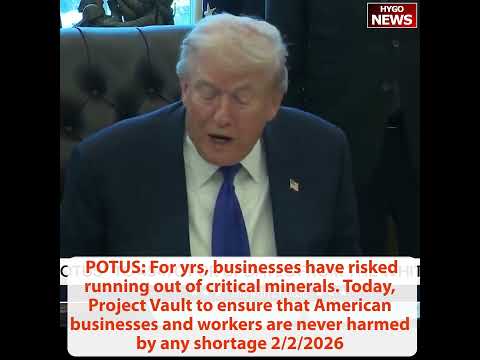
Project Vault critical minerals & rare earths American businesses
President Trump announced Project Vault — a strategic critical minerals reserve to protect American businesses from supply disruptions and foreign leverage. Trump framed the initiative as filling a gap analogous to the Strategic Petroleum Reserve but focused on minerals critical to American industry rather than defense alone. The $12 billion initiative combines $10 billion in Export-Import Bank financing with $2 billion in private sector financing. Trump emphasized the American taxpayer will actually profit from the interest on the loans. Trump connected Project Vault to broader critical minerals policy including mining project investment, federal permitting acceleration under EPA Administrator Lee Zeldin, and signed mineral deals with countries worldwide. The context — China controls vast portions of rare earth processing and critical mineral supply chains, creating vulnerability for American defense and commercial industries. Trump referenced a prior year’s disruption that “worked out” but highlighted the risk of future supply chain attacks. Trump: “For years, American businesses have risked running out of critical minerals during market disruptions. Today, we’re launching what will be known as Project Vault to ensure that American businesses and workers are never harmed by any shortage.” Trump on financing: “This historic initiative will combine $10 billion dollars in export, import, bank financing with $2 billion dollars in private sector financing. And we even expect the American taxpayer to make a profit from the interest on the loan used to start the Project Vault.”
Project Vault Launch
Trump opened with the problem. “For years, American businesses have risked running out of critical minerals during market disruptions.”
The vulnerability — American industries dependent on foreign sources for critical minerals face supply disruption risk. Market disruptions can be:
- Deliberate (Chinese export restrictions)
- Natural (mine disasters, natural disasters)
- Political (regime changes in supplier countries)
- Strategic (geopolitical conflicts)
Each creates potential economic disruption for American industry.
“Today, we’re launching what will be known as Project Vault to ensure that American businesses and workers are never harmed by any shortage.”
Project Vault — the solution. A reserve system to protect American industry from supply disruptions.
Recent Disruption Reference
“We don’t want to ever go through what we went through a year ago, just as we, although it did work out.”
Trump referenced a prior disruption that “worked out” but highlighted the risk. The 2024-2025 period saw several critical mineral supply challenges:
- Chinese gallium and germanium export restrictions
- Chinese graphite export controls
- Rare earth processing bottlenecks
- Cobalt price surges
The disruptions resolved — but the risk remains.
Strategic Reserve Analog
“Just as we have long had a strategic patrol and reserve and a stockpile of critical minerals for national defense, we’re now creating this reserve for American industry so we don’t have any problems.”
“Strategic patrol and reserve” — transcription artifact for “Strategic Petroleum Reserve.” Trump’s analog:
Strategic Petroleum Reserve (SPR):
- 714 million barrels capacity
- Created 1975 after OPEC embargo
- Deployed in emergencies
- National security framework
Project Vault (proposed):
- Critical minerals storage
- Created 2026 to prevent supply crises
- Deployable to American businesses
- Commercial and defense framework
The defense stockpile of critical minerals has existed for decades (administered by Defense Logistics Agency). Project Vault extends the concept to commercial needs.
$12 Billion Financing
“This historic initiative will combine $10 billion dollars in export, import, bank financing with $2 billion dollars in private sector financing.”
The financing structure:
- Export-Import Bank: $10 billion
- Private sector: $2 billion
- Total: $12 billion
EXIM Bank — U.S. export credit agency. Traditional role: financing foreign buyers of U.S. exports. New role: financing domestic critical mineral strategic reserve.
Private sector component — $2 billion from American companies benefiting from the reserve. Mining companies, processors, end-users.
Taxpayer Profit
“And we even expect the American taxpayer to make a profit from the interest on the loan used to start the Project Vault.”
The structural framework — the EXIM Bank loans earn interest. The interest revenue exceeds the cost. American taxpayer makes money on the initiative.
This framework addresses conservative objection to federal programs. Rather than subsidy, Project Vault is structured as profitable lending.
“It’s an amazing thing. They’ve been talking about it for years. Other presidents say a lot of talking, but they didn’t do anything.”
Trump’s framework — decades of talk, no action. Trump administration finally acting.
Administration Track Record
“Over the past year, my administration has taken extraordinary steps to make sure the United States has all of the critical minerals and rare arts that we need.”
“Rare arts” — transcription artifact for “rare earths.”
The administration’s critical minerals framework includes multiple tracks:
- Mining project investment
- Processing facility investment
- Federal permitting acceleration
- International mineral deals
- Strategic stockpiling (Project Vault)
“We’re investing in mining projects. Really, we’re expediting federal permitting.”
Lee Zeldin and Permitting
“You know, the federal permitting, and a lot of it is Lee Zeldin has been fantastic, but federal permitting is such a big deal. And we’re doing that.”
EPA Administrator Lee Zeldin — responsible for environmental permitting. Zeldin’s EPA has accelerated permitting for:
- New mines (lithium, rare earth, copper, nickel)
- Processing facilities
- Related infrastructure
- Transmission lines for mining regions
Trump’s compliment — Zeldin delivering faster permitting than prior administrations.
“The permitting of mines and signing major critical mineral deals with countries from all over the world.”
International Deals
“And we’re getting along with all of them. Every one of them, they want to be in the proper position. We’re working very well with countries from all over the world today.”
The international framework — country-by-country mineral agreements. Examples include:
- Greenland — rare earth access framework
- Ukraine — critical mineral deposit agreements
- Saudi Arabia — mineral cooperation
- African nations — diversified source agreements
- Latin American partners — lithium and copper
- Indonesia — nickel cooperation
- Australia — critical mineral partnerships
Each deal reduces dependence on any single supplier (particularly China).
“We’re building on these achievements with this vital new reserve.”
China Context
The unstated backdrop — China’s dominance of critical mineral supply chains:
Rare earth processing:
- China: ~85% of global processing
- U.S.: minimal domestic capacity
- Strategic vulnerability
Specific minerals:
- Gallium: China ~98% production
- Germanium: China ~60% production
- Graphite: China ~65% production
- Rare earth elements: China dominant
China has repeatedly demonstrated willingness to use mineral exports as political leverage — restricting exports to Japan in 2010 over Senkaku dispute, to U.S. over trade tensions, and selectively during trade negotiations.
Project Vault mitigates this vulnerability. American industries would have domestic reserves to weather Chinese export restrictions.
Mining Renaissance
Beyond Project Vault, Trump’s broader framework aims at American mining renaissance:
New mining projects:
- Lithium in Nevada (Thacker Pass, Rhyolite Ridge)
- Rare earth at Mountain Pass California
- Copper in Arizona (Resolution Copper project)
- Nickel in Minnesota (Twin Metals)
- Uranium revival across the West
Processing infrastructure:
- Rare earth processing capacity
- Lithium conversion facilities
- Graphite processing
- Battery-grade materials
Mining revival faces regulatory resistance:
- Environmental groups opposition
- Indigenous land rights disputes
- State vs federal jurisdiction conflicts
- Water rights challenges
Trump’s framework — overcome obstacles through EPA/BLM coordination under administration direction.
Significance
Project Vault addresses structural American vulnerability in critical mineral supply chains. The initiative:
- Creates commercial reserve analogous to SPR
- Combines federal and private financing
- Structures as profitable lending
- Complements mining and processing investment
- Supports international diversification deals
The strategic benefit — American industries weather Chinese or other supplier disruption without losing access to needed materials. EV production, semiconductor manufacturing, defense systems, renewable energy all dependent on critical minerals.
The political framework — Trump delivering on decades-long bipartisan recognition that American critical mineral dependence creates strategic risk. Prior administrations studied the issue. Trump administration acted.
The $12 billion scale — modest in federal terms but substantial for the critical mineral sector. Combined with mining project investment, processing facility construction, and international deals, creates comprehensive critical mineral strategy.
Related Policy Framework
Project Vault connects to multiple Trump administration priorities:
Manufacturing revival:
- EV production (batteries require lithium, cobalt, nickel)
- Semiconductor production (requires gallium, germanium, rare earths)
- Defense systems (missiles, aircraft, ships require specialized minerals)
- Electric infrastructure (copper, aluminum, magnets)
Energy independence:
- Nuclear fuel (uranium)
- Solar panels (silicon, polysilicon)
- Wind turbines (rare earth magnets)
- Grid infrastructure (various)
National security:
- Military equipment critical minerals
- Strategic stockpile modernization
- Defense industrial base support
Trade strategy:
- Leverage against China
- Diversification of supply
- Allied cooperation framework
- Investment protection
Key Takeaways
- Trump on Project Vault purpose: “For years, American businesses have risked running out of critical minerals during market disruptions. Today, we’re launching what will be known as Project Vault to ensure that American businesses and workers are never harmed by any shortage.”
- Trump on SPR analog: “Just as we have long had a strategic patrol and reserve and a stockpile of critical minerals for national defense, we’re now creating this reserve for American industry so we don’t have any problems.”
- Trump on financing: “This historic initiative will combine $10 billion dollars in export, import, bank financing with $2 billion dollars in private sector financing. And we even expect the American taxpayer to make a profit from the interest on the loan used to start the Project Vault.”
- Trump on permitting and Zeldin: “Over the past year, my administration has taken extraordinary steps to make sure the United States has all of the critical minerals and rare arts that we need … we’re expediting federal permitting. You know, the federal permitting, and a lot of it is Lee Zeldin has been fantastic.”
- Trump on international deals: “The permitting of mines and signing major critical mineral deals with countries from all over the world, and we’re getting along with all of them. Every one of them, they want to be in the proper position.”