 HYGO News
 Press Sec's MAGA Minute: 'MagAMAZING Week' -- OBBB Passes House, TAKE IT DOWN Signed, MAHA Report, Golden Dome, Nuclear Renaissance, Medals of Sacrifice, Memorial Day Gas Prices 20-Year Low; Trump Pulls Cadet Verdugo Onstage: 'Army Strong!'
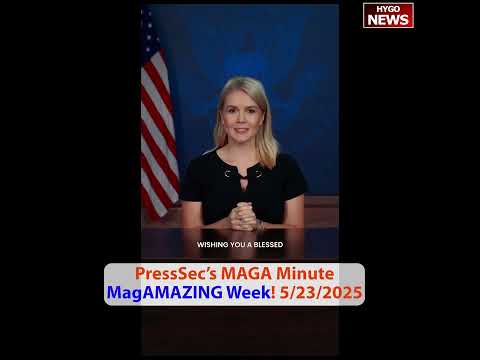
Press Sec’s MAGA Minute: “MagAMAZING Week” — OBBB Passes House, TAKE IT DOWN Signed, MAHA Report, Golden Dome, Nuclear Renaissance, Medals of Sacrifice, Memorial Day Gas Prices 20-Year Low; Trump Pulls Cadet Verdugo Onstage: “Army Strong!”
Press Secretary Karoline Leavitt delivered her weekly MAGA Minute summary for the week ending May 23, 2025. The week had been, as Leavitt described, “another very busy week here at the White House.” Among the accomplishments: One Big Beautiful Bill passed the House 215-214; Trump signed the First Lady’s TAKE IT DOWN Act against deepfakes; MAHA Commission released its landmark report on childhood chronic disease; Trump announced Golden Dome implementation plan; hosted South African President Ramaphosa with dramatic video confrontation; signed four nuclear executive orders launching “nuclear renaissance”; awarded first-ever Medals of Sacrifice to three police officers; and “gas prices have dropped this Memorial Day to their lowest price in more than 20 years. You’re welcome, America.” Separately, at West Point, President Trump pulled Cadet Chris Verdugo on stage after his speech: “Come up here, Chris. Get up here, Chris. Wow.” Verdugo said: “It’s been a long five years, but I couldn’t have done it without any of these guys. Love you guys all.” Trump closed: “That really is a definition of Army strong, isn’t it?"
"MagAMAZING Week”
Leavitt opened her weekly summary.
“Hey everybody, happy Friday. It was another very busy week here at the White House with President Trump,” Leavitt said. “Let’s go through it for the MAGA Minute.”
The weekly MAGA Minute had become a standard feature of the Trump second term communications strategy. The format was:
- Friday afternoon timing to capture weekend news cycles
- Rapid-fire summary of week’s accomplishments
- Direct communication to Trump supporter base
- Shareable content for social media
- Counter-framing to hostile mainstream media coverage
The format was effective because it bypassed traditional media filters. Rather than hoping that major news outlets would cover administration accomplishments positively, the MAGA Minute delivered a curated positive summary directly to audiences who wanted to see administration success.
The OBBB Success
Leavitt led with the legislative victory.
“This week, President Trump visited Capitol Hill to bring the historic one big beautiful bill over the finish line,” Leavitt said.
She described the substance: “This bill is going to put more money back in your pockets.”
She enumerated the benefits: “It’s going to keep your communities safe, deliver the largest middle-class tax cut in American history, fund deportations and the completion of the border wall.”
She included the specific immigration number: “And it’s going to kick 1.4 million illegal aliens off of your taxpayer-funded benefits.”
The “1.4 million illegal aliens” figure was a specific claim about the bill’s effect on federal benefit programs. The OBBB included provisions that would:
- Tighten eligibility verification for federal benefits
- Require Social Security number validation for Medicaid
- Increase penalties for benefits fraud
- Expand state authority to verify immigration status
- Reduce various programs’ availability to non-citizens
The combination would remove an estimated 1.4 million illegal immigrants from federal benefit rolls. Beyond the direct savings, the elimination of benefits represented a major reduction in the pull factor that had drawn illegal immigration. If illegal residents could not access significant federal benefits, the economic calculation for unauthorized migration would shift.
TAKE IT DOWN Act
Leavitt mentioned the signed legislation.
“Also, on the legislative front, the president signed the First Lady’s sponsored Take It Down Act, ensuring protections for young people who are targets of malicious deep fakes in personal attacks on social media,” Leavitt said.
The TAKE IT DOWN Act, which we discussed in depth in earlier coverage, had been:
- Signed by Trump in the Rose Garden earlier that week
- Championed by Melania Trump as one of her signature policy initiatives
- Passed with bipartisan support in Congress
- Targeted non-consensual intimate imagery and AI deepfakes
- Created federal criminal penalties and platform removal obligations
The “young people” framing Leavitt used was important. While the law protected all victims, the specific horror of AI-generated fake explicit imagery of minors had been a key motivator. Young teenagers who had their likenesses used for fake pornography faced devastating social and psychological consequences. The law addressed this specifically.
MAHA Commission Report
Leavitt addressed the health report.
“President Trump also attended the Make America Healthy Again Commission’s release of its landmark report, which exposes key factors contributing to childhood chronic diseases and points to a path forward to make our children healthy again,” Leavitt said.
The MAHA Commission Report, extensively covered in previous Hygo coverage, had documented:
- 40% of American children with chronic conditions
- 50% increase in childhood cancer since 1970s
- Obesity quadrupling from 5% to 20%
- Autism increasing from 1 in 10,000 to 1 in 31
- Four main causal factors: poor diet, chemicals, inactivity, over-medicalization
This was the first systematic federal acknowledgment that American children’s health was deteriorating and that specific root causes needed addressing. The report’s impact was less about immediate policy change and more about establishing an intellectual framework for ongoing reform.
Take Our Sons and Daughters to Work Day
Leavitt mentioned the family-oriented event.
“The president hosted the White House’s annual Take Our Sons and Daughters to Work Day Celebration,” Leavitt said.
Leavitt herself had hosted the kids’ press briefing that had become a viral moment that week. Children of reporters and White House staff had filled the James S. Brady Briefing Room, asking both serious questions (state of the border, climate change) and whimsical questions (Trump’s favorite food, does he like hugs, favorite child).
The event reflected a specific administration priority: demonstrating that despite political controversy, the White House remained a welcoming environment for children and families. The stark contrast with political attacks characterizing the administration as hostile or dangerous was implicit.
Golden Dome Implementation
Leavitt addressed the strategic announcement.
“President Trump also announced an implementation plan for the Golden Dome to protect our nation from wide-ranging global missile threats,” Leavitt said.
The Golden Dome announcement, extensively covered in earlier Hygo reporting, had included:
- “Officially selected an architecture” for the missile defense system
- Land, sea, and space-based sensors and interceptors
- Capability against ballistic, hypersonic, and cruise missiles
- “Fully operational before end of my term” (within approximately three years)
- Canadian expressed interest in participation
- Space-based interceptor capability previously only theoretical
The Golden Dome represented the largest strategic defense commitment since Reagan’s SDI initiative. If actually deployed as specified, it would transform American strategic posture.
South Africa and Nuclear Executive Orders
Leavitt mentioned two major events in one sentence.
“He also hosted the South African president at the White House and signed executive orders to start a nuclear renaissance in the United States,” Leavitt said.
The South African visit had featured the dramatic video confrontation with President Ramaphosa about Afrikaner farmer persecution. Trump had ordered Oval Office lights dimmed and played videos showing EFF leader Julius Malema chanting “Kill the Boer.” Images of the South African delegation refusing to look at the TV had become internationally viral content.
The nuclear executive orders had included four separate actions:
- Revitalize nuclear industrial base via Defense Production Act
- Speed SMR approval for defense and AI installations
- Create special envoy for nuclear technology exports
- Establish “Gold Standard Science” framework for regulatory decisions
Combined, these represented the most significant civilian nuclear policy shift since the 1970s — potentially launching the “nuclear renaissance” that industry advocates had predicted for years but that regulatory barriers had prevented.
First Medals of Sacrifice
Leavitt noted the law enforcement recognition.
“The president also hosted a law enforcement event in the Oval Office and awarded the first-ever Medals of Sacrifice to three heroic police officers,” Leavitt said.
The Medal of Sacrifice ceremony had honored three Palm Beach County Sheriff’s Office personnel killed in the line of duty. Eric Trump had shared the story’s origin: attending the funeral with his father and asking “why is there no medal that commemorates fallen law enforcement?” Tiffany’s had designed the medal within six months from conception to first award. Rep. Brian Mast had introduced legislation to institutionalize the medal for future fallen officers and first responders.
”Gas Prices Lowest in More Than 20 Years”
The most economically significant announcement came at the end.
“And finally, gas prices have dropped this Memorial Day to their lowest price in more than 20 years,” Leavitt said. “You’re welcome, America.”
The “20-year low” gas price was a remarkable achievement. Memorial Day weekend was traditionally the unofficial start of summer driving season and historically a period of peak gasoline prices. Prices at Memorial Day 2025 lower than any since approximately 2004 represented a dramatic reversal of Biden-era energy costs.
The combination of factors contributing to low Memorial Day 2025 gas prices:
- Increased domestic production: Trump administration had expanded oil and gas drilling on federal lands
- Reduced regulation: Repeal of various Biden-era emissions and drilling regulations
- Market confidence: Oil companies were investing in production with regulatory certainty
- Strategic reserve management: Proper maintenance of Strategic Petroleum Reserve levels
- International supply: OPEC+ coordination that maintained adequate supply
- Reduced demand: Inflation recovery shifting consumer spending patterns
The “You’re welcome, America” flourish was characteristic Leavitt. Rather than merely reporting the price, she claimed administration credit for achieving it. This was standard political communication, but the specific “you’re welcome” framing was Trump-ish humor that fit administration style.
Cadet Chris Verdugo at West Point
The video’s second segment was the Cadet Verdugo moment.
Trump had called out: “Come here. Come up here, Chris. Get up here, Chris. Wow.”
He had paused briefly: “Come here. That’s by 13 minutes. Come here, Chris. I want to see this guy.”
Verdugo arrived at the stage, and Trump encouraged him: “Say something. Come here. Come here.”
Verdugo spoke: “It’s been a long five years, but I couldn’t have done it with any of these guys. Love you guys all. Thank you.”
Trump encouraged him further: “That’s great. Keep it going, Chris.”
Trump delivered the closing line: “That really is a definition of Army strong, isn’t it?”
Cadet Chris Verdugo’s physical appearance had likely attracted Trump’s attention. The “Army strong” framing suggested Verdugo was particularly physically impressive — muscular, fit, clearly prepared for demanding military service.
The impromptu interaction reflected Trump’s genuine engagement with military cadets. Rather than delivering a formal speech and departing, Trump had taken time to call out and interact with specific cadets who caught his attention. This was characteristic of Trump’s political style: personal, interactive, engaged with individuals rather than abstract constituencies.
Verdugo’s brief remarks captured the emotion of the day. “Long five years” referenced the demanding West Point experience. “Couldn’t have done it with any of these guys” acknowledged the peer support that had carried him through. “Love you guys all” expressed the deep bonds formed during the intense academy experience.
The Weekly Messaging Function
The MAGA Minute format served specific political communication purposes:
Narrative control: By summarizing the week’s accomplishments in curated form, the administration controlled the story independent of mainstream media framing.
Volume and pacing: The rapid-fire listing of accomplishments created an impression of intense activity and success. Viewers watched one accomplishment after another, accumulating impression of competent governance.
Constituency reinforcement: The direct-to-base communication reinforced supporter confidence in the administration’s success and energy.
Opposition demoralization: The format’s constant stream of wins contrasted with Democratic opposition that often seemed reactive rather than productive.
Media counter-programming: When mainstream media focused on controversies or negative framing, the MAGA Minute provided alternative content focused on accomplishments.
Key Takeaways
- Leavitt’s weekly MAGA Minute for week ending May 23: “Another very busy week.”
- Legislative: OBBB passes House, TAKE IT DOWN Act signed by Trump with Melania.
- Policy: MAHA Commission report, Golden Dome announcement, nuclear renaissance executive orders.
- Diplomacy: South African President hosted with video confrontation on Afrikaner farm murders.
- Memorial Day gas prices “lowest price in more than 20 years. You’re welcome, America.”