 HYGO News
 Press Sec: WaPo poll 65% crime extremely/very serious; DC Police Chief Equity Officer & LA Mayor
Press Sec: WaPo poll 65% crime extremely/very serious; DC Police Chief Equity Officer & LA Mayor
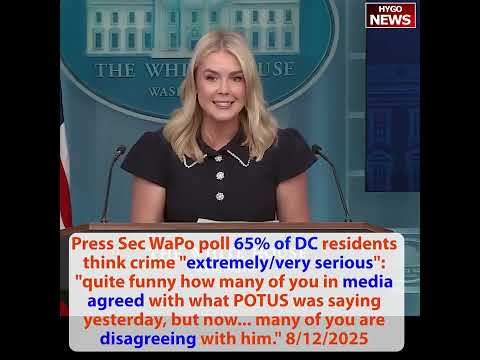
A White House reporter identified as a DC resident of 15 years delivered an extraordinary personal testimony about her family’s experience with DC crime, followed by Press Secretary Karoline Leavitt citing a Washington Post poll showing 65% of DC residents consider crime “extremely serious or very serious.” LA Mayor Karen Bass claimed DC residents “are not suffering” — while her own city has its own crime and homelessness problems. DC Police Chief Pamela Smith — formerly the department’s “Chief Equity Officer” — appeared confused when asked about the new chain of command post-federalization. The reporter’s personal testimony: “I witnessed so many muggings and so much theft … I was carjacked. I have murders on my ring camera and mass shootings … And my house was set ablaze in an arson with my infant child inside.” Leavitt: “65 percent of district residents think crime is an extremely serious or a very serious problem. And this was up from 56 percent last year.” On Democratic resistance: “I think it’s despicable that Democrats cannot agree that we need more law and order in a city that has been ravaged.” And Chief Smith’s now-famous response when asked “Do you know what the chain of command is now?”: “What does that mean?"
"As a DC Resident of 15 Years”
The reporter’s opening. “As a DC resident of 15 years, I lived on Capitol Hill. I witnessed so many muggings and so much theft. I lost track. I was carjacked. I have murders on my ring camera and mass shootings. I witnessed a woman on my block get held up at gunpoint for $20. And my house was set ablaze in an arson with my infant child inside.”
That is unprecedented testimony from the White House briefing room. The reporter — Benny Johnson, given the “Benny” reference later — is reporting from direct personal experience of DC crime:
- Muggings (multiple, “lost track”)
- Theft (repeated)
- Carjacking (personal victim)
- Murders on Ring camera (recorded)
- Mass shootings (witnessed)
- Armed robbery on the same block (held up at gunpoint for $20)
- Arson attack on his house with his infant child inside
That is a catalog of serious violent crime. All of it occurred in a 15-year residency on Capitol Hill — which is not a “bad neighborhood” in DC’s informal categorization. It is the political center of the nation, surrounded by federal buildings and congressional offices.
If Capitol Hill, with its proximity to federal security resources, produces this level of victimization, then the citywide crime picture is substantially worse. The reporter’s testimony is personal validation of the “crime ravaging DC” framing the administration has been using.
”Thank You for Making the City Safe”
“And so to any reporter that says and lies that DC is a safe place to live and work. Let me just say this. Thank you. Thank you for making the city safe because no parent should have to go through what my family went through having the fire department rip open their door to save their infant child.”
That is the reporter’s direct rejection of the “DC is safe” media framing. Reporters who frame DC as safe are, in his characterization, lying. He is speaking from the opposite experience. His child almost died in an arson attack. His family was subjected to repeated criminal victimization. DC is not safe.
“Thank you for your work on securing this city.” That is direct appreciation for the federalization effort. The administration’s intervention is, from his perspective, exactly what DC has needed.
The Pelosi and Clinton Attack
“My question to you is this. Nancy Pelosi has attacked the president for deploying the National Guard to the city saying that it is to cover for his incompetence. Hillary Clinton has also attacked the president for securing the city of Washington DC. I’d like to get your response to Nancy Pelosi and Hillary.”
Two senior Democratic figures — Pelosi and Clinton — have publicly criticized the DC federalization. Both framed the intervention as either political cover or illegitimate federal overreach. The reporter is asking Leavitt for the administration’s response.
The WaPo Poll Reveal
Leavitt’s response pivots to data. “Well, first of all, Benny, I’m so sorry that happened to you and your family. And I know the majority of residents in the District of Columbia agree with you. In fact, a new poll from the Washington Post. I was reading this morning this was released in May of 2024.”
A Washington Post poll. May 2024. That is the specific source. Washington Post is not a conservative publication. Its polls are widely trusted across the political spectrum.
“So it’s quite funny how many of you in the media agreed with what the president was saying yesterday. But now once the president says it, many of you are disagreeing with him.”
That is the media-hypocrisy point. Reporters in the room agreed with the Washington Post’s 2024 poll reporting. They are now disagreeing with the identical substantive framing when Trump articulates it. The inconsistency exposes the partisan alignment of the framing rather than the factual assessment.
”65 Percent of District Residents”
“But this poll released by the Washington Post found that 65 percent of district residents think crime is an extremely serious or a very serious problem. And this was up from 56 percent last year.”
65% “extremely serious or very serious.” Up from 56% the prior year. That is year-over-year deterioration of DC residents’ perception of crime. The trajectory is not improvement. The trajectory is worsening.
“So the concern that you share with so many other residents in the District of Columbia is real. And that’s why this president is taking action to address it.”
Leavitt’s direct framing. The reporter’s experience is not an outlier. 65% of DC residents share versions of that experience or concern. Trump is responding to majority public opinion in DC by federalizing the National Guard.
That is a specific political point. Federalization is not imposed on unwilling DC residents. It is responsive to majority concern among DC residents. The pushback from Pelosi and Clinton does not match their own constituents’ views.
”Despicable That Democrats Cannot Agree”
“To get to the heart of your question, I think it’s despicable that Democrats cannot agree that we need more law and order in a city that has been ravaged by this should be a winning issue for all Americans. I don’t understand. It’s just anything President Trump does the Democrats want to disagree with.”
“Despicable.” Leavitt’s specific word choice. Democratic opposition to DC law and order is despicable — morally condemnable, not merely politically incorrect.
“Anything President Trump does the Democrats want to disagree with.” That is the meta-observation. Democratic opposition has become automatic rather than substantive. If Trump proposes law and order, Democrats oppose law and order — not because they actually prefer lawlessness, but because opposing Trump is the default posture.
That automatic opposition produces electoral problems. Voters who want law and order see Democrats opposing it and conclude Democrats are not interested in public safety. The partisan identity becomes stronger than the policy merit.
”Would Love to Work with Democrats”
“I think the president would love to work with Democrats on this issue to bring law and order to America’s cities. But unfortunately, they have failed. And that’s why he’s taken this historic action to federalize the National Guard.”
The administration’s stated openness to bipartisanship. Trump would work with Democrats on law and order. Democrats have failed to participate. That is why federalization became necessary — unilateral action when cooperative action was unavailable.
“And as you’re seeing from last night’s numbers, we already have seen success.” Operational results are emerging. The federalization is not merely symbolic. Actual crime reduction and arrest numbers are producing measurable improvement.
Karen Bass: “They Are Not Suffering”
Los Angeles Mayor Karen Bass’s pushback. “It’s interesting which mayors in which cities he’s chosen to focus on in Los Angeles, where you have crime down 60 year low in terms of homicides, homelessness is down. He points to homelessness and he points to crime in Washington, D.C. I don’t know what’s going on there, but I imagine that they are not suffering in the despair that he described in his press conference that in any way would warrant the use of federal officials in this manner.”
“I don’t know what’s going on there, but I imagine that they are not suffering.” That is an extraordinary statement from a mayor of another major American city about DC residents. Bass does not know, but she imagines that DC residents are not suffering.
The reporter’s testimony — the 65% poll data — the operational reality all contradict Bass’s imagination. DC residents are in fact concerned. They are in fact experiencing crime. They are in fact supportive of federal intervention.
Bass’s framing reflects the broader Democratic institutional posture. Deny the problem. Frame federal intervention as illegitimate regardless of underlying facts. Maintain the statistical narrative even when experienced reality diverges from it.
”LA Crime Down 60-Year Low”
Bass’s LA defense. Crime down to 60-year low in homicides. Homelessness down. Both claims are specific and testable. Whether they are fully accurate is a separate question. LAPD crime statistics, like DC MPD statistics, can be subject to classification choices that affect apparent trends. Homelessness counts are notoriously difficult to conduct accurately.
But even if Bass’s numbers are accurate, LA still has significant crime and homelessness problems. Both are highly visible. Both contribute to LA’s post-pandemic reputation challenges. Framing LA as a model of public safety success is a political stretch.
Police Chief Smith: “What Does That Mean?”
The segment pivoted to DC Police Chief Pamela Smith. The reporter’s question. “Do you know what the chain of command is now?”
Smith’s response. “What does that mean?”
That is, charitably, a confused response from the chief of a major American city’s police department. Post-federalization, the chain of command changed — federal officials now have operational authority over MPD coordination. Smith, as the MPD chief, should understand precisely what the new chain of command is and be able to articulate it.
“What does that mean?” does not articulate any chain of command. It reflects either genuine confusion about the new command structure or a deliberate refusal to engage with the question.
Smith’s background is relevant. She previously served as MPD’s “Chief Equity Officer” — a position responsible for equity and inclusion work, not operational law enforcement. Her promotion to Chief is seen, in administration framing, as emblematic of a police department that has prioritized identity-politics credentials over operational competence.
”Is It Pam Bondi Speaking to the Mayor?”
Continuing the exchange. “Is it Pam Bondi speaking to the mayor?”
That is the reporter’s specific hypothesis. Attorney General Pam Bondi, as Trump’s designated proxy, communicates with DC Mayor Bowser to direct MPD operations. The executive order establishes that chain.
Smith’s response clarifies. “The executive order is clear. The president has requested MPD services and our home rule charter outlines the process. The president designated Attorney General Bondi as his proxy to request services through me.”
That is the actual chain. President → Attorney General Bondi → MPD Chief Smith. Smith should have been able to articulate that directly when first asked. Her “What does that mean?” response was either confusion or obstruction.
Three Reinforcing Stories
The 15-year-DC-resident reporter’s personal testimony. The WaPo 65% poll. Karen Bass’s imagined DC reality. Chief Smith’s chain-of-command confusion.
All four stories reinforce the administration’s framing. Crime in DC is real and serious. Residents support intervention. Democratic pushback is detached from experienced reality. Local law enforcement leadership is insufficiently equipped for the federalized operational environment.
The cumulative effect strengthens the political case for continued federal intervention. Whatever pushback Pelosi, Clinton, and Bass generate, the underlying data and testimony support the administration’s operational posture.
Key Takeaways
- DC resident reporter’s personal testimony: “I was carjacked. I have murders on my ring camera and mass shootings … my house was set ablaze in an arson with my infant child inside” — on 15 years living on Capitol Hill.
- Press Secretary Leavitt citing WaPo poll (May 2024): “65 percent of district residents think crime is an extremely serious or a very serious problem. And this was up from 56 percent last year.”
- Leavitt on Democratic opposition: “I think it’s despicable that Democrats cannot agree that we need more law and order in a city that has been ravaged … anything President Trump does the Democrats want to disagree with.”
- LA Mayor Karen Bass dismissing DC concerns: “I don’t know what’s going on there, but I imagine that they are not suffering in the despair that he described.”
- DC Police Chief Pamela Smith — formerly MPD’s “Chief Equity Officer” — when asked “Do you know what the chain of command is now?”: “What does that mean?”