 HYGO News
 Leavitt: 'Everybody Melts Down' Over Third Term Question; Wednesday 'Liberation Day' -- First Rose Garden Event; 17 Terrorists Deported
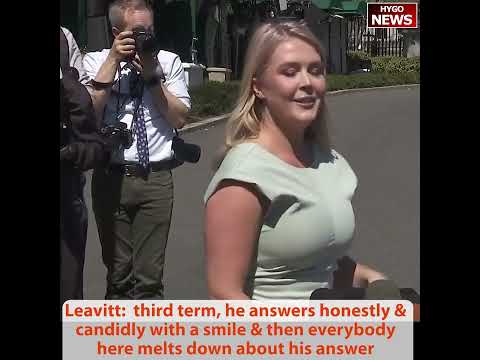
Leavitt: “Everybody Melts Down” Over Third Term Question; Wednesday “Liberation Day” — First Rose Garden Event; 17 Terrorists Deported
Press Secretary Karoline Leavitt opened the week of April 2 “Liberation Day” with a Monday briefing that dismissed the third-term controversy, previewed the historic Rose Garden tariff announcement, reported the deportation of 17 Tren de Aragua and MS-13 terrorists, and cataloged the foreign tariffs that justified reciprocal action: “50% from the EU on American dairy, 700% from Japan on American rice, 100% from India on American agriculture, nearly 300% from Canada on American butter and cheese."
"Everybody Here Melts Down”
Leavitt opened by addressing the question that had dominated weekend coverage.
“Look, you guys continue to ask the president this question about a third term, and then he answers honestly and candidly with a smile, and then everybody here melts down about his answer,” Leavitt said.
She provided Trump’s own assessment: “The president talked about this last night on the plane. He said, it’s not really something we’re thinking about. He has four years. There’s a lot of work to do.”
She cited the track record: “We’ve done a lot in these nearly first 100 days, and the American people love what this president is doing, particularly when it comes to efforts to secure the border.”
The response was designed to accomplish two things: dismiss the third-term question as a media-manufactured controversy while keeping the possibility alive as a psychological advantage. If Trump’s opponents feared he might seek a third term, they would be forced to fight both the current term’s policy agenda and a hypothetical future campaign simultaneously. The ambiguity was, itself, a form of leverage.
Leavitt’s observation that Trump answered “honestly and candidly with a smile” suggested that the president’s third-term comments were part teasing, part trolling, and part genuine reflection on the enthusiasm his second term had generated. The “meltdown” was the media’s problem, not the administration’s.
Liberation Day: The Preview
Leavitt then delivered the week’s most significant announcement.
“It’s Monday. We have another big week,” she said. “On Wednesday, it will be Liberation Day in America, as President Trump has so proudly dubbed it.”
She described the setting: “The cabinet will be here for the event. It will be our first Rose Garden event of this administration. So you all will be invited to attend and cover this historic moment.”
The substance: “The president will be announcing a tariff plan that will roll back the unfair trade practices that have been ripping off our country for decades. He’s doing this in the best interest of the American worker.”
The choice of the Rose Garden for the administration’s first outdoor event signaled the importance Trump placed on the tariff announcement. The Rose Garden was the president’s most prestigious outdoor stage — the setting reserved for events of national significance. Using it for the tariff announcement rather than a state dinner or diplomatic ceremony was a statement that trade policy was the defining issue of the second term.
The “Liberation Day” branding — which Commerce Secretary Lutnick had introduced weeks earlier — framed April 2 not as a technical trade action but as a national liberation from decades of exploitation. The rhetoric was designed to make every American feel that the tariffs were being imposed on their behalf, not as an abstract economic policy.
17 Terrorists Deported
Leavitt reported the latest border enforcement results.
“We also had great news this morning on the border,” she said. “Our Homeland Security team, our national security team, continues to do an incredibly effective job when it comes to deporting foreign terrorists from American soil.”
The specifics: “17 Tren de Aragua and MS-13 illegal criminal terrorists were deported from our country back to El Salvador, and they will no longer ever be able to say they can roam free in this country under this president.”
She described who had been removed: “These were convicted felons, murderers, rapists who are no longer in our country. And I think we should all be very grateful for that.”
The deportation of gang members to El Salvador using the Alien Enemies Act had become a regular feature of the administration’s enforcement agenda. Each deportation flight removed individuals who posed genuine threats to American communities while demonstrating that the legal tools the administration was defending in court were being used for their intended purpose: removing dangerous foreign nationals from American soil.
The Tariff Catalog: What Other Countries Charge
When reporters asked whether countries could “stave off” the tariffs, Leavitt responded by cataloging the trade barriers that made reciprocal action necessary.
“Unfortunately, these countries have been ripping off our country for far too long, and they’ve made their disdain for the American worker quite clear,” she said.
Then the numbers: “If you look at the unfair trade practices that we have: 50% from the European Union on American dairy. You have a 700% tariff from Japan on American rice. You have a 100% tariff from India on American agricultural products. You have nearly a 300% tariff from Canada on American butter and American cheese.”
She stated the consequence: “This makes it virtually impossible for American products to be imported into these markets, and it has put a lot of Americans out of business and out of work over the past several decades.”
The conclusion: “So it’s time for reciprocity, and it’s time for a president to take historic change to do what’s right for the American people, and that’s going to take place on Wednesday.”
The tariff catalog was the administration’s most effective argument for reciprocal tariffs. Americans who had been told that Trump’s tariffs were “protectionist” or “inflationary” could see that the countries criticizing American tariffs imposed far higher tariffs on American products. Japan charged 700% on rice while complaining about a 25% auto tariff. Canada charged 300% on butter while demanding free access to American markets. The asymmetry was indefensible, and Leavitt made sure every reporter in the room — and every viewer at home — could see the numbers.
The Trade Team
When asked who was involved in designing the tariff plan, Leavitt named the full roster.
“He has a brilliant team of trade advisors,” she said. “You have Secretary Bessent, Secretary Lutnick, Jamieson Greer — our U.S. trade representative — Peter Navarro, of course, and Kevin Hassett here at the White House. Stephen Miller as well. The vice president has been deeply involved in these conversations.”
She deferred to the president: “All of these individuals have presented plans to the president on how to get this done, and it’s the president’s decision to make, and we will not get ahead of him on the specifics of the announcement.”
The naming of the full team served notice that the tariff plan was not a one-man show. It had been developed through a deliberative process involving the Treasury Secretary, Commerce Secretary, Trade Representative, senior advisors, and the vice president. The breadth of the team suggested that the plan had been stress-tested from multiple angles — economic, diplomatic, legal, and political.
Key Takeaways
- Leavitt dismissed the third-term controversy: “The president answers honestly and candidly with a smile, and then everybody here melts down.”
- Wednesday April 2 “Liberation Day” would be the administration’s first Rose Garden event: “The president will announce a tariff plan to roll back unfair trade practices ripping off our country for decades.”
- 17 Tren de Aragua and MS-13 terrorists deported to El Salvador: “Convicted felons, murderers, rapists who are no longer in our country.”
- Leavitt cited foreign tariffs justifying reciprocity: EU 50% on dairy, Japan 700% on rice, India 100% on agriculture, Canada 300% on butter and cheese.
- The trade team: Bessent, Lutnick, Greer, Navarro, Hassett, Miller, and VP Vance — “All have presented plans. It’s the president’s decision.”