 HYGO News
 Press Sec on NPR/PBS: partisan, left-wing outlets funded by taxpayers; NOT support amnesty, ZERO
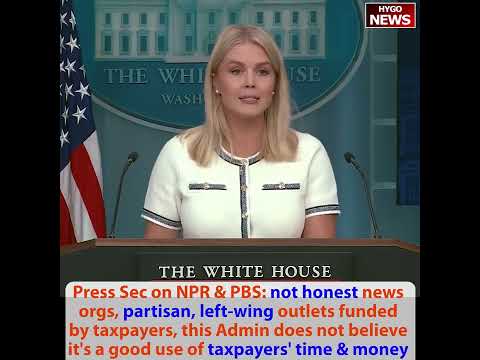
Press Sec on NPR/PBS: partisan, left-wing outlets funded by taxpayers; NOT support amnesty, ZERO
White House Press Secretary Karoline Leavitt delivered a data-heavy briefing that packed four distinct policy victories into a single session. On amnesty: “The president has made it very clear he will not support amnesty for illegal aliens in any way.” On NPR and PBS: “These are not honest news organizations. These are partisan left wing outlets that are funded by the taxpayers. And this administration does not believe it’s a good use of the taxpayers’ time and money.” On the border: June Customs and Border Protection numbers showed “only 6,072 Southwest apprehensions … 15% lower than the previous record … zero illegal aliens released along the southwest border for the second consecutive month in a row.” And on the Senate: “Last night, Senate Republicans passed President Trump’s $9 billion rescissions package … rescinding billions in wasteful foreign aid, and finally ending taxpayer funding for PBS and NPR."
"Not Support Amnesty in Any Way”
Leavitt opened with a categorical restatement of the administration’s immigration enforcement posture. “The president has made it very clear he will not support amnesty for illegal aliens in any way.”
That statement has been made repeatedly across multiple cycles because the administration knows that political pressure for some form of legalization pathway — whether for agricultural workers, hospitality workers, or long-present populations — continues to surface from industries, state officials, and advocacy groups. The restatement is designed to close off those pathways before they can be formalized as negotiating positions.
“In any way” is the language that removes wiggle room. Not partial amnesty. Not categorical exemptions. Not long-term residents. Not workers in specific sectors. The administration is committed to enforcement without carve-outs.
The Murkowski Challenge
The press secretary was asked about Senator Lisa Murkowski’s argument for preserving public broadcasting funding. “Murkowski has argued that public broadcasting stations save lives. Could you respond to these concerns? NPR CEO said cutting NPR will be a risk to public safety.”
Leavitt’s response punctured the framing immediately. “I am not sure how NPR helps the public safety of our country, but I do know that NPR unfortunately has become really just a propaganda voice for the left.”
The Murkowski/NPR CEO argument relies on public broadcasting’s role in emergency alerts and rural information access. That argument has real validity in certain contexts — particularly in Alaska, where Murkowski’s constituents depend on public radio infrastructure for weather alerts and emergency information. Leavitt did not engage that specific dimension. She addressed the broader programming question instead.
The NPR Hunter Biden Laptop Example
Leavitt gave specific examples of NPR editorial decisions. “In 2020, NPR refused to cover the Hunter Biden laptop scandal and the run up to the election. They said their assertions don’t amount to much, writing they did not want to waste the listeners and readers time on stories that are just pure distraction. That does not sound like an unbiased opinion. That sounds like a partisan opinion to me. And this is a taxpayer funded organization.”
The Hunter Biden laptop decision is one of the most documented cases of 2020-era mainstream-media editorial malpractice. NPR, in October 2020, published a statement explaining that the network would not cover the New York Post story about the laptop, citing unresolved questions about the story’s origins and arguing listeners’ time should not be wasted on it. That editorial call has been revisited multiple times since 2020, with the underlying factual basis of the laptop story now broadly confirmed across multiple outlets.
“That does not sound like an unbiased opinion. That sounds like a partisan opinion to me” is the Leavitt framing. A tax-funded news organization that editorially decides not to cover a story that was accurate because covering it would help the candidate the organization did not favor is, in her framing, the definition of partisan.
The NPR CEO’s Background
Leavitt then pivoted to the NPR CEO’s personal history. “In 2018, that same CEO that you’re talking about, she called him racist, shared a photo of herself wearing a Biden for president campaign hat, serves on the board of a Soros funded activist group.”
The CEO in question is Katherine Maher, who took over NPR after previously running the Wikimedia Foundation. Maher’s social media history from before her NPR tenure has been extensively scrutinized — including the Biden campaign hat and various political statements that opponents have cited as evidence of her left-leaning perspective.
“Serves on the board of a Soros funded activist group” is the activist-credential charge. Maher has historically been involved in various civil-society organizations, some of which receive funding from Open Society Foundations. Whether that specific affiliation disqualifies her from leading NPR is a question of institutional governance standards. That she has that history is not disputed.
The PBS Examples
Leavitt extended the critique to PBS. “In 2020, PBS’s White House correspondent at the time characterized President Trump’s speech then at Mountain Rushmore as a love letter to white resentment, promoting the myth of America. In 2017, PBS devoted an entire panel talking about what it means to be woke and white privilege.”
The Mount Rushmore speech framing is a specific PBS editorial choice that became emblematic of the network’s editorial voice on Trump during the first term. Whether “love letter to white resentment” is fair commentary or partisan characterization depends on the political lens through which the speech itself is read. Leavitt’s point is that taxpayer-funded journalism should not be producing characterizations that function as partisan editorial.
“In 2023, P. Brown Table covered up Joe Biden’s clear mental divine.” (The transcript’s “P. Brown Table” is Whisper’s rendering of “PBS Brown Table” or a similar panel show; “clear mental divine” is the audio-to-text system’s attempt at “mental decline.”) The argument: during 2023, PBS editorial content downplayed or dismissed concerns about Biden’s cognitive state, which in retrospect have been validated by subsequent events.
”Not Honest News Organizations”
Leavitt’s closing framing on the public-broadcasting question was categorical. “These are not honest news organizations. These are partisan left wing outlets that are funded by the taxpayers. And this administration does not believe it’s a good use of the taxpayers’ time and money.”
That is the administration’s position. Not “should be reformed.” Not “should be made more balanced.” Should be defunded. The taxpayer should not be paying for institutions the administration has judged to be partisan vehicles rather than impartial journalism.
The June Border Numbers
Leavitt then pivoted to immigration enforcement metrics. “The complete and total success at our southern border that many in the media in this room continue to ignore is another example of the president keeping his word to families. Customs and border protection just released the final operationalized stats for the month of June. And I must highlight some of these incredible numbers.”
“There were only 6,072 Southwest apprehensions in June, 15% lower than the previous record that this president set in the month of March. To put that in perspective, the Biden administration routinely saw the same number of encounters in a single day. And on many days, that number was more than 10,000 apprehensions at the southwest border.”
The contrast is stark. June 2025: 6,072 apprehensions for the entire month. Biden-era peak: 10,000-plus apprehensions in a single day. That is a two-orders-of-magnitude shift in the operational reality at the southern border.
“There were also zero illegal aliens released along the southwest border for the second consecutive month in a row.”
Zero releases. That is the number that matters most for the political argument. During the Biden administration, the “catch and release” practice — apprehending individuals at the border and releasing them into the interior pending immigration court hearings (which many then skipped) — became the symbol of immigration enforcement collapse. Zero releases for two consecutive months indicates the catch-and-release pipeline has been shut down entirely.
”Promise to End the Illegal Alien Invasion”
“President Trump promised to end the illegal alien invasion, and he has delivered on that promise to the American people in record time.”
“Invasion” is the specific language the president has used repeatedly. It is a contested framing — critics argue that immigration is not an invasion in the legal or military sense — but it is the framing the administration has committed to and which has been validated by the border operational data.
“In record time” is the temporal claim. Six months into the term, the border apprehension numbers have collapsed to levels not seen in two decades. That speed is what the press secretary is emphasizing.
The $9 Billion Rescissions Package
Leavitt closed with a legislative victory. “Last night, Senate Republicans passed President Trump’s $9 billion rescissions package. This will help restore fiscal sanity in our country by rescinding billions in wasteful foreign aid, and finally ending taxpayer funding for PBS and NPR, two media organizations that have ridiculously used federal dollars to push a partisan left-wing agenda for many years.”
A rescissions package is a specific budget mechanism that allows Congress to cancel previously appropriated spending. The $9 billion figure targets foreign aid programs and public broadcasting — two categories where the administration has identified what it calls waste or misuse.
“The House should pass this rescissions package immediately and send it to the president’s desk for signature.”
That is the press secretary publicly lobbying House Republicans to move the rescissions package quickly. In the congressional calendar, rescissions packages have a limited window for action once passed by one chamber — delay can kill them. Leavitt is applying White House pressure to close the window before it closes on its own.
Four Wins, One Briefing
The briefing compressed four policy wins into a single session: amnesty reiteration, public-broadcasting defunding via rescissions, border enforcement metrics, and the $9 billion fiscal cut.
Each item has its own political trajectory. Amnesty rhetoric feeds the enforcement base. Public broadcasting defunding feeds the culture-war base. Border metrics feed the quality-of-life base Miller described elsewhere. Fiscal cuts feed the austerity base.
Four constituencies, one briefing, one White House message: promises made, promises kept. The test of the second term is not whether the administration can announce wins. It is whether the wins, compounded over four years, add up to the transformation the president has promised.
Key Takeaways
- Press Secretary Karoline Leavitt restated: “The president has made it very clear he will not support amnesty for illegal aliens in any way.”
- On NPR/PBS: “These are not honest news organizations. These are partisan left wing outlets that are funded by the taxpayers. And this administration does not believe it’s a good use of the taxpayers’ time and money.”
- June CBP numbers: “only 6,072 Southwest apprehensions … 15% lower than the previous record” — compared to Biden-era “10,000 apprehensions at the southwest border” in single days, with “zero illegal aliens released along the southwest border for the second consecutive month in a row.”
- The Senate passed Trump’s $9 billion rescissions package, “rescinding billions in wasteful foreign aid, and finally ending taxpayer funding for PBS and NPR” — with Leavitt urging House passage “immediately.”
- Specific NPR/PBS examples cited: NPR’s 2020 refusal to cover the Hunter Biden laptop, the NPR CEO’s “Biden for president” hat history, PBS characterizing Trump’s Mount Rushmore speech as “a love letter to white resentment.”