 HYGO News
 Leavitt: Trump Sat Down with Atlantic's Goldberg Despite Disagreements -- 'That's What We Should Expect'; 2028 Hats 'Flying Off Shelves'
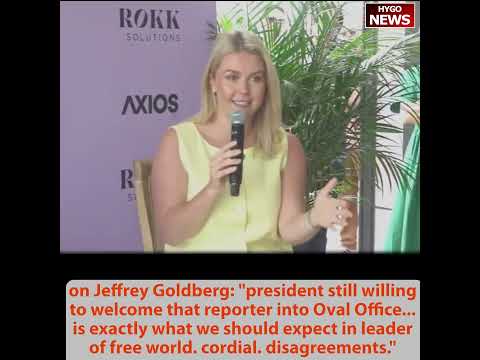
Leavitt: Trump Sat Down with Atlantic’s Goldberg Despite Disagreements — “That’s What We Should Expect”; 2028 Hats “Flying Off Shelves”
Press Secretary Karoline Leavitt addressed Trump’s sit-down with the Atlantic’s Jeffrey Goldberg, the viral 2028 hats, and White House media access reforms in an April 2025 briefing. On Goldberg: “The fact that the president is still willing to welcome that reporter into the Oval Office to have a direct conversation is exactly what we should expect in a leader of the free world. It was cordial. There were disagreements.” On the Trump 2028 hats selling for $50: “It’s just a hat. It’s not something he’s thinking of, though I hear the hats are flying off the shelves.” On AP access changes: “Why should a single outlet have the privilege of being in that 13-person press pool every single day? We’ve just given more spots to more outlets and more voices. It’s not about ideology.”
The Goldberg Interview
A reporter opened with a pointed question about the administration’s relationship with media.
“You and your colleagues dog the media a lot, but the president devours the media,” the reporter said. “He loves Time magazine — again this morning in a cover story — watches Good Morning America Sunday. How do you square that with constant complaints?”
Leavitt turned the question into a positive: “He has constant complaints because he watches everything and reads everything and consumes it all. But I think again it speaks to his transparency and accessibility.”
She then addressed the Goldberg interview: “Yesterday he sat down with Jeffrey Goldberg of the Atlantic, and we all know the story that Jeffrey Goldberg recently wrote. It was quite a big news cycle.”
She stated the principle: “But the fact that President Trump was willing to talk to a reporter who wrote a story that we absolutely disagreed with — in many stories that we absolutely disagree with, we have condemned because they are false, they are hoaxes — the fact that the president is still willing to welcome that reporter into the Oval Office to have a direct conversation with them is exactly what we should expect in a leader of the free world.”
She contrasted with Biden: “You had a previous president in Joe Biden who hid from the press, who didn’t do press engagements, hardly did sit-down interviews.”
She described how the interview went: “It was cordial. It was okay. And there were disagreements. They are writing a story in which the reporting will be revealed.”
The Goldberg interview was a remarkable demonstration of Trump’s media strategy. Jeffrey Goldberg’s Atlantic had published stories that the administration considered fabricated — including the notorious “suckers and losers” story about Trump’s alleged comments about military veterans. Despite this history, Trump invited Goldberg into the Oval Office for a face-to-face conversation.
The decision defied conventional political logic. Most presidents would have blacklisted a journalist who had published damaging stories they considered false. Trump’s approach was the opposite: confront the journalist directly, have the conversation, and let the reporter see firsthand the president he had been writing about. It was a confidence play — Trump believed that direct engagement would produce better coverage than avoidance, or at minimum demonstrate to the public that he was willing to face his critics.
”It’s Just a Hat”
A reporter raised the viral Trump 2028 hats.
“The official Trump stores are now selling hats that say ‘Trump 2028’ — $50,” the reporter noted. “Even though the Constitution doesn’t envision a term three for any president. Is that just a hat?”
Leavitt was succinct: “It’s just a hat. The president was asked and answered this question yesterday. It’s not something he’s thinking of, though I hear the hats are flying off the shelves.”
The 2028 hat phenomenon was a master class in political merchandising. The hats served multiple purposes simultaneously. They generated media coverage — every outlet that reported on them gave the Trump brand free publicity. They generated revenue — at $50 per hat, the “flying off the shelves” sales were a significant fundraising mechanism. They generated conversation — every person who wore one became a walking discussion-starter about Trump’s influence on politics beyond his presidency.
The constitutional question — whether Trump could serve a third term — was a red herring that Leavitt dispatched efficiently. The Twenty-Second Amendment prohibited a third term. The hats were not a legal argument for overturning the Constitution; they were a cultural statement about the Trump movement’s durability. Whether Trump himself ran in 2028 or endorsed a successor, the “Trump 2028” brand signaled that his political influence would extend beyond his presidency.
Media Access: “More Outlets, More Voices”
A reporter challenged Leavitt on changes to the White House press pool that had reduced the Associated Press’s privileged position.
“You’ve curtailed access to the Associated Press, which reaches half the world’s population every day,” the reporter said. “Do you worry about history being lost with these new restrictions?”
Leavitt rejected the premise: “I don’t view them as restrictions. We view them as opening access to more outlets, more voices, more news journalists.”
She made the case: “We shouldn’t have a few outlets who have a monopoly over the briefing room or over that 13-person press pool that covers the president.”
She described the change: “We’ve actually ensured that more print outlets like Axios have a greater chance of being part of that 13-person press pool.”
She posed the fundamental question: “There are thousands of outlets who have White House press credentials. There are hundreds that actually show up every day and cover the beat. Why should a single outlet have the privilege of being in that 13-person press pool every single day?”
She addressed the White House Correspondents’ Association criticism: “I think that a small group of journalists who comprise the board of the White House Correspondents’ Association should not dictate who gets to go into the Oval Office and who gets to ride on Air Force One. There should be equal access for all outlets, and that’s exactly what we’re doing.”
She preempted the ideological accusation: “If we were trying to create positive press for the president, if we were trying to make it easier on him or on the administration, we wouldn’t allow some of these fake news leftist outlets in. But we continue to do that.”
She stated the principle: “No one has been restricted. We’ve just given more spots to more outlets and more voices. It’s not about ideology. It’s just about increasing the wide variety of outlets that have access.”
She connected it to the campaign: “We live in a digital age and we’re recognizing that at the White House. The president ran a non-traditional media campaign which propelled him back to the highest office in the land, and we felt it was our responsibility to continue that in our coverage at the White House.”
The media access debate was fundamentally about who controlled the narrative. The legacy press pool system gave a small number of outlets — AP, Reuters, the major networks — permanent privileged access to the president. These outlets then served as gatekeepers, determining what quotes, images, and stories reached the public.
The administration’s reforms disrupted this gatekeeping function. By expanding the pool to include digital outlets, podcasters, and non-traditional media, the White House was ensuring that no single outlet or small group of outlets could filter the president’s message before it reached the public.
Trump’s Communication Revolution
Leavitt articulated the broader philosophy behind the administration’s media approach.
“President Trump has revolutionized the way a president communicates,” she said. “Not only does he engage directly with reporters, but he speaks directly to the public through Truth Social.”
She described the process: “He put statements out directly. He writes them himself. He dictates them to us as staff.”
She assessed the impact: “And I think that level of transparency is quite refreshing. And I think it’s a big reason he was reelected.”
The “revolutionized” claim was not hyperbole. Trump had fundamentally altered the relationship between the presidency and the media. Previous presidents communicated through press secretaries, written statements, and carefully staged press conferences. Trump communicated directly — through social media posts, impromptu press gaggles, phone calls to media personalities, and the sheer volume of unscripted interactions that produced more presidential quotes in a week than previous administrations produced in a month.
Key Takeaways
- Leavitt on Trump meeting Goldberg despite Atlantic’s controversial reporting: “That’s exactly what we should expect in a leader of the free world. It was cordial.”
- On Trump 2028 hats ($50): “It’s just a hat. Not something he’s thinking of, though I hear they’re flying off the shelves.”
- On AP access changes: “Why should a single outlet have privilege in the 13-person pool every day? We’ve given more spots to more outlets.”
- On media philosophy: “No one has been restricted. If we wanted positive press, we wouldn’t allow fake news outlets in. But we do.”
- Leavitt contrasted Trump’s accessibility with Biden: “He hid from the press. Trump has revolutionized how a president communicates.”