 HYGO News
 Press Sec on H-1Bs: Trump NOT support American being replaced; Plaskett initiated text Epstein
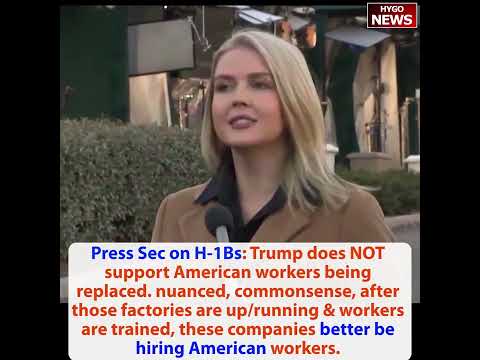
Press Sec on H-1Bs: Trump NOT support American being replaced; Plaskett initiated text Epstein
Multiple significant moments. Press Secretary Karoline Leavitt clarified Trump’s H-1B visa position: Trump does NOT support American workers being replaced. Trump’s framework is nuanced — foreign companies investing trillions in U.S. manufacturing may bring specialized workers initially to set up battery factories and similar specialized facilities, but Trump has told these companies “you better be hiring my people” once facilities are operational. Rep. Jamie Raskin was called out by CNN for defending Stacey Plaskett’s 2019 Epstein texting, having characterized it as “taking a phone call from one of her constituents.” CNN corrected: Plaskett INITIATED the text exchange with Epstein. Tennessee Democratic congressional candidate Aftyn Behn refused three separate times to answer questions about her deleted “defund the police” tweets from 2020, including calling for the Metropolitan Nashville Police Department to be “dissolved” and supporting “burning down a police station.” Behn’s dodges: “I’m not going to engage in cable news talking points,” “I don’t remember these tweets,” and “I’m here to talk about my race.” Leavitt on H-1B: “The president wants to see our American manufacturing industry be revitalized … He wants to see if foreign companies are investing trillions of dollars … He’s told these foreign companies that are investing here, you better be hiring my people if you’re going to be doing business in the United States.” CNN to Raskin: “To be clear, she initiated the text exchange.” Behn on tweets: “I don’t remember these tweets.”
H-1B Framework
A reporter asked Press Secretary Leavitt: “Is it MAGA to support American workers being replaced with H-1B visa holders? Are Americans not capable of filling most of these positions?”
The H-1B visa question had become politically charged. Trump’s base includes workers concerned about visa replacement of American jobs. Tech industry supports H-1B use. Trump’s framework needed clarification.
“Who supports getting American workers getting replaced?”
Leavitt’s opening framework: who supports this? The question implies nobody in the administration.
“I know the president mentioned that he wanted to bring in some workers that he could eventually send back in regards to…”
The reporter referenced specific Trump comments.
“The president does not support American workers being replaced. You are mischaracterizing what the president said.”
Leavitt’s clear statement: Trump does NOT support replacement.
Manufacturing Revitalization
“The president wants to see our American manufacturing industry be revitalized better than ever before. That’s part of what he’s doing with his effective use of tariffs and cutting good trade deals around the world. That’s why he’s recruited trillions and trillions of dollars in investments into our country.”
Trump’s manufacturing framework:
- Tariffs (force production back to US)
- Trade deals (market access + manufacturing commitments)
- Investment flows ($18T secured)
- Result: American manufacturing jobs
“Those are creating good paying American jobs right here at home.”
Investment = American jobs. The investment commitments from Japan, Korea, Saudi Arabia, Switzerland, etc., all require American factories and American workers.
H-1B Nuance
“As for the H-1B visa issue, the president has a very nuanced and common sense opinion on this issue.”
Leavitt’s framing: nuanced, not absolute.
“He wants to see if foreign companies are investing trillions of dollars in the United States of America and they’re bringing foreign workers with them to create very niche things like batteries. He wants to see that at the beginning to get those manufacturing facilities and those factories up and running.”
The framework:
- Foreign companies investing
- Specialized/niche products (batteries, semiconductors, advanced materials)
- Initial specialized workers (limited in number)
- Set up facilities
- Transition to American workers
The logic: Americans don’t currently have expertise for novel manufacturing (Chinese-style battery production, Korean semiconductor processes). Foreign specialists bring expertise. Train Americans. Americans take over.
”You Better Be Hiring My People”
“But ultimately the president always wants to see American workers in those jobs and he’s told these foreign companies that are investing here, you better be hiring my people if you’re going to be doing business in the United States.”
Trump’s direct instruction to foreign companies:
- Hire American workers
- “My people” = American citizens
- Condition of doing business in U.S.
This is enforcement framework. Companies investing here must actually create American jobs, not just import foreign workers.
“So there’s been a lot of misunderstanding of the president’s position.”
The framework resolves apparent contradiction. Trump supports:
- Initial specialized foreign expertise (temporary)
- Training American workers
- Transition to American workforce
Trump does NOT support:
- Permanent foreign worker substitution
- H-1B as cheap labor replacement
- Immigration as job displacement
Raskin on Plaskett
The CNN interviewer then pressed Rep. Jamie Raskin on his Plaskett defense. “Democratic congressman Stacey Plaskett, last week as you know there was a failed censure effort over her text with Epstein during an oversight hearing in 2019.”
The context: Republicans had attempted to censure Plaskett. Resolution failed.
“He was a known sex offender. She acknowledged Epstein’s influence in her line of questioning during that hearing on this show when we had her on but would not say it was an error in judgment.”
CNN framework:
- Epstein was known sex offender in 2019
- Plaskett acknowledged Epstein’s influence
- Plaskett wouldn’t admit error
Raskin’s Defense Played Back
“Here’s how you defended her on the House floor last week so our viewers can listen.”
“However ill advised it may have been she took a phone call from one of her constituents.”
CNN playing Raskin’s actual defense. “Ill advised” acknowledges some wrong, but “phone call from constituent” minimizes dramatically.
“They’ve arraigned a Democratic member for taking a phone call from her constituent Jeffrey Epstein in the middle of a hearing and of course I don’t think there’s any rule here against taking phone calls in a hearing.”
Raskin’s full defense: just a phone call from a constituent. No rule against it.
CNN Corrects
“To be clear she initiated the text chain on that day but are Democrats losing the moral high ground on the Epstein issue by defending her as you have?”
CNN’s factual correction:
- Plaskett initiated the text chain
- Not “taking a call”
- Actively sought Epstein coordination
The framework destroys Raskin’s defense. “Taking a call from constituent” implies passive reception. Reality: Plaskett initiated communication with convicted sex offender for political purposes.
Raskin’s Retreat
“Well look we’ve been demanding a complete release of the file and now they wanted to discipline her, censure her because she’d engage in that text exchange with a convicted criminal.”
Raskin’s pivot:
- Democrats demand Epstein file release
- Republicans trying to discipline Plaskett
- Plaskett’s “text exchange with convicted criminal”
Raskin acknowledges Epstein was “convicted criminal” when Plaskett coordinated with him. This contradicts his earlier minimization.
The framework collapses. Plaskett initiated coordination with known convicted sex offender for political attack questions. Raskin’s defense is inadequate.
Aftyn Behn Dodges
The interview shifted to Tennessee Democratic candidate Aftyn Behn. “In 2020 you made some tweets that have since been deleted that were very critical of police. You said in those since deleted tweets that the Metropolitan Nashville Police Department should be dissolved.”
Behn’s 2020 tweets:
- Metropolitan Nashville Police should be “dissolved”
- Defund the police as schools reopening requirement
- Supporting burning police stations (54% statistic)
“Another cheered on a teacher’s union saying that defund the police should be a requirement for schools reopening.”
Combining defund police with school reopening. Progressive cross-issue framework.
“And another saying good morning especially to the 54% of Americans that believe burning down a police station is justified.”
Behn celebrated the minority that supported violent destruction of police facilities.
First Dodge
“I’m not going to engage in cable news talking points but what I will say is that you know our communities need solutions.”
Behn’s first dodge: “cable news talking points.”
These aren’t talking points. They’re her actual documented tweets. Characterizing her own record as “talking points” is evasive.
“We need local people deciding solving local problems with local solutions and that’s not the overreach of a federal government or state government of is of which we are dealing with and in Nashville and our cities across the state of Tennessee.”
Behn’s pivot to localism framework. Avoids the question.
Second Dodge
“So you don’t want to clarify whether you still believe that the police should be defunded?”
The interviewer pressed.
“Once again I don’t remember these tweets but what I’m saying is is that…”
Behn’s second dodge: “I don’t remember these tweets.”
The tweets were documented. Behn made them. The “don’t remember” framework is implausible for someone running for Congress and facing scrutiny.
Third Dodge
“I’m not asking if you remember what is your position today? How’s that on this issue?”
The interviewer clarified: not asking about memory, asking about current position.
“I mean once again I’m here to talk about my race which is in literally nine days.”
Behn’s third dodge: “I’m here to talk about my race.”
Nine days before the election. Behn wants to discuss campaign only, not substantive policy questions about her record.
Behn’s Strategic Problem
Behn has a fundamental problem:
- Past progressive positions recorded
- Current moderate positioning needed
- Can’t admit past positions (alienates moderates)
- Can’t deny past positions (dishonest, verifiable)
- Can’t defend past positions (alienates general election voters)
The only strategy: dodge. Refuse to engage. Change subject.
The Democratic candidate’s approach illustrates broader Democratic dilemma. Many Democrats embraced “defund police” in 2020. Most have walked back. But their statements exist. Republicans exploit. Democrats dodge.
The political cost:
- Moderate voters suspicious
- Republican voters energized
- Independent voters see evasion
- Base voters frustrated (Behn not defending progressive values)
Significance
Three substantively important items:
-
H-1B clarification: Trump’s nuanced framework explained. Addresses base concerns while maintaining investment flows.
-
Plaskett-Raskin exposure: CNN correcting false defense. Plaskett initiated coordination. Raskin’s defense fails.
-
Behn dodges: Democratic candidate unable to engage own record. Pattern across Democratic candidates facing past statements.
The H-1B issue is politically sensitive. Trump needs to balance:
- Tech industry donors (want H-1B)
- Working-class base (concerned about displacement)
- Manufacturing investors (need specialized workers initially)
- Immigration hawks (want American workers only)
Leavitt’s nuanced framework threads the needle. Specialized workers temporary, American workers permanent, companies must hire Americans.
Plaskett matter will likely continue. Committee assignment implications possible. House Ethics may review. Republican pressure continues.
Behn’s race in Tennessee will be observed. If she can’t defend past statements, likely loses. Tennessee district politics matter for 2026 midterm.
Key Takeaways
- Leavitt on H-1B: “The president does not support American workers being replaced … The president wants to see our American manufacturing industry be revitalized better than ever before … The president has a very nuanced and common sense opinion on this issue.”
- Leavitt on foreign workers: “He wants to see if foreign companies are investing trillions of dollars in the United States of America and they’re bringing foreign workers with them to create very niche things like batteries. He wants to see that at the beginning to get those manufacturing facilities and those factories up and running.”
- Leavitt on hiring mandate: “He’s told these foreign companies that are investing here, you better be hiring my people if you’re going to be doing business in the United States.”
- CNN correcting Raskin: Raskin: “She took a phone call from one of her constituents.” CNN: “To be clear she initiated the text chain on that day.”
- Behn dodging: “I’m not going to engage in cable news talking points” … “Once again I don’t remember these tweets” … “I’m here to talk about my race which is in literally nine days.”