 HYGO News
 Press Sec: most successful 6 months; Bessent: Universal Income for PhD econ; Jeffries: shut down gov
Press Sec: most successful 6 months; Bessent: Universal Income for PhD econ; Jeffries: shut down gov
White House Press Secretary Karoline Leavitt doubled down on the six-month declaration: “We’ve had the most successful six months of any administration. The president has delivered on his two core campaign promises, defeat inflation and secure the homeland in record time.” Treasury Secretary Scott Bessent took the rhetorical axe to Federal Reserve culture: “All these PhDs over there, I don’t know what they do. I don’t know what they do. This is like universal basic income for academic economists.” Senate Majority Leader John Thune accused House Democratic Leader Hakeem Jeffries of threatening to shut down the government over a “one tenth of one percent” spending trim. Rep. Pramila Jayapal, speaking about SNAP and Medicaid cuts, accidentally revealed that illegal immigrants do receive those benefits: “It’s not just undocumented immigrants. It is people of all legal statuses. It’s undocumented immigrants who have been here for 20 years.” And Rep. Hakeem Jeffries himself framed the administration as wanting to “shut down the government,” citing Project 2025.
”Most Successful Six Months”
Leavitt opened with a summary framing. “They’ve learned nothing from President Trump’s overwhelming victory on November 5th. The American people want deportations, they want secure borders. That’s why we’ve had the most successful six months of any administration. The president has delivered on his two core campaign promises, defeat inflation and secure the homeland in record time.”
“Most successful six months of any administration” is the maximalist claim. The comparison would run against Reagan’s 1981 opening, FDR’s first hundred days, Obama’s 2009 stimulus year. Leavitt is asserting that the current Trump administration’s first six months exceed any of those benchmarks.
That is a claim about pace, not about outcomes — outcomes need more time to assess. But on pace — legislative wins, executive orders, diplomatic moves, personnel actions — the second term opens with an unusual tempo.
“Defeat inflation and secure the homeland in record time” — “record time” is the operative phrase. Inflation at 2.1%, border at zero releases, all delivered in six months.
Bessent on the Fed’s PhDs
Treasury Secretary Scott Bessent’s critique of the Federal Reserve was framed as an institutional examination. “What we need to do is examine the entire Federal Reserve institution and whether they have been actually I’m going to be in the building this evening. There is a regulatory conference that begins tomorrow.”
The setup is that Bessent was about to deliver a keynote address at a regulatory conference at the Fed. “I’m the keynote speaker tonight talking about regulation, monetary policy, regulations, financial stability.”
“Again, I think that we should think HESI organizations succeeded in its mission.”
“HESI” appears to be a Whisper artifact — likely “these” or “this.” Bessent’s point is that institutional examination should ask whether the Fed has succeeded in its mission.
”If This Were the FAA”
Bessent’s analogy. “You know, if this were the FAA and we were having this many mistakes, we would go back and look at why has this happened?”
The FAA comparison is sharp. After major aviation incidents, regulators and the industry conduct detailed post-mortems. Why did the mistake happen? What were the contributing factors? How does the institution prevent recurrence? That culture of after-action review is standard in aviation.
Bessent’s argument: the Fed makes major policy mistakes — and the pre-tariff inflation predictions he is specifically citing are an example — but the institutional culture does not conduct FAA-style post-mortems. “Fear mongering over tariffs and thus far we have seen very little if any inflation. We’ve had great inflation numbers.”
That is the data point Bessent is pointing to. Fed staff predicted substantial tariff-driven inflation. Inflation has remained muted. In any other institutional setting, that forecasting failure would trigger review. In the Fed, Bessent is arguing, the prediction failures accumulate without consequences.
”Universal Basic Income for Academic Economists”
“You know, I think this idea of them not being able to break out of a certain mindset, you know, all these PhDs over there, I don’t know what they do. I don’t know what they do. This is like universal basic income for academic economists.”
“Universal basic income for academic economists” is the meme line of the cycle. The Federal Reserve employs hundreds of PhD economists. Many of them rotate in from or out to academic positions. The intellectual culture of the Fed’s research division is heavily influenced by academic economics.
Bessent’s critique: the intellectual capture of the Fed by academic economics produces a specific kind of groupthink that is durable to evidence. The same kind of analysis produces the same kind of predictions, even when the predictions fail in real-world conditions. The PhDs are being paid — generously — for analysis that does not improve over time. “Universal basic income” frames the payments as subsidies for credentialed but non-productive work.
That critique, whatever its institutional merit, is calibrated for an audience that is skeptical of expert class compensation and intellectual capture. It will be quoted widely by Fed critics. It will be rejected as unfair by Fed defenders. Both reactions will contribute to the ongoing narrative pressure on the institution.
Thune on the Shutdown Threat
Senate Majority Leader John Thune addressed the looming appropriations showdown. “Of course, any regular order consideration of appropriation bills is going to require cooperation from Democrats. And this week we’ll get a glimpse of where Democrats are on this issue.”
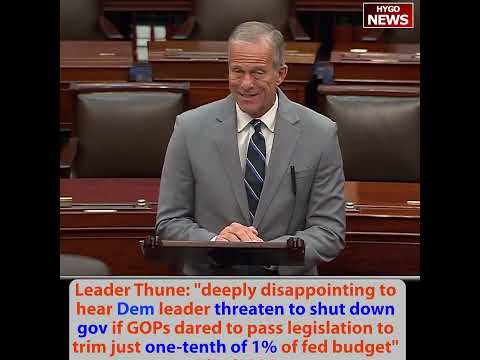
“It was deeply disappointing to hear the Democrat leader threaten to shut down the government if Republicans dared to pass legislation to trim just one tenth of one percent of the federal budget. But I’m hopeful that that is not the position of the Democrat Party. Time will tell.”
“One tenth of one percent” — 0.1% — of the federal budget. That is the magnitude of the spending reduction the Democrats are threatening to shut down the government over, according to Thune’s framing. Whether the characterization is accurate — whether the Democrats would truly shut down over such a small trim — is the test that is about to unfold in the appropriations fight.
If Thune’s framing holds, the political optics are punishing for Democrats. A party that will not accept a 0.1% budget reduction under any circumstances is a party that has aligned itself against any fiscal adjustment.
Jayapal’s Accidental Admission
Rep. Pramila Jayapal’s comments on SNAP and Medicaid cuts contained what the administration’s allies flagged as an accidental admission. “Yesterday I was at a food bank in my district talking about the snap cuts, the horrible snap cuts and Medicaid cuts. And they told me that people are not even showing up to head start where they get their food. They’re not showing up to the food banks because they’re afraid.”
The “afraid” framing is about immigration enforcement. Jayapal is saying undocumented immigrants (and people related to them) are afraid to show up to public services because of potential ICE enforcement.
Then the specific admission: “And it’s not just undocumented immigrants. It is people of all legal statuses. It’s undocumented immigrants who have been here for 20 years."
"Not Just Undocumented Immigrants”
That phrasing is the crack. Jayapal, addressing SNAP and Medicaid benefit reductions, said the affected population includes “people of all legal statuses” and specifically “undocumented immigrants who have been here for 20 years.”
For Democratic talking points, the standard framing has been that undocumented immigrants do not receive SNAP or Medicaid federally. Federal law restricts those benefits to legal residents and citizens. But states and municipalities have layered their own programs on top of federal benefits, and in those layered programs, undocumented immigrants can access some benefit categories.
Jayapal’s phrasing — that undocumented immigrants who have been in the country for 20 years are afraid to show up at food banks and Head Start programs because of benefit cuts — implies they were receiving those benefits. If they were not receiving them, they would not be affected by the cuts.
That admission contradicts the Democratic framing that Scott Jennings, Jessica Tarlov, and other voices have argued against. The administration’s allies seized on the admission as verification that their position on this question was correct.
Jeffries: “Shut Down the Government”
Rep. Hakeem Jeffries framed the appropriations fight in the opposite direction from Thune. “It’s my expectation that if Republicans tried to jam a highly partisan spending bill down the throats of the American people here in the House, we’ll reject it.”
Jeffries’s framing: the Republicans are the ones pushing a “highly partisan spending bill.” The Democrats are the ones being reasonable.
“Rosa de Loro will take the lead has consistently expressed an interest in trying to arrive at a bipartisan spending agreement that meets the needs of the American people in terms of their health, their safety and their economic well-being.”
Rep. Rosa DeLauro, ranking member of the House Appropriations Committee, is — in Jeffries’s framing — the reasonable voice seeking bipartisan agreement. The “horrible snap cuts and Medicaid cuts” Jayapal raised are, in this framing, the proof that Republican spending priorities are harming vulnerable Americans.
“But it’s Republicans who have shown no willingness to do that. And you have Trump administration officials like the author of Project 2025 saying that we should walk away as Republicans from the appropriations process, which means they want to shut down the government.”
“The author of Project 2025” is Paul Dans or the broader team at the Heritage Foundation. Jeffries is accusing the administration of wanting to shut down the government as a way to accelerate agency-level reforms that could happen more easily during a shutdown’s chaos.
Two Opposite Framings
The same appropriations fight generates opposite characterizations. Thune: Democrats will shut down the government over a 0.1% trim. Jeffries: Republicans will shut down the government to force an unrepresentative spending agenda. Both cannot be correct. The outcome of the fight will reveal which framing aligned with the underlying political dynamics.
Key Takeaways
- Press Secretary Karoline Leavitt: “The most successful six months of any administration … defeat inflation and secure the homeland in record time.”
- Treasury Secretary Scott Bessent attacked Fed culture: “All these PhDs over there, I don’t know what they do. I don’t know what they do. This is like universal basic income for academic economists” — with tariff-inflation predictions as the specific failure.
- Bessent: “if this were the FAA and we were having this many mistakes, we would go back and look at why has this happened?”
- Senate Leader John Thune accused Democrats of threatening “to shut down the government if Republicans dared to pass legislation to trim just one tenth of one percent of the federal budget.”
- Rep. Pramila Jayapal accidentally admitted undocumented immigrants receive public benefits: “It’s not just undocumented immigrants. It is people of all legal statuses. It’s undocumented immigrants who have been here for 20 years.”