 HYGO News
 Leavitt on Tariff Court Ruling: 'Another Example of Judicial Overreach -- Trade Deficit in Goods Exceeded $1 Trillion in 2024, Every Year Since 1975'; Appeal to Supreme Court; COOKS Reporter on Gaza Aid: 'Previous Administration Rejected Such a Plan; Their Pier Cost $230M, Lasted 20 Days, Injured 60 Service Members'
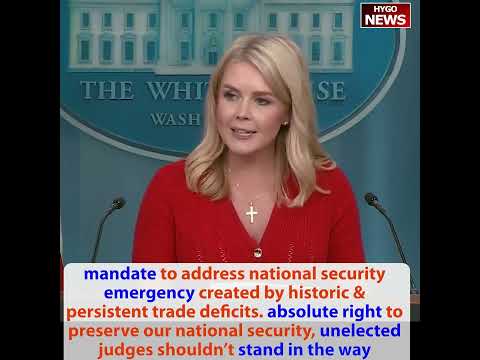
Leavitt on Tariff Court Ruling: “Another Example of Judicial Overreach — Trade Deficit in Goods Exceeded $1 Trillion in 2024, Every Year Since 1975”; Appeal to Supreme Court; COOKS Reporter on Gaza Aid: “Previous Administration Rejected Such a Plan; Their Pier Cost $230M, Lasted 20 Days, Injured 60 Service Members”
Press Secretary Karoline Leavitt delivered substantive remarks on two significant May 2025 issues. On the tariff court ruling: “Last night, the Trump administration faced another example of judicial overreach. Using his full and proper legal authority, President Trump imposed universal tariffs and reciprocal tariffs on Liberation Day to address the extraordinary threat to our national security and economy posed by large and persistent annual U.S. goods trade deficits. The United States has run a trade deficit of goods every year since 1975. In 2024, our trade deficit in goods exceeded $1 trillion. Everybody agrees this is unacceptable. Three judges of the U.S. Court of International Trade brazenly abused their judicial power to usurp the authority of President Trump… Congress firmly rejected an effort led by Senator Rand Paul and Democrats to terminate the President’s reciprocal tariffs… Ultimately the Supreme Court must put an end to this for the sake of our Constitution and our country.” On Gaza aid: “When aid was rolled out to Gaza for the first time in many months, thanks to President Trump… The previous administration rejected such a plan… They built this pier that cost $230 million. It lasted about 20 days. More than 60 U.S. service members were injured as part of this floating aid pier that did nothing for the people of Gaza."
"Another Example of Judicial Overreach”
Leavitt opened with the tariff court ruling.
“Last night, the Trump administration faced another example of judicial overreach,” Leavitt said.
She laid out the president’s position: “Using his full and proper legal authority, President Trump imposed universal tariffs and reciprocal tariffs on Liberation Day to address the extraordinary threat to our national security and economy posed by large and persistent annual U.S. goods trade deficits.”
She cited the historical record: “The United States has run a trade deficit of goods every year since 1975.”
She cited the current scale: “In 2024, our trade deficit in goods exceeded $1 trillion. Everybody agrees this is unacceptable.”
She described Trump’s response: “President Trump is delivering on his promise to fix this problem, and he has taken a long overdue and much needed bold stance for American workers after decades of our manufacturing base being hollowed out.”
The 50-Year Trade Deficit
The “every year since 1975” framing was historically significant. The American trade deficit had been growing for 50 years:
Mid-1970s: Small trade deficits emerged as Japan’s export economy matured 1980s: Significant deficits emerged, particularly with Japan 1990s: Broad-based trade deficits as globalization accelerated 2000s: China emerged as dominant source of trade deficits 2010s: Deficits grew to unprecedented levels with China 2020s: Deficits exceeded $1 trillion annually
The cumulative effect had been:
- $20+ trillion in accumulated trade deficits over 50 years
- Millions of American manufacturing jobs lost
- Industrial capability transferred abroad
- Dependence on foreign supply chains
- Wealth transfer from American consumers to foreign producers
- Strategic vulnerabilities across multiple sectors
Traditional economic theory had held that trade deficits were not problematic — countries with strong consumption and weak savings would naturally import more than they exported. But this theory had failed to account for:
- Strategic considerations (military, health, essential supplies)
- Community effects (industrial devastation, social decline)
- Distributional effects (benefits to capital, costs to labor)
- Political effects (alienation of working-class voters)
- Cumulative effects over long time periods
Trump’s trade policy represented a break with 50 years of bipartisan consensus that had tolerated or encouraged growing trade deficits. Reversing this trajectory would require substantial policy intervention.
The Court’s Ruling
Leavitt described the court decision.
“Three judges of the U.S. court of international trade disagreed and brazenly abused their judicial power to usurp the authority of President Trump to stop him from carrying out the mandate that the American people gave him,” Leavitt said.
She identified the legal basis: “These judges failed to acknowledge that the President of the United States has core foreign affairs powers and authority given to him by Congress to protect the United States economy and national security.”
She referenced congressional procedures: “Congress had created the National Emergency Act to provide the congressional framework to strike down improper IEPA use.”
She cited the specific congressional action: “In any questions over whether President Trump improperly imposed these IEPA tariffs were already adjudicated in Congress following Liberation Day. Congress firmly rejected an effort led by Senator Rand Paul and Democrats to terminate the President’s reciprocal tariffs.”
She made the constitutional point: “The courts should have no role here.”
The Constitutional Issue
The tariff case involved significant constitutional questions:
Executive authority in foreign commerce: The Constitution gives Congress authority over commerce with foreign nations. Congress had delegated various emergency authorities to the president through statutes like IEEPA.
National Emergencies Act: Congress had created specific procedures for terminating national emergency declarations. When Rand Paul and Democrats attempted to terminate Trump’s emergency declaration in Congress, they failed. Congress had explicitly declined to override Trump’s emergency determination.
Judicial review: Courts had traditionally been deferential to executive determinations about national security and emergency conditions. The Court of International Trade’s willingness to second-guess Trump’s emergency finding represented judicial expansion into areas traditionally reserved for political branches.
Constitutional framework: The Constitution distributes authority among three coordinate branches. When a judge strikes down a presidential action that Congress has implicitly or explicitly accepted, the court is claiming authority that the Constitution might not support.
Leavitt’s argument was that:
- Congress delegated emergency tariff authority to the president through IEEPA
- Trump declared the emergency and imposed tariffs under this authority
- Congress had opportunity to terminate the emergency and declined
- The courts therefore had no legitimate role in second-guessing
- Judicial striking of the tariffs exceeded proper judicial authority
”Trend of Unelected Judges”
Leavitt made the broader institutional critique.
“There is a troubling and dangerous trend of unelected judges inserting themselves into the presidential decision-making process,” Leavitt said.
She identified the operational consequence: “America cannot function if President Trump or any other president for that matter has their sensitive diplomatic or trade negotiations railroaded by activist judges.”
She described the current policy work: “President Trump is in the process of rebalancing America’s trading agreements with the entire world bringing tens of billions of dollars in tariff revenues to our country and finally ending the United States of America from being ripped off.”
She made the credibility point: “These judges are threatening to undermine the credibility of the United States on the world stage.”
The Appeals Process
Leavitt described the legal strategy.
“The administration has already filed an emergency motion for a stay pending appeal and an immediate administrative stay to strike down this egregious decision,” Leavitt said.
She stated the ultimate objective: “But ultimately the Supreme Court must put an end to this for the sake of our Constitution and our country.”
The legal path forward involved multiple steps:
Emergency stay request: Asking the trial court to pause its own ruling pending appeal. This had been filed.
Court of Appeals: The case would go to the Federal Circuit Court of Appeals, which had jurisdiction over international trade matters. The administration would argue for the ruling’s reversal.
Supreme Court: If unsuccessful at the appellate level, the administration would petition the Supreme Court. Given the constitutional significance and the administration’s need for certainty, Supreme Court review was highly likely.
Timeline: This process could take months or even a year. During appeals, various procedural mechanisms could preserve tariffs or allow their continued enforcement.
Parallel actions: As Vance had noted, other statutory authorities (Section 232, Section 301, etc.) could support tariffs even if IEEPA authority were ultimately restricted.
The Gaza Aid Question
The briefing transitioned to Gaza humanitarian assistance.
A reporter asked: “This administration has been briefed about the incident that happened in Gaza during on Tuesday during the rollout of the Gaza humanitarian foundation distribution of aid Palestinians there and should there be a ceasefire will this administration continue to rely on this foundation for the distribution of aid to civilians?”
Leavitt sought clarification: “Are you referring what what incident are you referring to?”
The reporter clarified: “On Tuesday when the aid was rolled out to Gaza for the first time in many months and meals and food was given to hungry people thanks to President Trump.”
Leavitt’s response was extensive and pointed: “Yes we were briefed on that plan the president was the reason that that aid went into Gaza and he got the Israelis to support that plan and I would add that the previous administration rejected such a plan to ensure that these starving and devastated people in the Gaza Strip were given humanitarian aid and assistance.”
The Biden Pier Failure
Leavitt raised a specific comparison point.
“It was the previous administration that tried to build this pier if you all remember it,” Leavitt said.
She described the timing: “It was brought to my attention this morning and I thought that’s a good point why don’t I bring that up.”
She noted the media context: “Because there’s been so much criticism in fact it was on the front page of a newspaper this morning about the criticism for the president having a humanitarian heart and giving people badly needed food and supplies.”
She delivered the historical comparison: “Nobody wanted to talk about how the previous administration failed in that endeavor they built this pier that cost 230 million dollars it lasted about 20 days and more than 60 U.S. service members were injured or I’m sorry service members were injured as a part of this floating aid pier that did nothing for the people of Gaza.”
The 2024 Pier Fiasco
The pier reference was to a specific Biden administration failure:
The plan: In March 2024, President Biden announced plans for a temporary pier off the Gaza coast to deliver humanitarian aid without relying on Israeli-controlled border crossings.
Construction: The U.S. military built the pier over several weeks.
Operational problems: Weather conditions, particularly waves and seas, repeatedly damaged the pier.
Service member injuries: More than 60 U.S. service members were injured during construction and operation, some seriously.
Operational failures: Aid actually delivered through the pier was minimal compared to what had been promised.
Aid destination issues: Some aid delivered to the pier was stolen or diverted rather than reaching civilians.
Short duration: After approximately 20 days of operation, the pier was dismantled due to damage and operational problems.
Cost: Total costs exceeded $230 million for minimal results.
The pier had been a fiasco on multiple levels:
- Wasted taxpayer funds
- Injured American service members for limited benefit
- Failed to meaningfully help Gaza civilians
- Had been criticized for poor planning
- Represented poor judgment about operational feasibility
- Was ultimately abandoned
By contrast, Trump’s approach to Gaza aid:
- Used Israeli-approved distribution system
- Avoided deploying American service members
- Didn’t build expensive fragile infrastructure
- Got aid to civilians more effectively
- Avoided the casualty risks of the pier
- Delivered results the Biden pier had promised but failed to achieve
Leavitt’s comparison was devastating. The Biden pier represented everything wrong with the previous administration’s approach:
- Expensive
- Dangerous to Americans
- Operationally impractical
- Ineffective for intended beneficiaries
- Politically performative rather than substantively helpful
”Humanitarian Heart”
Leavitt framed Trump’s Gaza approach positively.
“The president is opening up his humanitarian heart to get aid into the region while his team simultaneously negotiates a ceasefire in the return of all hostages,” Leavitt said.
She described the broader objective: “We are moving the ball forward in a positive direction for all people the president wants to see peace for all people.”
The “humanitarian heart” framing was politically sophisticated. It:
- Positioned Trump as caring about Palestinian civilians
- Contrasted with the progressive framing of Trump as callous
- Provided rebuttal to media criticism
- Emphasized practical results over symbolic gestures
- Connected Gaza aid to broader peace objectives
The dual-track approach Leavitt described was also substantive:
- Immediate humanitarian aid for civilians
- Simultaneous negotiations for ceasefire
- Hostage return as component of ceasefire
- Peace for all people as ultimate objective
This reflected Trump administration coordination. Gaza policy was not just humanitarian assistance; it was comprehensive engagement combining:
- Military pressure on Hamas
- Humanitarian aid to civilians
- Hostage negotiations
- Ceasefire discussions
- Post-war governance considerations
- Reconstruction planning
Each element supported the others. Effective humanitarian aid weakened Hamas’s ability to instrumentalize civilian suffering. Ceasefire negotiations could succeed only with hostage returns. Peace required all elements functioning together.
The Media Criticism Context
Leavitt had noted front-page criticism of Trump’s Gaza approach. The media pattern had been:
- Criticism when Trump’s approach seemed tough
- Silence when Trump’s approach succeeded
- Criticism when new aid mechanism had initial challenges
- No credit when mechanism delivered results
- Consistent framing as callous toward Palestinians
This asymmetric media coverage was a pattern that Trump officials had been documenting. Democratic approaches to Gaza received favorable coverage regardless of results (the pier failed spectacularly but received limited critical coverage). Republican approaches received critical coverage regardless of success.
Leavitt’s willingness to challenge this pattern directly — contrasting the $230 million Biden pier failure with Trump’s successful aid delivery — was important. Each such specific challenge made it harder for media to maintain the asymmetric coverage pattern.
Key Takeaways
- Leavitt on tariff court: “Another example of judicial overreach. Trade deficit in goods every year since 1975 — $1 trillion in 2024.”
- Congressional procedure: “Congress firmly rejected effort by Rand Paul and Democrats to terminate the tariffs.”
- Appeal strategy: “Supreme Court must put an end to this for the sake of our Constitution and our country.”
- Gaza aid: “Trump got Israelis to support plan. Previous administration rejected such a plan.”
- Biden pier comparison: “$230 million, 20 days, 60+ service members injured — did nothing for Gaza.”