 HYGO News
 Press Sec's MAGA Minute from Abu Dhabi: Historic Week -- $600B Saudi, $1.2T Qatar, $200B UAE, China Deal, India-Pakistan Ceasefire, Hostage Freed; Rubio: 'Holy See Willing to Be Involved' in Russia-Ukraine
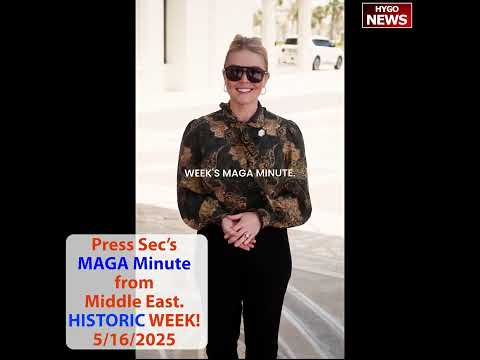
Press Sec’s MAGA Minute from Abu Dhabi: Historic Week — $600B Saudi, $1.2T Qatar, $200B UAE, China Deal, India-Pakistan Ceasefire, Hostage Freed; Rubio: “Holy See Willing to Be Involved” in Russia-Ukraine
Press Secretary Karoline Leavitt delivered the May 16, 2025 “MAGA Minute” from Abu Dhabi, summarizing what she called “a historic week.” The headline accomplishments: $600 billion in Saudi investment commitments, a $1.2 trillion Qatar economic exchange, $200+ billion in UAE commercial deals, the initial U.S.-China trade deal, an India-Pakistan ceasefire “preventing a nuclear war,” the release of last American hostage Eden Alexander after 584 days in Hamas captivity, a drug pricing executive order, and inflation falling to a four-year low. Secretary of State Marco Rubio separately thanked the Holy See for its willingness to help with Russia-Ukraine peace talks: “We are grateful for their longstanding efforts, not simply on trying to broker peace but on the exchanges of prisoners. There are children currently being taken from their homes that the Ukrainians would like to see returned.”
The MAGA Minute from Abu Dhabi
Press Secretary Leavitt opened with the location.
“President Trump has been on a historic tour of the Middle East this week,” Leavitt said. “We’re coming to you live for the MAGA Minute from Abu Dhabi, so let’s roll through it.”
She framed the strategic significance: “This week in the Middle East, President Trump marked a new era of American foreign policy, encouraging peace and prosperity through strength.”
The “peace through strength” framing was the defining characterization of Trump’s foreign policy approach. The formulation, originally associated with Reagan, meant that peace was achievable only when adversaries and allies alike recognized American strength and credibility. Projection of weakness invited aggression; projection of strength deterred it.
The “new era” claim was not rhetorical excess. By May 2025, the Middle East had been transformed from its 2023 condition:
- Hamas had been militarily decimated in Gaza
- Hezbollah had been leadership-decapitated in Lebanon
- The Assad regime in Syria had fallen to HTS-led rebels
- Iran had lost its proxy network’s capacity for coordinated action
- Saudi-Israeli normalization was back on track
- The Abraham Accords framework had expanded
- Gulf states were deeply committed to American economic partnerships
The Investment Numbers
Leavitt ran through the financial commitments.
“President Trump announced a $600 billion commitment in investments from the country of Saudi Arabia,” Leavitt said, “which will mean hundreds of thousands of new jobs in your communities.”
She continued: “In Qatar, the president signed a historic agreement to generate an economic exchange with the United States worth $1.2 trillion.”
She described the specific deals: “And the dealmaker in chief also announced a historic sale of American-made Boeing aircrafts and American-made GE aerospace engines to Qatari airways.”
She covered the UAE: “Finishing off the trip in the United Arab Emirates, the president announced more than $200 billion in commercial deals between the United States and the UAE.”
The total across the three Gulf stops — $600B Saudi + $1.2T Qatar + $200B UAE — came to approximately $2 trillion. Including Trump’s separate claim of roughly $10 trillion in potential investments over time, the trip had generated commitment flows on a scale that was unprecedented in American diplomatic history.
The “jobs in your communities” framing was directly populist. By tying foreign investment to domestic employment impact, Leavitt was making the case that the Middle East trip was not abstract diplomatic theater but rather concrete economic benefit for American workers. Aircraft manufacturing, energy equipment production, AI data center construction, defense industrial base activity — all would generate American jobs in specific regions.
China Initial Trade Deal
Leavitt covered the China breakthrough.
“The president this week also signed a historic initial trade deal with China to reduce tariffs,” Leavitt said, “and to continue discussing opening Chinese markets to American-made products and goods.”
The Switzerland meeting Bessent had announced had produced substantive initial results. Both sides had agreed to temporary tariff reductions while continuing negotiations on structural issues: intellectual property protection, market access, currency policy, and forced technology transfer.
The “initial” framing was accurate. The China deal was not a complete resolution of the bilateral trade dispute. Many structural issues remained. But the 90-day tariff truce with substantial rate reductions was the first major de-escalation in the trade conflict that had begun in Trump’s first term and had escalated dramatically in early 2025.
India-Pakistan Ceasefire
Leavitt described the South Asia breakthrough.
“President Trump also secured a ceasefire between India and Pakistan,” Leavitt said, “literally preventing a nuclear war.”
The “preventing a nuclear war” framing was not hyperbolic. Operation Sindoor, India’s response to the Pahalgam terror attack that killed 26 Hindu pilgrims, had led to the most serious India-Pakistan military confrontation in decades. Direct military exchanges between the two nuclear-armed neighbors had escalated rapidly. Public statements from both sides had referenced the nuclear dimension of their arsenals.
Trump’s direct involvement — with Rubio, Vance, and Whitcoff conducting shuttle diplomacy — had produced a ceasefire when the situation was at the edge of full-scale war. The American ability to simultaneously maintain warm relationships with both India and Pakistan, which was unusual in contemporary great-power diplomacy, had enabled the mediation role.
Hostage Edan Alexander Released
Leavitt noted the Gaza hostage development.
“President Trump and Special Envoy Whitcoff secured the release of American Eden Alexander,” Leavitt said, “the last remaining American hostage in Gaza, after 584 days in Hamas captivity.”
Edan Alexander had been a 20-year-old American-Israeli soldier kidnapped from his base near the Gaza border during the October 7, 2023 Hamas attack. His release in May 2025 — secured through direct Trump administration engagement with Hamas via Qatari intermediaries — meant that no living American citizens remained in Hamas captivity.
The 584-day captivity was harrowing. Alexander had been held in Hamas tunnel networks for over 19 months, often in conditions of extreme deprivation. His survival was considered remarkable given the conditions. His release was the product of sustained American pressure through multiple channels — military, diplomatic, and economic — that had led Hamas to conclude that his continued captivity was no longer strategically beneficial.
Drug Prices and Inflation
Leavitt covered the domestic policy wins.
“On the home front, President Trump signed an executive order putting American patients first to lower your drug prices,” Leavitt said, “and to end foreign nations paying cheaper money for drugs in ripping off American pharmaceutical innovation.”
She cited the inflation number: “Washington fell to its lowest level in more than four years this past month.”
The drug pricing executive order had been a major domestic policy announcement. The “Most Favored Nation” pricing structure — requiring that Americans pay no more than the lowest price charged to similarly developed nations — was intended to eliminate what Trump called international “freeloading” on American pharmaceutical innovation.
The “lowest level in four years” inflation claim referred to April 2025 CPI data, which had shown year-over-year inflation at its lowest level since 2021. Combined with the PPI data showing wholesale prices declining dramatically, the inflation picture was significantly improved from the Biden-era peaks.
”One Big Beautiful Bill” Preview
Leavitt previewed the legislative agenda.
“It was certainly a packed week and we look forward to working with Congress next week to pass the one big beautiful bill,” Leavitt said, “which means the greatest tax cuts in history.”
The “One Big Beautiful Bill” was the administration’s signature legislative initiative, combining tax cut extensions, new tax cuts, immigration enforcement funding, and various other priorities into a single reconciliation package. The bill was scheduled for floor action in the weeks following the Middle East trip.
Rubio: The Holy See Role
Secretary of State Marco Rubio separately addressed Russia-Ukraine peace efforts.
“Yes, and we thank the Holy See for its willingness to be involved in this process,” Rubio said.
He acknowledged the broader diplomatic field: “Obviously, there are a number of countries that have offered that as well.”
Asked whether the Vatican could be “the broker” or “once a broker,” Rubio clarified: “Well, I wouldn’t call it a broker, but it certainly is a place that I would think that both sides would be comfortable coming.”
He praised the Vatican’s track record: “So we are grateful for their longstanding efforts, not simply on trying to broker peace, but on the exchanges of prisoners.”
He specified one particular contribution: “There are children that are currently being taken from their homes that the Ukrainians would like to see returned and the Holy See has been very involved in that regard.”
He closed: “So we’ll talk about that and all of it. And obviously, we’re always grateful for the willingness of the Vatican to play this constructive and positive role.”
The Vatican’s role in Russia-Ukraine diplomacy was substantial. The Holy See had facilitated prisoner exchanges throughout the war, had been actively involved in efforts to return Ukrainian children abducted by Russia, and maintained the unusual position of direct diplomatic relations with both Moscow and Kyiv. Pope Francis (and subsequently Pope Leo XIV after Francis’s April 2025 death) had consistently called for negotiated peace rather than military resolution.
The “children currently being taken from their homes” reference was to the mass abduction of Ukrainian children by Russian forces. Ukrainian authorities estimated that approximately 19,000 Ukrainian children had been forcibly transferred to Russia or Russian-occupied territory, in apparent violation of international law. The International Criminal Court had issued arrest warrants for Vladimir Putin and his children’s commissioner specifically for this practice. The Holy See had been working quietly to facilitate returns.
Rubio’s framing — “a place that both sides would be comfortable coming” — indicated that Switzerland, Turkey, and the Vatican were all being considered as potential venues for future U.S.-Russia-Ukraine diplomacy. The multi-venue approach reflected the complexity of the diplomatic effort required to end the war.
Key Takeaways
- MAGA Minute from Abu Dhabi: Saudi $600B, Qatar $1.2T, UAE $200B+, China deal, India-Pakistan ceasefire, hostage freed.
- Trump secured ceasefire “literally preventing a nuclear war” between India and Pakistan.
- Edan Alexander, last American hostage in Gaza, released after 584 days in Hamas captivity.
- Drug pricing EO ends foreign “freeloading” on American pharmaceutical innovation; inflation at 4-year low.
- Rubio: Holy See willing to help with Russia-Ukraine — especially on exchanging prisoners and returning abducted Ukrainian children.