 HYGO News
 Leavitt: Biden Cover-Up Was 'One of the Greatest Scandals in American History'; Media 'Accused Us of Manufacturing Deep Fakes'
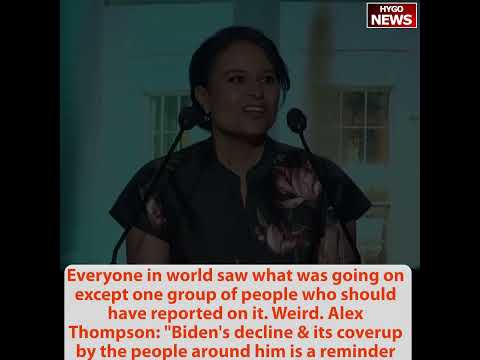
Leavitt: Biden Cover-Up Was “One of the Greatest Scandals in American History”; Media “Accused Us of Manufacturing Deep Fakes”
Press Secretary Karoline Leavitt delivered a blistering response to the White House Correspondents’ Dinner coverage in April 2025, connecting the media’s belated acknowledgment of Biden’s decline to years of deliberate suppression. “Millions of Americans watched our mentally incompetent president struggle with his day-to-day duties of this office,” Leavitt said. “Nobody in the media wanted to write about that. I remember being on President Trump’s campaign talking about Biden’s clear mental incompetence and being accused by people in this room of manufacturing deep fake videos — trying to persuade the public into not believing what they saw with their own eyes. I think it’s about time the legacy media finally admits that was one of the greatest cover-ups and scandals that ever took place in American history."
"Greatest Cover-Ups in American History”
Leavitt opened with the human cost of the cover-up.
“Millions of Americans watched our mentally incompetent president struggle with his day-to-day duties of this office,” she said. “We watched our country be run into the ground as a result.”
She described the media’s role: “And nobody in the media wanted to write about that, talk about it.”
She noted who did cover it: “There were many, many reporters — I will say, right-leaning reporters — who did talk about that, who didn’t get awards, didn’t get coverage. In fact, they were lambasted for their coverage.”
She drew on personal experience: “And I remember being on President Trump’s campaign talking about Joe Biden’s clear mental incompetence and being accused by people in this room of manufacturing deep fake videos, trying to persuade the public into not believing what they saw with their own eyes for many years.”
She delivered the verdict: “And I think it’s about time the legacy media finally admits that was one of the greatest cover-ups and scandals that ever took place in American history.”
She connected it to trust: “And certainly, it did contribute to the decline in the trust that Americans have for the legacy media.”
The “deep fake” accusation was perhaps the most damning detail in Leavitt’s account. When the Trump campaign had shared videos of Biden stumbling, freezing, or appearing confused, media outlets had not merely ignored the evidence — they had actively accused the campaign of fabricating it. “Cheap fakes,” “deep fakes,” “manipulated video” — these were the terms used to dismiss visual evidence that millions of Americans could verify by watching Biden’s public appearances in full.
The accusation of manufacturing deep fakes was not a disagreement about interpretation. It was a claim that the Trump campaign was creating fraudulent video content to deceive the public. This was a serious charge — tantamount to accusing a political campaign of technological fraud — and it was entirely false. The videos were real. Biden was struggling. The media knew it and chose to call reality a fabrication.
The Right-Leaning Reporter Problem
Leavitt’s observation that “right-leaning reporters” had covered Biden’s decline while legacy reporters ignored it exposed a structural problem in how journalism awards and recognition worked.
Conservative reporters who had accurately reported on Biden’s cognitive decline — providing the public with information they needed to evaluate their president — had been “lambasted” rather than praised. Their coverage had been dismissed as partisan attack rather than recognized as legitimate journalism. No conservative reporter was going to win the Aldo Beckman Award for reporting on Biden’s decline, no matter how early, how accurate, or how thorough their coverage had been.
The award went instead to Thompson — an Axios reporter who, by his own admission, had “missed a lot of this story.” The journalism establishment was rewarding the person who caught up last rather than the people who got it right first. This backward incentive structure meant that reporters who prioritized accuracy over access — who were willing to report uncomfortable truths even when it cost them relationships with sources — were punished, while those who played along with the cover-up until it became untenable were celebrated.
The Thompson-Leavitt Contrast
Leavitt’s briefing played clips from the correspondents’ dinner, including Thompson’s acceptance speech and the award citation.
The juxtaposition was powerful. Thompson had said: “We, myself included, missed a lot of this story. And some people trust us less because of it.” Leavitt was saying: we told you the truth all along, and you accused us of lying.
Thompson’s admission was genuine and commendable in isolation. But viewed from the White House podium, it was insufficient. “Missing” the story implied accidental oversight — a reporter who simply didn’t see the evidence. Leavitt’s account described something much worse: reporters who saw the evidence, dismissed it, and then attacked anyone who reported it.
The distinction between “missing” a story and “suppressing” a story was the gap between Thompson’s characterization and Leavitt’s. Thompson framed the Biden cover-up as a journalistic failure — an error of omission. Leavitt framed it as a journalistic betrayal — an active conspiracy to deceive the public about the fitness of their president.
The “Deep Fake” Timeline
Leavitt’s reference to being accused of “manufacturing deep fake videos” pointed to a specific period in the campaign when the narrative battle over Biden’s fitness reached its most intense phase.
In mid-2024, as Biden’s public appearances became increasingly difficult to defend, the Trump campaign and conservative media had shared unedited video clips showing Biden appearing confused, wandering off-stage, freezing mid-sentence, or being redirected by handlers. Major media outlets responded by labeling these clips as “cheap fakes” or “deceptive edits” — arguing that the clips were taken out of context or deliberately manipulated to make Biden look worse than he was.
The “cheap fakes” defense collapsed completely at the June 2024 debate, when 50 million Americans watched Biden display exactly the symptoms the clips had depicted — in real time, unedited, on a stage with no handlers to redirect him. The debate vindicated every video the media had called a fake, every observation the media had called a conspiracy theory, and every reporter the media had called a liar.
The Correspondents’ Dinner Response
Leavitt’s briefing was the administration’s official response to the correspondents’ dinner — an event the administration had skipped (Trump was in Rome for Pope Francis’s funeral). Rather than the conciliatory tone that previous administrations had taken when commenting on the dinner, Leavitt used the opportunity to put the media on trial.
Her argument was straightforward: the media could not simultaneously give itself awards for covering Biden’s decline and pretend that it had not spent years covering up that decline. Thompson’s award and his admission of failure were evidence for the prosecution, not the defense. They confirmed what the administration had been saying all along: the media had participated in a cover-up that left an incompetent president in office for years.
The dinner had been intended as a celebration of journalism. Leavitt turned it into an exhibit of journalism’s failure — using the media’s own words, from its own award ceremony, to make the case that the Biden cover-up was “one of the greatest scandals in American history.”
Key Takeaways
- Leavitt: “Millions watched our mentally incompetent president struggle. Nobody in the media wanted to write about it — one of the greatest cover-ups in American history.”
- She recalled the campaign: “I was accused by people in this room of manufacturing deep fake videos — trying to persuade the public into not believing their own eyes.”
- Right-leaning reporters who covered Biden’s decline “were lambasted” while Thompson won the Aldo Beckman Award after admitting “we missed a lot of this story.”
- Thompson from the dinner: “We bear some responsibility for faith in the media being at such lows.”
- Leavitt connected the cover-up directly to “the decline in trust that Americans have for legacy media.”