 HYGO News
 Press Sec: leaked & false narrative, same CNN reporter Hunter laptop; Gulf states Abraham Accords
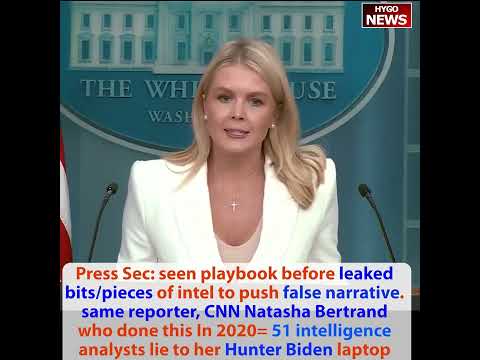
Press Sec: leaked & false narrative, same CNN reporter Hunter laptop; Gulf states Abraham Accords
Press Secretary Karoline Leavitt delivered one of the more unusual press briefings of the week by walking through the professional track record of a specific reporter — Natasha Bertrand of CNN — who has become the principal recipient of leaked intelligence used against the Trump administration. Leavitt identified Bertrand by name and recounted the series of stories she published over the past five years that relied on intelligence community leaks that later proved false — the Hunter Biden laptop “Russian disinformation” story, the ruled-out Wuhan lab leak theory, the Iran influence campaign denial, the suckers and losers hoax, the fine people hoax. The briefing argued that Bertrand has become a conduit for intelligence community officials who want to damage the administration, and that the current Iran damage leak fits the same pattern. Leavitt also signaled the administration’s forward diplomatic agenda — pursuing expanded Abraham Accords membership among Gulf and Arab states.
”Low Confidence, Preliminary”
Leavitt opened with the specific characterization of the leaked report. “This was a low confidence, preliminary intelligence assessment. And the entirety of that assessment was not leaked to the media. Only tidbits of that assessment were leaked to CNN.”
The two qualifications — “low confidence” and “preliminary” — are the intelligence community’s own self-characterization of the report’s reliability. Low confidence means the analysts producing the report did not believe its conclusions were robust. Preliminary means the report was subject to revision as more information arrived. Both qualifications indicate that the report should not have been treated as the final intelligence community assessment.
“Only tidbits of that assessment were leaked to CNN” is the selective-disclosure charge. The full report contained multiple conclusions at various confidence levels. Only the specific conclusions that undermined the administration’s damage assessment were selectively disclosed.
”We Have Seen This Playbook”
Leavitt then introduced the pattern analysis. “And we have seen this playbook run before, where you have people in the intelligence community, or perhaps on Capitol Hill, we don’t know. But I believe the FBI is investigating to find out who that leaker was, because it’s illegal, and they should be held accountable for that.”
The “playbook” framing is important. Leavitt is not characterizing the leak as an isolated incident. She is characterizing it as an instance of a broader practice — intelligence community or congressional staff leaking selectively to specific reporters for political purposes.
”Natasha Bertrand Of CNN”
Leavitt then named the recipient. “Leaked bits and pieces of an intel assessment to push a false narrative. And it’s to the same reporter, I will add, Natasha Bertrand of CNN, who has done this in the past.”
Naming specific reporters in a White House press briefing is unusual. Press secretaries typically address networks and outlets rather than individual journalists. Leavitt’s willingness to name Bertrand specifically reflects the administration’s strategic judgment that Bertrand has become an identifiable conduit for a specific pattern of leaks.
The Hunter Biden Laptop Pattern
Leavitt walked through the first example. “In 2020, it was Natasha Bertrand, who had 51 intelligence analysts falsely lied to her, but she still put it on paper for some reason, that the Hunter Biden laptop story was Russian disinformation. We all know that’s not true, right? We can all agree on that now. That was a lie from the intelligence community.”
The Hunter Biden laptop story arc is one of the clearest examples of intelligence community failure in recent American media history. In October 2020, 51 former intelligence officials signed a public letter claiming the Hunter Biden laptop story had “all the classic earmarks of a Russian information operation.” That characterization dominated American media coverage in the final weeks before the 2020 election.
The characterization was wrong. The laptop was authentic. Its contents were not Russian disinformation. The 51 officials had no evidentiary basis for the claim. They made it anyway. Bertrand wrote about it as though it were a credible assessment.
The subsequent years have made the falsity of the 2020 letter a matter of public record. News organizations that relied on the letter have had to walk back their coverage. Some of the 51 former officials have publicly regretted signing the letter.
The Lab Leak Example
Leavitt provided the second example. “Also in 2020, this same reporter, Natasha Bertrand, wrote that a top intel agency ruled out the man-made lab leak theory of the coronavirus origins. Again, the president was right about that. This reporter wrote a lie from the intelligence community to seek a narrative she wanted to prove. And guess what? We now know that’s the truth.”
The Wuhan lab leak theory has, over time, shifted from fringe hypothesis to mainstream consideration. Early coverage — including Bertrand’s coverage — characterized the theory as debunked and the intelligence community’s assessment as ruling it out. Subsequent intelligence community assessments have shifted substantially. The Department of Energy and the FBI have, at various points, indicated that a lab leak is the most likely origin scenario.
The early coverage that dismissed the lab leak theory has aged badly. Reporters who accepted intelligence community framing as definitive look, in retrospect, to have been used by sources with specific political preferences.
Suckers And Losers
Leavitt continued. “Also in 2024, Bertrand pushed the suckers and losers hoax. She also pushed the fine people hoax, which was taking the president’s words purposely out of context.”
“Suckers and losers” refers to a reported Trump statement about American war dead. “Fine people” refers to Trump’s 2017 statement after the Charlottesville rally, characterized by critics as calling neo-Nazis “fine people” when the full context indicates he was describing participants in the Confederate monument debate.
Both characterizations have been the subject of extensive post-event analysis. The “suckers and losers” story was sourced anonymously and has been disputed by individuals who were present. The “fine people” characterization relies on selective quotation. Leavitt is arguing that Bertrand’s reporting on both reflects a pattern of accepting and amplifying sourced claims that do not survive scrutiny.
The Iran Campaign Influence Story
Leavitt offered the most recent example. “And then last October, and I believe this is notable, Natasha Bertrand published an article in Politico from the intelligence agency. She said that John Ratcliffe was speaking without any evidence when he said Iran was attempting to undermine President Trump’s presidential campaign. And then we of course found out that was absolutely true.”
John Ratcliffe, then-Director of National Intelligence, had said in October 2024 that Iran was conducting an influence campaign against Trump’s presidential campaign. Bertrand’s reporting characterized Ratcliffe’s claim as unsupported by evidence. Subsequent intelligence community assessments — released after the election — confirmed that Iran had indeed conducted the influence campaign Ratcliffe described.
“We know the Iranians tried to take President Trump’s life” is Leavitt’s reference to the attempted assassination plots that have been publicly documented. The Iranian regime’s hostility toward Trump extended beyond influence operations to actual attempted killings.
”Used By People Who Dislike Donald Trump”
Leavitt’s summary was direct. “And so this is a reporter who has been unfortunately used by people who dislike Donald Trump in this government to push fake and false narratives.”
“Used by people who dislike Donald Trump in this government” is the charge. Intelligence community officials with specific political preferences, according to Leavitt, are feeding Bertrand false information for her to publish. Whether Bertrand knows the information is false is a separate question. Whether her use as a conduit is intentional or inadvertent, the effect is the same — false narratives getting into public circulation through her byline.
”She Should Be Ashamed”
Leavitt extended the personal critique. “She should be ashamed of herself. And that’s not what reporting is. Journalism is trying to find the facts and the truth. And this week, we saw this same reporter being used to push a fake narrative to try to undermine the president of the United States.”
“She should be ashamed” is a strong personal criticism. Leavitt is not just criticizing CNN. She is directly criticizing Bertrand by name and asking her to experience shame for her reporting. That level of personal focus on a specific reporter is unusual for a White House press briefing.
”The Brave Fighter Pilots”
Leavitt connected the critique to the operational context. “And more importantly, the brave fighter pilots who conducted one of the most successful operations in United States history. And I think the American people fully know that this operation was a complete and total success.”
The framing returns to the pilots. The critique of Bertrand is not merely about journalistic ethics. It is about the specific cost her reporting has imposed on the American servicemembers who executed the Iran mission. The pilots deserve recognition. Bertrand’s reporting denies them that recognition. Therefore, the reporting damages something real.
The Diplomatic Agenda
Leavitt then pivoted to the forward-looking diplomatic agenda. “The president wants peace. He always has. And right now we’re on a diplomatic path with Iran. President and his team, namely Special Envoy Witkoff, continue to be in communication with the Iranians and especially our Gulf and Arab partners in the region to come to an agreement with Iran.”
Witkoff is the administration’s Middle East envoy. His continued communication with Iranian counterparts is the diplomatic machinery of the post-strike era. The administration is actively pursuing a negotiated settlement that consolidates the outcomes the strikes produced.
“Gulf and Arab partners in the region” are the regional actors whose cooperation is essential to any durable settlement. Saudi Arabia, the UAE, Qatar, Bahrain, Oman, Kuwait — each has specific interests in the Iran settlement. American diplomacy is coordinating across all of them.
The Israel Relationship
Leavitt framed the alliance posture. “As for our alliance with the state of Israel and that friendship and that partnership between the United States and the state of Israel, I would argue it has never been stronger.”
The characterization is notable. Despite Trump’s earlier public criticism of Israel’s post-ceasefire strikes, the core relationship remains robust. Temporary tactical disagreements do not affect the strategic alignment. The U.S.-Israel partnership has survived decades of tactical disputes and remains strong.
The Abraham Accords Expansion
Leavitt then offered the specific diplomatic objective. “And we see a new era in which perhaps some of these Gulf and Arab states can sign on to the Abraham Accords. That was one of the president’s most signature accomplishments in his first term. And he’d like to see more of those countries sign on in this second term.”
The Abraham Accords — signed in 2020 during Trump’s first term — established formal diplomatic relations between Israel and the United Arab Emirates, Bahrain, Morocco, and Sudan. The accords represented a breakthrough in Israeli-Arab relations that had eluded previous American administrations.
The expansion Leavitt is describing would bring additional countries into the Accords framework. Saudi Arabia is the most prominent candidate. Qatar and Kuwait are also possibilities. If additional major Arab states sign on, the regional diplomatic architecture transforms substantially.
”Long And Durable Peace”
Leavitt concluded with the strategic framing. “And so we look forward to sustaining a long, indurable peace in the region. And the president wants to do that through a diplomatic solution. But as he proved on Saturday night, he’s not afraid to use strength if we need to do it.”
“Long and durable peace” is the aspirational objective. A peace that lasts — not a temporary pause, not a delay in the underlying conflicts, but a durable settlement that removes the root causes of regional instability.
“Not afraid to use strength” is the deterrence commitment. The diplomatic path is preferred, but the military path remains available. Actors in the region who might consider testing the American posture have to factor in the demonstrated willingness to use force when necessary.
The Briefing’s Strategic Purpose
The briefing served multiple strategic purposes. First, it named specific institutional problems — the pattern of intelligence leaks to specific reporters. Second, it documented the track record of those leaks — showing that the pattern is not new but has been running for years. Third, it previewed the forward diplomatic agenda — Witkoff engagement, Abraham Accords expansion, Gulf state coordination.
Each element serves both immediate political purposes and longer-term strategic objectives. The attack on Bertrand damages her future credibility and raises the cost of intelligence community leaks. The track record documentation provides the basis for FBI investigation and potential prosecution. The forward diplomatic agenda positions the administration for sustained Middle East engagement.
Key Takeaways
- Leavitt on the leak report: “This was a low confidence, preliminary intelligence assessment…Only tidbits of that assessment were leaked to CNN.”
- The Bertrand pattern: Hunter Biden laptop as “Russian disinformation,” ruled-out lab leak, suckers and losers, fine people, Iran influence campaign denial.
- On Bertrand personally: “She should be ashamed of herself. And that’s not what reporting is. Journalism is trying to find the facts and the truth.”
- The forward diplomatic agenda: “We’re on a diplomatic path with Iran…Special Envoy Witkoff continues to be in communication with the Iranians.”
- The Abraham Accords expansion: “Some of these Gulf and Arab states can sign on to the Abraham Accords…the president wants to see more of those countries sign on in this second term.”