 HYGO News
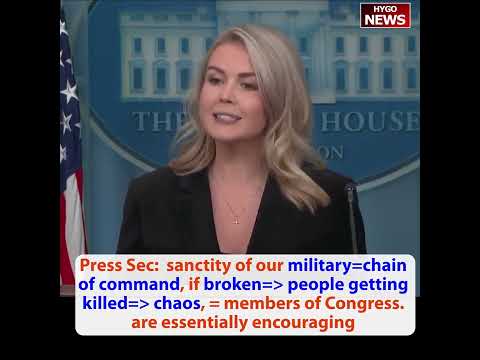
 Press Sec COOKS reporter: members of Congress incite; military rests on chain of command, if broken
Press Sec COOKS reporter: members of Congress incite; military rests on chain of command, if broken
Press Secretary Karoline Leavitt delivered a devastating response to a reporter’s framing of Trump’s comments on Democratic Congress members. The Democratic veterans’ video — featuring Senators Elissa Slotkin (D-MI), Mark Kelly (D-AZ), and Rep. Maggie Goodlander (D-NH, wife of Jake Sullivan) — called for active-duty military to refuse “illegal orders” from Trump. Leavitt framework: these members are inciting military insubordination against lawful orders, risking “chaos” and getting “people killed.” The Democrat video targeted “1.3 million active duty service members” with message to defy chain of command. Leavitt noted the Supreme Court has repeatedly upheld Trump administration orders — making the “illegal orders” claim false. Trump’s response (that the conduct could be “seditious behavior punishable by death”) is response to the Congressional incitement, not threat to execute lawmakers. Leavitt emphasized these Democrats weren’t ignorant — they used their CIA/Navy credentials specifically to signal to military personnel. Slotkin (former CIA), Kelly (former Navy captain), Goodlander (former naval officer, wife of Biden National Security Advisor Jake Sullivan) knew exactly what they were doing. Leavitt left legal consequences to DOJ and DOD determination. Leavitt: “Why aren’t you talking about what these members of Congress are doing to encourage and incite violence? They’re suggesting, Nancy, that the President has given illegal orders, which he has not.” On chain of command: “The sanctity of our military rests on the chain of command. And if that chain of command is broken, it can lead to people getting killed. It can lead to chaos.” On accountability: “These members of Congress who swore an oath to abide by the Constitution are essentially encouraging … chaos and incite violence.”
Opening Exchange
A reporter opened the questioning. “When he says that members of Congress should be killed, why aren’t you talking about what these members of Congress are doing to encourage it in sight violence?”
The reporter was referencing Trump’s Truth Social post calling the Democratic veterans’ video “seditious behavior punishable by death” — a characterization the press interpreted as Trump threatening to execute the senators.
The reporter’s implicit framework: Trump’s response is the problem.
Leavitt’s immediate pivot: what are the Congress members doing to incite violence? Why is that not the focus?
The Democratic Video
The Democratic veterans’ video content: “Our laws are clear. You can refuse illegal orders. You can refuse illegal orders. You must refuse illegal orders. No one has to carry out orders that violate the law or our Constitution.”
The repetition of “You can refuse illegal orders” three times is striking. It’s not a neutral legal education — it’s emphatic signaling.
“We know this is hard and that it’s a difficult time to be a public servant. But whether you’re serving in the CIA, the Army, or Navy, Air Force, your vigilance is critical and know that we have your back.”
The video targeted:
- CIA personnel
- Army
- Navy
- Air Force
All branches of military plus intelligence. Comprehensive targeting of national security apparatus.
“Because now more than ever, the American people need you. We need you to stand up for our laws, our Constitution, and who we are as Americans.”
The framework: military personnel need to “stand up” against something. Given context (Trump administration), clear implication that Trump is threatening laws and Constitution.
“Don’t give up. Don’t give up. Don’t give up. Don’t give up the ship.”
The rhetorical escalation. “Don’t give up the ship” is military mutiny-era rhetoric (famous 1813 quote from Captain James Lawrence during War of 1812).
Reporter’s Follow-up
“The President and the Vice President, for that matter, have accused the other side of encouraging political violence.”
The reporter framed it as both sides accusing each other.
“Isn’t that exactly what the President is doing when he says that members of Congress should be killed?”
The reporter characterized Trump’s “seditious behavior punishable by death” as suggesting members should be killed — interpreting legal statement about sedition penalties as personal threat.
“Why aren’t you talking about what these members of Congress are doing to encourage it in sight violence?”
Leavitt Pivots
Leavitt’s response pivoted to the substantive Democrat misconduct. “They are literally saying to 1.3 million active duty service members not to defy the chain of command, not to follow lawful orders.”
The scale: 1.3 million active duty. The Democratic video targeted all of them.
“Every single… They said you can refuse an illegal order, which is illegal.”
Leavitt stated correctly that Crow/Slotkin et al. framed their message around “illegal orders.”
“But they’re suggesting Nancy, that the President has given illegal orders, which he has not.”
The critical rebuttal: Trump has not given illegal orders. The Democrats’ framework implies Trump has, which is false.
Every Order Lawful
“Every single order that is given to this United States military by this commander in chief, and through this chain of command, through the Secretary of War, is lawful.”
Leavitt’s framework:
- Every Trump military order has been lawful
- Chain of command (Secretary of War) operates lawfully
- No illegal orders exist
“And the courts have proven that.”
Judicial validation. Trump’s military orders have been reviewed by courts.
“This administration has an unparalleled record at the Supreme Court, because we are following the laws.”
Supreme Court record. The Trump administration has won substantial number of cases, including challenges to executive orders. The framework: if SCOTUS upholds, orders are lawful.
“We don’t defy court orders. We do things by the books.”
Legal compliance framework. Administration follows court orders and statutes.
Dangerous Action
“And to suggest and encourage that active duty service members defy the chain of command is a very dangerous thing for sitting members of Congress to do. And they should be held accountable. And that’s what the President wants to see.”
Leavitt’s framework:
- Encouraging military insubordination = dangerous
- Congress members involved should face accountability
- Trump demanding consequences
The accountability call. Trump’s “seditious behavior punishable by death” wasn’t threat to execute — it was statement about legal penalties for sedition (which historically have included capital punishment under 18 U.S.C. § 2384).
Reporter Presses
“This morning, President Trump accused six Democratic lawmakers of seditious behavior punishable by death. Just to be clear, does the President want to execute members of Congress?”
The reporter pressed for clarification. Is Trump threatening execution?
“No.”
Direct answer. Trump is not threatening execution.
Context of Trump’s Response
“Let’s be clear about what the President is responding to, because many in this room want to talk about the President’s response, but not what brought the President to responding in this way.”
Leavitt’s framework: the response is being discussed without context. The original action (Democratic video) is being ignored by press.
“You have sitting members of the United States Congress who conspired together to orchestrate a video message to members of the United States military, to active duty service members, to members of the National Security apparatus, encouraging them to defy the President’s lawful orders.”
Leavitt’s characterization:
- Congress members “conspired”
- Coordinated video messaging
- Targeted military and national security personnel
- Encouraged defiance of lawful orders
”Chain of Command”
“The sanctity of our military rests on the chain of command. And if that chain of command is broken, it can lead to people getting killed. It can lead to chaos.”
Leavitt’s framework on military necessity:
- Chain of command sacred
- Breaking it = deaths
- Breaking it = chaos
Military operational effectiveness depends entirely on chain of command. Troops must act on orders immediately. Encouraging hesitation or refusal threatens:
- Combat effectiveness
- Operational security
- Unit cohesion
- Hierarchical authority
“And that’s what these members of Congress who swore an oath to abide by the Constitution are essentially encouraging.”
The oath framework:
- Congress members swore Constitutional oath
- Constitution grants Commander-in-Chief authority
- Undermining that authority violates oath
- Members violating own commitment
”Could Inspire Chaos”
“We have 1.3 active duty service members in this country. And if they hear this radical message from sitting members of Congress, that could inspire chaos and it could incite violence and it certainly could disrupt the chain of command.”
The risks:
- Chaos
- Violence incited
- Chain of command disrupted
All three outcomes serious. Particularly during heightened operational tempo (Venezuela drug boat strikes, Mexico border operations, Arctic patrols).
Credentialed Participants
“These three members of Congress, I will also add, knew exactly what they were doing. You look at Alyssa Slotkin, she’s a former member of the CIA. Mark Kelly was a captain in the U.S. Navy. Maggie Goodlander was a naval officer. And notably, she was also, she is also the wife of Joe Biden’s National Security former advisor, Jake Sullivan.”
The credentials:
- Elissa Slotkin (D-MI): Former CIA analyst, Iraq postings
- Mark Kelly (D-AZ): Former Navy captain, astronaut
- Maggie Goodlander (D-NH): Former naval officer, DOJ
- Jake Sullivan connection: Goodlander is married to former Biden National Security Advisor Jake Sullivan
All three had military/intelligence credentials. They leveraged those credentials specifically.
“And so these members knew what they were doing.”
Not ignorance. Deliberate strategy.
”Leading Into Credentials”
“They were leading into their credentials as former members of our military, as veterans, as former members of the National Security apparatus to signal to people serving under this commander in chief, Donald Trump, that you can defy him and you can betray your oath of office.”
Leavitt’s characterization:
- Used credentials to give message legitimacy
- Signaled active-duty personnel
- Suggested defying Trump
- Encouraged betraying oath
The danger: when CIA-former Slotkin speaks to current CIA operators, they listen differently than if random congressperson speaks. The credentials weaponize the message.
“That is a very, very dangerous message. And it perhaps is punishable by law. I’m not a lawyer. I’ll leave that to the Department of Justice and the Department of War to decide.”
Leavitt’s conclusion:
- Potentially illegal conduct
- DOJ determination
- DOD determination
- Actual consequences to be determined by proper authorities
Significance
The exchange captures constitutional crisis attempt:
-
Democratic military-targeted video: Unprecedented direct targeting of active military by sitting Congress members
-
Credentials weaponization: Former military/intelligence officials signaling current personnel
-
“Illegal orders” framework without specifics: Advocating refusal without identifying actual illegal orders (as Crow admitted in prior interview)
-
Chain of command threat: Breaking military hierarchy = operational disaster
-
Press framing: Media focusing on Trump’s response rather than Democrats’ action
-
Sedition framework: 18 U.S.C. § 2384 makes seditious conspiracy a crime. Penalty historically included capital punishment.
The Democratic veterans’ video crossed a line. Even if rhetorically framed as “following law,” the video:
- Targeted active military
- Made no specific illegal order claim
- Signaled defiance of Commander-in-Chief
- Used military credentials to legitimize insubordination
The press responded by treating Trump’s statement about legal consequences as the problem. Leavitt’s response forces focus back to actual Democrat misconduct.
This episode may produce actual legal action. DOJ/DOD review of the video could produce indictments for sedition or related offenses. The political consequences would be severe.
Key Takeaways
- Reporter’s question: “When he says that members of Congress should be killed, why aren’t you talking about what these members of Congress are doing to encourage it, incite violence?”
- Leavitt on Democrat message: “They are literally saying to 1.3 million active duty service members not to defy the chain of command, not to follow lawful orders … They said you can refuse an illegal order … But they’re suggesting, Nancy, that the President has given illegal orders, which he has not.”
- Leavitt on execution question: Reporter: “Does the President want to execute members of Congress?” Leavitt: “No.”
- Leavitt on chain of command: “The sanctity of our military rests on the chain of command. And if that chain of command is broken, it can lead to people getting killed. It can lead to chaos.”
- Leavitt on credentials: “These three members of Congress knew exactly what they were doing. You look at Alyssa Slotkin, she’s a former member of the CIA. Mark Kelly was a captain in the U.S. Navy. Maggie Goodlander was a naval officer. And notably … the wife of Joe Biden’s National Security former advisor, Jake Sullivan … these members knew what they were doing. They were leading into their credentials … to signal to people serving under this commander in chief, Donald Trump, that you can defy him and you can betray your oath of office.”