 HYGO News
 Press Sec: OBBB $1.6T Savings + $2.8T Tariffs + 3% Growth = $8T Deficit Cut Over 10 Years; LA Mayor Karen Bass: 'Fight for All Angelenos Whether Papers or Not'; Booker Calls Anti-ICE Riots 'Peaceful'; Border Czar Homan: 'Newsom Is an Embarrassment'; CEA Hassett: CBO's $2.8T Tariff Revenue Exceeds Bill Cost; Rand Paul Wants to Cut ICE Funding in Half
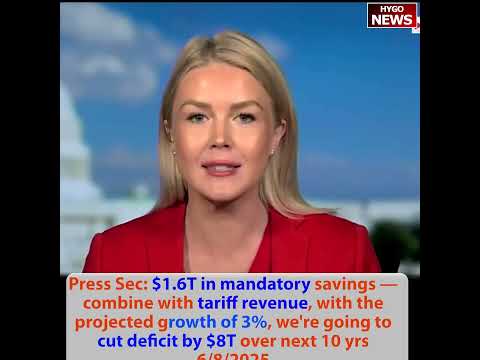
Press Sec: OBBB $1.6T Savings + $2.8T Tariffs + 3% Growth = $8T Deficit Cut Over 10 Years; LA Mayor Karen Bass: “Fight for All Angelenos Whether Papers or Not”; Booker Calls Anti-ICE Riots “Peaceful”; Border Czar Homan: “Newsom Is an Embarrassment”; CEA Hassett: CBO’s $2.8T Tariff Revenue Exceeds Bill Cost; Rand Paul Wants to Cut ICE Funding in Half
Multiple stories converged in June 2025. Press Secretary Leavitt laid out OBBB’s total fiscal impact: “This bill provides $1.6 trillion in mandatory savings. When you combine that with the tariff revenue that President Trump’s America First trade agenda is bringing in nearly $3 trillion over the next 10 years, that’s a projection according to the Congressional Budget Office. And when you combine that with the Council of Economic Advisers projected growth of 3%, we’re going to cut the deficit by $8 trillion over the next 10 years.” LA Mayor Karen Bass declared during Anti-ICE riots: “We are going to fight for all Angelenos. Regardless of when they got here, whether they have papers or not, we are a city of immigrants.” Sen. Cory Booker characterized riots featuring concrete projectiles and arson as “peaceful protests.” Border Czar Tom Homan: “Governor Newsom is an embarrassment for the state. He’s the one that’s feeding this mantra. He supports sanctuary cities. If he cared about public safety, he would not have a sanctuary for criminals.” CEA Chair Kevin Hassett: “CBO 10-year tariff estimate says $2.8 trillion — more than their own estimate for the cost of this entire bill, so that’s deficit reduction right there.” Sen. Rand Paul: “We should cut the immigration enforcement funding in Trump’s Big Beautiful Bill in half.”
The $8 Trillion Calculation
Press Secretary Leavitt laid out comprehensive fiscal math.
“This bill provides $1.6 trillion in mandatory savings,” Leavitt said.
She combined revenues: “And when you combine that with the tariff revenue that President Trump’s America First trade agenda is bringing in nearly $3 trillion over the next 10 years, that’s a projection, according to the Congressional Budget Office.”
She added growth effects: “And when you combine that with the Council of Economic Advisers projected growth of 3%, we’re going to cut the deficit by $8 trillion over the next 10 years.”
She elaborated: “And look at all of the other pro-growth economic policies this president has taken.”
She framed Trump’s priority: “He understands the concerns about our nation’s crippling debt. That’s why we need this bill to pass. It will ultimately reduce the deficit. And the president is very much focused on signing this historic piece of legislation.”
The $8 Trillion Breakdown
The specific math was significant.
Component 1: $1.6 trillion in mandatory savings
- Medicaid reforms
- SNAP reforms
- Various program changes
- Historical savings size
- Since 1990s scale
Component 2: $2.8 trillion in tariff revenue
- CBO official estimate
- 10-year projection
- Already-in-place tariffs
- Continuing revenue stream
- Growing over time
Component 3: Growth effects
- 3% annual growth projection
- CEA estimate
- Above trend growth
- Additional tax revenue
- Compounding effect
Total: ~$8 trillion deficit reduction
- Over 10-year window
- Combining static and dynamic effects
- Comprehensive fiscal impact
- Historic scale
- Structural change
The Historical Context
$8 trillion in deficit reduction was extraordinary.
Historical comparison:
- 1997 Balanced Budget Act: ~$127 billion in savings
- 2011 Budget Control Act: ~$2 trillion (caps)
- 2013 Sequestration: ~$1.2 trillion
- Previous Trump administration: ~$1.5 trillion
- OBBB + tariffs + growth: $8 trillion
Why this was unprecedented:
- Combined multiple mechanisms
- Larger than single act
- Structural rather than arithmetic
- Spending + revenue + growth
- Comprehensive fiscal restructuring
The significance:
- $8 trillion over 10 years
- 2.5-3% GDP impact annually
- Fiscal trajectory change
- Debt ratio improvement
- Long-term sustainability
The LA Riots Context
The broadcast addressed ongoing LA riots.
The LA situation:
- ICE operations in Los Angeles
- Protests began
- Escalated to riots
- Violence against ICE agents
- National Guard deployed
The specific violence:
- Concrete projectiles thrown at vehicles
- Fires set
- Property destruction
- Federal officers attacked
- Police injuries
The political context:
- Democratic leaders supporting protesters
- Some calling violent riots “peaceful”
- Trump administration deploying federal force
- Escalating federal-state tension
- Political divisions widening
LA Mayor Karen Bass on “All Angelenos”
Mayor Bass made a notable statement.
“We are going to fight for all Angelenos,” Bass said.
She extended: “Regardless of when they got here, whether they have papers or not, we are a city of immigrants.”
She added specifics: “And this impacts hundreds of thousands of Angelenos.”
The Bass Position
Bass’s framing was significant.
What Bass claimed:
- LA will protect all residents
- Papers/legal status irrelevant
- City of immigrants identity
- Universal protection
- Sanctuary commitment
Why this was problematic:
- Local government can’t overrule federal law
- Illegal immigrants have different legal status
- “Papers or not” ignores legal framework
- Encourages illegal immigration
- Undermines federal enforcement
The specific claims:
- “All Angelenos”: includes illegal immigrants
- “Hundreds of thousands”: implies vast affected population
- “City of immigrants”: conflates legal and illegal immigration
- “Fight for all”: implies opposition to federal enforcement
- Commitment ignoring legal distinctions
The constitutional framework:
- Federal government has immigration authority
- State and local governments don’t
- Supremacy clause applies
- Local noncooperation allowed
- Active obstruction not allowed
Booker on “Peaceful Protests”
Senator Cory Booker made a remarkable characterization.
“The reality is we see peaceful protests launching in Los Angeles,” Booker said.
He continued: “And again, any violence against police officers should not be accepted. Local authorities can handle that.”
He delivered the core framing: “But remember, a lot of these peaceful protests are being generated because the president of the United States is sowing chaos and confusion by arresting people who are showing up for their immigration hearings.”
The “Peaceful” Framing
Booker’s characterization was politically astonishing.
What Booker called “peaceful”:
- Concrete projectiles thrown at vehicles
- Fires set
- Property destruction
- Federal officer attacks
- Police injuries
Why this was politically damaging:
- Direct contradiction of visible reality
- Video evidence widely available
- Voters watching events unfold
- Democratic credibility damaged
- Characteristic of denial approach
The 2020 parallel:
- Democrats had characterized BLM riots as “peaceful”
- Journalists had used “mostly peaceful” framing
- Similar reality denial
- Cost Democratic credibility
- Pattern continuing
The “mostly peaceful” fallacy:
- 99% might be peaceful
- 1% engaged in violence
- 1% still violent
- Violence not excused by majority
- Peaceful characterization misleading
The Immigration Hearing Framing
Booker’s claim about causation was also problematic.
Booker’s claim:
- Peaceful protests caused by Trump
- ICE arresting people at immigration hearings
- Creating chaos and confusion
- Justifying opposition
- Political cover for violence
Reality check:
- Immigration hearing attendance didn’t trigger arrests
- Specific criminal illegal immigrants targeted
- Standard enforcement practice
- Not randomly arresting
- Focus on criminal elements
The political purpose:
- Create false narrative
- Justify violent response
- Shift blame to administration
- Rally base
- Avoid responsibility for consequences
Border Czar Homan on Newsom
Border Czar Tom Homan delivered sharp criticism.
“Governor Newsom is an embarrassment for the state,” Homan said.
He made the specific charges: “He’s the one that’s feeding this mantra. He supports sanctuary cities. He supports sanctuary laws.”
He made the public safety argument: “If he cared about public safety in the state of California, he would not have a sanctuary for criminals. Where criminals get released to the streets of this state every day because of his policy.”
The Newsom Critique
Homan’s critique was substantive.
What Homan alleged:
- Newsom supports sanctuary policies
- Sanctuary policies endanger public safety
- Criminals released to California streets
- State policy responsible for crime
- Democratic priorities misplaced
Why this mattered:
- California actually had high crime
- Specific sanctuary incidents occurred
- ICE requesting detention of criminals
- California refusing cooperation
- Public safety consequences real
The specific California policies:
- SB 54 (California Values Act) - Sanctuary policy
- Limits on ICE cooperation
- Prevents detention holds
- Releases criminals despite federal interest
- Documented consequences
The documented incidents:
- Kathryn Steinle killed in San Francisco
- Multiple murders by released illegal immigrants
- Various crimes after sanctuary policy release
- Specific public safety failures
- Political cost accumulating
Hassett’s Fiscal Analysis
CEA Chair Kevin Hassett provided specific fiscal detail.
“We had about $60 billion in tariff revenue in the U.S.,” Hassett said.
He connected to inflation: “And inflation, every measure of inflation is the lowest that has been for more than four years.”
He articulated the comprehensive impact: “And so all of our policies together are reducing inflation and helping reduce the deficit by getting revenue from other countries.”
The $2.8 Trillion Tariff Estimate
Hassett cited the specific CBO estimate.
“And how much revenue, I think that you might have covered it, the Congressional Budget Office put out a 10-year estimate that says that the tariff revenue that’s already in place right now is going to raise $2.8 trillion over the next 10 years.”
He delivered the key insight: “That’s more than their own estimate, their own static estimate for the cost of this entire bill.”
He drove the point home: “So that’s deficit reduction right there.”
The Deficit Reduction Logic
Hassett’s logic was simple but powerful.
The CBO’s own estimates:
- Tariff revenue: $2.8 trillion
- OBBB cost (static): less than $2.8 trillion
- Therefore: $2.8T > OBBB cost
- Net effect: deficit reduction
- Using CBO’s own methodology
Why this mattered:
- CBO’s own numbers support OBBB
- Net deficit reduction even without growth effects
- Not relying on optimistic assumptions
- Using scoring system Democrats demanded
- Undercuts Democratic criticism
The distinction from CBO’s OBBB analysis:
- CBO analyzes OBBB isolated
- Ignores tariff revenue connection
- Treats as separate policies
- Misses comprehensive picture
- Obscures total fiscal impact
Rand Paul’s Rebuttal
The Senator Rand Paul position was captured.
“There are people who are questioning why you would not support a bill that puts more money into border security, particularly at this moment in time when we see what’s going on in Los Angeles this morning,” a reporter noted.
The context: “The president had to send the National Guard to Los Angeles.”
The reporter asked: “Are you suggesting that the money being spent on the border is too excessive?”
Paul’s Specific Objections
Paul laid out his critique.
“What I’m suggesting is that we can add some money to the border, but what they’re asking for is excessive.”
He gave a specific example: “And I’ll give you an example. For the fence, they want $46.5 billion.”
He did the math: “Well, I did the math on this. The current rate, according to the Border Patrol, is $6.5 million per mile. That would be $6.5 billion for 1,000 miles.”
He made the comparison: “Nobody’s really estimating there’s more than 1,000 miles that could be fenced at this point. So that’s $6.5 billion versus $46.5 billion.”
He asked the pointed question: “Where’s all the money going?”
Paul’s Math on Border Wall
Paul’s specific calculation was politically damaging.
Paul’s calculation:
- Border Patrol rate: $6.5 million per mile
- 1,000 miles of fencing
- Total need: $6.5 billion
- OBBB request: $46.5 billion
- Discrepancy: $40 billion
What the administration would argue:
- Urban vs. rural mileage different
- Additional technology and infrastructure
- Access roads and maintenance
- Detention facilities
- Sensor and camera systems
- Administrative costs
The political problem:
- Paul’s math appeared reasonable
- Administration hadn’t clearly explained gap
- $40 billion is significant amount
- Fiscal hawks concerned
- Communication failure
The substantive reality:
- Border wall is comprehensive system
- Not just fence
- Includes roads, facilities, technology
- Multiple layers of defense
- Complex infrastructure
The Agent Hiring Question
Paul addressed agent hiring.
“As far as hiring new people, I would hire some new people. I would give some bonuses.”
He suggested cutting: “I’d probably do half as much as what they’re asking for because the border is largely controlled right now.”
He articulated the concern: “And what we don’t want is when we wind up looking back at this, have an army of Border Patrol agents that we have on the hook for payments and pensions and everything else.”
He concluded: “We need to do it judiciously and not in a reckless manner.”
The “Largely Controlled” Claim
Paul’s “largely controlled” framing was significant.
Current border situation:
- Border crossings dramatically reduced
- Enforcement strong
- Apprehensions near historical lows
- Administrative effectiveness
- Political success
Paul’s argument:
- Don’t hire excessively now
- Border problem largely solved
- Reduce future liability
- Long-term fiscal prudence
- Conservative principle
The administration position:
- Sustain enforcement long-term
- Need personnel for maintenance
- Prevent regression to open border
- Demographic growth requires scaling
- Long-term investment
The political tension:
- Paul: Don’t build too much government
- Administration: Build capacity for future
- Different time horizons
- Different risk assessments
- Different philosophical commitments
”An Army of Border Patrol Agents”
Paul’s concern about long-term liability was substantive.
The specific concern:
- Current hiring creates future obligations
- Pensions cost billions over decades
- Benefits commit future taxpayers
- Shrinking later is difficult
- Long-term fiscal drag
The administration response:
- Personnel essential to security
- Need ongoing force to deter illegal immigration
- Can always adjust later if conditions change
- Worth investment for security
- Strategic rather than minimal
The conservative argument:
- Smaller government preferred
- Temporary needs don’t require permanent structures
- Consider alternatives
- Bonuses rather than positions
- Flexibility preserved
The political calculation:
- Fiscal hawks concerned
- Administration wants comprehensive package
- Tension within Republican coalition
- Compromise possible
- Substance matters
The Paul Position Significance
Paul’s cuts proposal was politically significant.
What Paul proposed:
- Cut ICE funding in half
- Reduce border wall funding
- Limit agent hiring
- Reduce future liabilities
- Smaller fiscal commitment
Why this was politically damaging:
- Appears to undermine border security
- Creates Democratic talking points
- Splits Republican coalition
- During actual LA riots
- Political timing bad
The Democratic exploitation:
- Democrats citing Paul as Republican critic
- Suggesting administration priorities excessive
- Building case against OBBB
- Finding Republican allies against OBBB
- Political coalition-building
The administration response:
- Defend specific provisions
- Explain fiscal justification
- Address concerns substantively
- Maintain Republican unity
- Protect core priorities
Key Takeaways
- Leavitt: “OBBB $1.6T + $2.8T tariffs + 3% growth = $8 trillion deficit cut over 10 years.”
- LA Mayor Bass on Angelenos: “Regardless of when they got here, whether they have papers or not.”
- Booker calls anti-ICE riots featuring concrete projectiles and fires “peaceful protests.”
- Border Czar Homan: “Governor Newsom is an embarrassment. If he cared about public safety, he wouldn’t have sanctuary.”
- Rand Paul: “Cut ICE funding in half… border wall should be $6.5B, not $46.5B.”