 HYGO News
 Pres Ilham Aliyev: joint appeal to Nobel committee to award Trump with Nobel Peace Prize; not 30 yrs
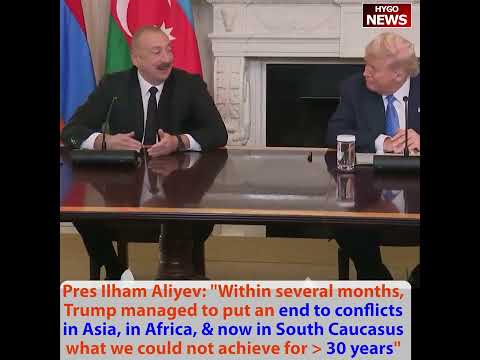
Pres Ilham Aliyev: joint appeal to Nobel committee to award Trump with Nobel Peace Prize; not 30 yrs
Azerbaijani President Ilham Aliyev, at a historic peace summit between Armenia and Azerbaijan at the White House, proposed a joint Armenia-Azerbaijan appeal to the Nobel Committee to award President Trump the Nobel Peace Prize. “Maybe we agree with Prime Minister Pashinyan to send a joint appeal to the Nobel Committee … This is tangible result of President Trump’s leadership, and no one could have achieved that.” Aliyev noted the Minsk Process — the OSCE-led negotiation framework that had sought to resolve Armenia-Azerbaijan tensions — had continued for over three decades without results: “Who, if not President Trump, deserves the Nobel Peace Prize?” And the specific critique of past Nobel recipients: “I don’t want to go into the history of some very strange decisions of the Nobel Peace Committee to award the prize for someone who didn’t do anything at all. But President Trump in six months did miracle."
"Joint Appeal to the Nobel Committee”
Aliyev’s proposal. “Can I have a suggestion? Yes. So maybe we agree with Prime Minister Pashinyan to send a joint appeal to the Nobel Committee to award President Trump with the Nobel Peace Prize, because from the leaders of the countries which were at war for more than three decades, having this historic signature here, it really means a lot.”
The proposal’s power is in the joint framing. Aliyev and Pashinyan represent the two governments that have been at war with each other since 1988. Their joint appeal — the signatures of both leaders of two warring countries who have now signed a peace agreement at the White House — would be specifically weighty for the Nobel Committee.
Nobel Peace Prize nominations from joint parties to a conflict are unusual. Most nominations come from parliamentarians, past laureates, or qualified individuals on political grounds. A joint nomination from formerly warring parties reflecting gratitude for peace would be a specific kind of endorsement that the Nobel Committee has historically valued.
“This is tangible result of President Trump’s leadership, and no one could have achieved that.”
“Tangible result.” Not merely rhetorical commitment. Actual signed peace agreement. The South Caucasus has been one of the world’s persistently unresolved conflict regions. Resolution has eluded every previous administration and every international mediator.
“No one could have achieved that.” Aliyev’s assertion that Trump specifically produced what no one else could. The assertion implicitly rejects the notion that any American president — or international mediator — could have done what Trump did.
The Minsk Process
“There have been many presidents here since the beginning of the 90s, and the so-called Minsk process, which by the way today we put an end to with my Armenian colleague, started in 1992. So negotiation under the auspices of OSE continued for more than three decades without any result.”
The Minsk Process is the specific historical framework Aliyev is referencing. Created in 1992 by the OSCE (Organization for Security and Cooperation in Europe), the Minsk Group was co-chaired by the U.S., Russia, and France. Its mandate was resolving the Nagorno-Karabakh conflict between Armenia and Azerbaijan.
33 years. Multiple American administrations (Clinton, Bush, Obama, Trump 1, Biden). Multiple Russian presidents. Multiple French governments. Thousands of meetings. Multiple draft agreements. No resolution.
“Without any result.” That is the blunt assessment. The most sustained international mediation effort in post-Cold War history, spanning three decades, produced nothing.
“We put an end to with my Armenian colleague, started in 1992.”
Today — at the White House, under Trump’s mediation — Aliyev and Pashinyan ended the Minsk Process by signing an actual peace agreement. The framework that had been the locus of mediation for 33 years was replaced with an actual agreement.
”Very Strange Decisions”
“So who, if not President Trump, deserves the Nobel Peace Prize? I don’t want to go into the history of some very strange decisions of the Nobel Peace Committee to award the prize for someone who didn’t do anything at all. But President Trump in six months did miracle.”
“Very strange decisions of the Nobel Peace Committee to award the prize for someone who didn’t do anything at all.” That is a direct critique of past Nobel awards. Barack Obama’s 2009 award — given in his first year before concrete accomplishments — is the most common example of a Nobel given for prospective rather than actual peacemaking. Various other awards have been similarly questioned.
Aliyev is leveraging that history. If the Nobel Committee awards prizes to those who have not yet achieved concrete results, it should certainly award to someone who has achieved specific, documentable results.
“President Trump in six months did miracle.” Six months of the second term. Six conflicts ended. The Armenia-Azerbaijan peace agreement is the latest.
”Miracle”
“Miracle” is a specific word choice. Aliyev, speaking English as a second language, chose the specific word. A miracle is something beyond ordinary expectation or explanation. The South Caucasus peace, achieved in six months, qualifies as miraculous in Aliyev’s view.
That framing matters politically. If observable events justify miracle-level language from a head of state whose country is direct beneficiary, the case for Nobel recognition becomes substantial.
”I Think My Armenian Colleague Will Support It”
“So I think that my Armenian colleague will support it, and judging by the reaction of the audience, I think as soon as we come back, we will agree to issue a joint letter.”
Aliyev’s confidence that Pashinyan will join. “Judging by the reaction of the audience” — the White House audience (which likely included Pashinyan and his delegation) responded positively to the Nobel proposal. Pashinyan’s body language or immediate response apparently indicated willingness.
“As soon as we come back, we will agree to issue a joint letter.” The operational commitment. When Aliyev and Pashinyan return to their respective countries, they will coordinate the joint Nobel nomination.
”Invite Us to the Ceremony”
“And hopefully, and I also joined when President is awarded, we hope that he will invite us to the ceremony.”
That is Aliyev already imagining the ceremony. The Nobel Peace Prize is awarded in Oslo, Norway, each December. If Trump wins, Aliyev hopes to attend the ceremony as the joint nominator.
The implicit confidence is high. Aliyev is not merely proposing the nomination. He is already imagining the outcome — Trump winning, being invited to Oslo, Aliyev attending.
”Historic Peace Summit Between Armenia and Azerbaijan”
Aliyev’s characterization of the White House event. “It’s really a great thrill for me. I love seeing good people get together, and that’s what you have. You have two great leaders.”
That is Trump’s framing, not Aliyev’s. Trump is welcoming both leaders.
“I want to congratulate these two visionary people, Prime Minister Pashinyan and President Aliyev for coming to Washington to sign this momentous joint declaration.”
Trump characterizing Aliyev and Pashinyan as “visionary people” who had the political courage to sign the peace agreement. That framing elevates both leaders’ standing.
“It’s a tremendously important document, and it’s been a long time in coming. They were explaining before that so many times they thought they could get there. It never happened. It just never happened.”
Trump’s observation — validated by Aliyev’s comments about the Minsk Process — is that resolution had been tried many times before. Multiple negotiation rounds. Multiple near-agreements. Each attempt failed.
”35 Years”
“It’s a long time, 35 years they fought, and now they’re friends, and they’re going to be friends for a long time.”
“35 years” from the start of Nagorno-Karabakh tensions in 1988 through the full Armenia-Azerbaijan War (1988-1994), the intervening decades of armed cease-fire, the 2020 Second Karabakh War, and the subsequent conflict through this summit’s resolution.
“Now they’re friends, and they’re going to be friends for a long time.” Trump’s forward projection. Whether the peace holds depends on implementation — borders drawn, prisoners exchanged, refugees resettled, trade resumed. The signed agreement is the framework. The implementation is the test.
“But it’s a big, beautiful honor to welcome everyone to the White House for this very historic peace summit between Armenia and Azerbaijan.”
What the Agreement Achieves
The Armenia-Azerbaijan peace agreement resolves the Nagorno-Karabakh question — the region that was internationally recognized as part of Azerbaijan but populated by ethnic Armenians and governed (from 1991 to 2023) by a self-declared Armenian-backed republic. The 2020 Second Karabakh War resulted in Azerbaijani reconquest of most of the region. Subsequent Azerbaijani operations in 2023 produced the effective end of the Armenian self-administered area.
The peace agreement formalizes those outcomes while providing guarantees for both parties. For Azerbaijan, international recognition of its territorial integrity including the previously disputed region. For Armenia, formal border recognition and transit rights through Azerbaijan to exclave territory.
Why Past Mediation Failed
The Minsk Process failed for multiple reasons:
- Russia’s role was conflicted (Russia supported Armenia militarily while acting as mediator)
- France’s role was limited (large Armenian diaspora in France produced bias toward Armenia)
- U.S. engagement across administrations was inconsistent
- The underlying territorial question had no settlement acceptable to both sides
- Each country’s domestic politics constrained negotiation flexibility
Trump’s success required specific conditions: Azerbaijan had achieved military dominance that removed the territorial question from active dispute, Armenia’s post-2020 government had accepted the new reality, Russia’s influence had been reduced by its Ukraine war, and U.S. leverage through economic relationships was deployed effectively.
Whatever the specific combination of factors, the fact that Trump achieved resolution where decades of mediation had failed is Aliyev’s central point. The Nobel recognition would validate that achievement.
The Nobel Calculus
The Nobel Peace Prize process typically operates on February nomination deadlines and October announcements. A joint Armenia-Azerbaijan nomination filed in early 2026 (for the 2026 prize, announced October 2026) would be in the active consideration pool.
Previous Trump nominations — three documented so far in his second term — have been from various eligible nominators. A joint head-of-state nomination from formerly warring parties would be qualitatively different. The Nobel Committee could not easily dismiss such a nomination as politically motivated since both leaders have direct experience with the peace process in question.
Whether the Committee will act on the nomination is uncertain. The Committee has historically avoided awarding to politically divisive figures while active in office. Trump’s polarization in Western media and among European political elites could influence Committee deliberations. But a specific joint nomination from beneficiaries of proven peacemaking creates strong grounds for recognition.
Six Conflicts, One Term
“Within several months he managed to put an end to conflicts in Asia, in Africa, and now in Southern Caucasus.”
That is Aliyev’s summary. Trump’s six-month record includes:
- Asia: India-Pakistan de-escalation, Cambodia-Thailand ceasefire
- Africa: Rwanda-DRC peace agreement
- Southern Caucasus: Armenia-Azerbaijan comprehensive peace
- Plus: Middle East (Israel-Iran war ending), potentially Russia-Ukraine (pending)
- Plus: Serbia-Kosovo ceasefire (earlier-cycle news)
- Plus: Egypt-Ethiopia (referenced in Leavitt’s catalog)
Six to eight conflicts, depending on how counted. One per month is the pace. For a single term, if the pace continues, 50+ conflicts could be resolved or de-escalated.
Key Takeaways
- Azerbaijani President Ilham Aliyev proposed a joint Armenia-Azerbaijan nomination of Trump for the Nobel Peace Prize: “This is tangible result of President Trump’s leadership, and no one could have achieved that.”
- The Minsk Process (started 1992) — 33 years of OSCE-led mediation — produced “no result” until Trump ended it today with an actual peace agreement.
- Aliyev’s critique of past Nobel recipients: “Some very strange decisions of the Nobel Peace Committee to award the prize for someone who didn’t do anything at all. But President Trump in six months did miracle.”
- Trump on the 35-year conflict: “It’s a long time, 35 years they fought, and now they’re friends, and they’re going to be friends for a long time.”
- Aliyev’s summary: Trump has ended conflicts “in Asia, in Africa, and now in Southern Caucasus” — what “we could not achieve for more than 30 years.”