 HYGO News
 Prefer athlete over Marine? A: of course, of course prefer both released
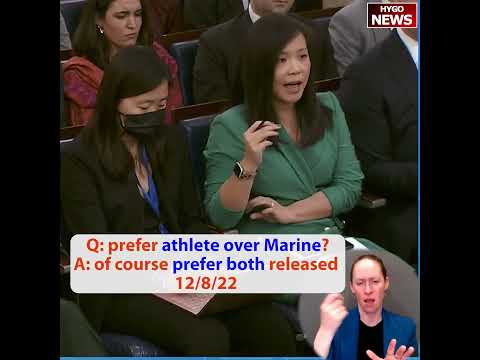
Reporter to KJP: Does Celebrity Get Preferential Treatment? KJP: “Not a Choice of Which American to Bring Home” — Paul Whelan Left in Russia
On 12/9/2022, a reporter confronted White House Press Secretary Karine Jean-Pierre with the optics problem created by the Bout-Griner swap: Brittney Griner, a celebrity athlete, had been brought home while Paul Whelan, a former U.S. Marine also detained in Russia since 2018, remained imprisoned. “How do you dispel the public perception that if you are a celebrity or a professional athlete, you get preferential treatment in a situation like this?” the reporter asked. KJP denied that the administration had chosen between Americans: “I see this was not a choice for us on of which American to bring home. That was not the choice. It was a choice between bringing home one American or bringing home none. We would have preferred, of course, of course we would have preferred to see them both released.” The answer framed the exchange as binary rather than as a choice among possible deals — but it didn’t directly explain why the deal secured Griner rather than Whelan.
The Perception Problem
The reporter’s question captured a widely-felt public concern. “How do you dispel the public perception that if you are a celebrity or a professional athlete, you get preferential treatment in a situation like this?” the reporter asked.
The perception was grounded in observable facts:
Griner had celebrity profile — Prominent WNBA player with significant media attention.
Whelan was less famous — Former Marine with less public profile despite longer detention.
Griner’s case had higher priority — Administration engagement had been extensive.
Whelan’s case had received less attention — Family had complained about lower priority.
Result was unequal — One freed, one still detained.
The pattern matched concerns that government treatment of Americans in crisis often reflected their social status rather than equal principles of citizenship. A cynical interpretation was that celebrity profile determined effort level, with more famous Americans getting more resources than less famous ones.
This perception, if true, was troubling on multiple levels:
Democratic principles — All citizens should receive equal government protection.
Veterans’ status — Whelan was a former Marine — treating a veteran as lower priority than a basketball player raised specific concerns.
Government accountability — Treating celebrity as relevant to release priority undermined equal-protection principles.
Family fairness — Whelan’s family had the same obligation to advocate for him that Griner’s family had for her.
The Paul Whelan Context
Whelan’s case had been a long-running frustration for U.S. diplomacy. Whelan had been arrested in Moscow in December 2018 and charged with espionage. He was a former Marine who had received a bad-conduct discharge, but had a successful post-military career in corporate security. Russia’s espionage charges against him were widely viewed as fabricated to create leverage.
Whelan had been tried, convicted, and sentenced to 16 years in a Russian penal colony. He had spent nearly four years imprisoned by the time of the Bout-Griner swap. His family had been publicly vocal about seeking administration attention. Other detained Americans had been released during his detention (Trevor Reed in April 2022), but Whelan had remained.
The Whelan family had been particularly disappointed by the Bout-Griner deal. They had hoped for an expanded trade that would include Whelan. The deal’s structure — Bout for Griner alone — had left Whelan detained for additional time with no clear path to release.
”Not a Choice for Us”
KJP denied the choice framing. “Look, I see this was not a choice for us on of which American to bring home. That was not the choice. It was a choice between bringing home one American or bringing home none,” KJP said.
The “not a choice” framing had a specific claim: Russia had offered only Griner, not Whelan, in exchange for Bout. The administration could accept the offered deal (get Griner) or reject it (get no one). There was no option to swap Bout for Whelan instead.
This framing had some plausibility. Russia had treated Whelan as a more serious case because of the espionage charges, which elevated him to a higher category than the drug charges against Griner. From Russia’s perspective, Whelan was worth more than Griner, and potentially worth more than Bout.
But the framing also had limitations:
Negotiating position — The administration might have insisted on including Whelan.
Time pressure — The deal might have been accepted hastily rather than negotiated hard.
Alternative pressures — Other leverage might have been explored.
Priority signals — The deal’s acceptance signaled which American was prioritized.
The binary “one or none” framing obscured these considerations. By asserting that the only choice was take-it-or-leave-it, KJP avoided addressing whether the administration had pushed for a better deal.
”Choice Between Bringing Home One American or Bringing Home None”
KJP repeated the framing. “It was a choice between bringing home one American or bringing home none,” she said.
The repetition emphasized the binary framing. In a hostage situation, this kind of stark framing had both merits and problems:
Merits — Made clear that refusing the trade meant Griner staying detained. Showed why the administration had acted.
Problems — Didn’t address whether alternative deals existed. Assumed Russia’s initial offer was final.
Analytical limitations — Treated a dynamic negotiation as a static choice.
Accountability avoidance — Prevented questions about whether more could have been done.
”Would Have Preferred To See Them Both Released”
KJP expressed the preference for both. “We would have preferred, of course, of course we would have preferred to see them both released. That’s what we’ve been calling on. That’s what you’ve been hearing from me and the president this past year,” KJP said.
The “of course, of course” doubling was interesting. The repetition of “of course” emphasized the obvious nature of preferring both released — which had the effect of making the statement seem more defensive than confident. If it was obviously true, why did it need double emphasis?
The answer suggested that the administration felt pressure on exactly this point. The obvious preference for both released was obvious in principle but not reflected in outcomes. Saying “of course we would have preferred” couldn’t change the fact that only one had been released.
The “that’s what we’ve been calling on” claim had some accuracy. The administration had publicly advocated for both Griner and Whelan throughout 2022. Rhetorical commitments to both cases had been consistent. But the operational reality was that only one deal had been achieved.
”We Did Not Want to Lose the Opportunity”
KJP’s closing framing was about opportunity. “But we did not want to lose the opportunity before us to secure the release of one of them,” KJP said.
The “opportunity” framing was consistent with previous KJP explanations of the trade. The argument was:
The specific deal was time-limited — Russia’s willingness might have dissipated.
Refusing meant losing Griner — Without guarantee of future options.
One release was better than none — The utilitarian argument.
Future opportunities remained — For Whelan and others.
This framing had some legitimacy. Hostage situations often involve windows of opportunity. Russia’s willingness to release Griner at a specific moment, at a specific price, might not have been permanent. Accepting the deal while it was available was better than holding out for a better deal that might never come.
But the framing couldn’t fully address Whelan’s situation. If the administration had a choice between Griner-alone and no-deal, the Griner-alone deal was defensible. But was that really the choice? Could harder negotiation have produced Griner-plus-Whelan for Bout? Could a different Russian prisoner have satisfied Russia for Whelan? These questions weren’t addressed.
The Whelan Family Perspective
The Whelan family’s public response to the deal was notably measured but pointed. They expressed happiness for the Griner family while lamenting that Paul remained detained. David Whelan, Paul’s brother, had said publicly that the family had known Paul wouldn’t be included because Russia treated him differently.
The family’s public statements had several features:
Genuine well-wishing for Griner — Not expressing anger at another family’s relief.
Frustration with administration — Over the perceived failure to include Paul.
Transparency about family expectations — Making clear they had been prepared for this outcome.
Commitment to continued advocacy — Continuing to press for Paul’s release.
The family’s dignified response didn’t reduce the substantive concerns about the administration’s handling. The administration had publicly committed to bringing home all detained Americans but had accepted a deal that left one of them behind for additional time. The political messaging about “bringing Americans home” was being tested against the specific reality of who had actually been brought home.
The Eventual Whelan Release
Paul Whelan’s release eventually came in August 2024, more than 20 months after the Bout-Griner deal. His release was part of a much larger multi-country prisoner swap that involved:
Multiple Americans released — Including Whelan, journalist Evan Gershkovich, and others.
Multiple Russian nationals returned — Including Vadim Krasikov, a convicted assassin held in Germany.
Coordination with allies — Germany, Norway, Slovenia, and others.
Extensive negotiation — Over many months.
The larger deal demonstrated what more ambitious negotiations could accomplish. Rather than single-person trades, the 2024 exchange brought home multiple Americans in a comprehensive arrangement. The contrast highlighted what had been possible — but hadn’t been achieved in the December 2022 Bout-Griner deal.
Whether the 2022 administration could have achieved a comprehensive deal earlier was debated. Some analysts argued that 2024 conditions were more favorable. Others argued that more ambitious 2022 negotiations might have produced similar results earlier. The counterfactual was unknowable, but the question remained whether the administration had been sufficiently ambitious in the 2022 negotiations.
The Celebrity Perception
The reporter’s original question about celebrity preferential treatment was substantively unanswered. KJP’s “not a choice” framing denied that celebrity mattered, but didn’t explain why Russia had been willing to release Griner (higher celebrity) but not Whelan (lower celebrity). If Russia’s willingness depended partially on relative American public attention, then celebrity was indirectly affecting outcomes.
The administration’s public messaging had consistently emphasized Griner’s profile. White House coordination with Griner’s family, high-profile public statements about her case, and extensive administration attention had all reflected Griner’s celebrity status. Whether or not this was intentional preferential treatment, it produced a pattern where celebrity Americans received more visible administration engagement.
The perception problem the reporter had raised was therefore based on observable reality, even if the administration denied that celebrity had determined outcomes directly.
Key Takeaways
- A reporter asked KJP how the administration could dispel the perception that celebrities receive preferential treatment in hostage situations.
- The question reflected the concern that Brittney Griner (celebrity) had been released while Paul Whelan (former Marine, less famous) remained detained.
- KJP denied celebrity preference: “I see this was not a choice for us on of which American to bring home.”
- She framed the choice as binary: “bringing home one American or bringing home none.”
- KJP expressed preference for both released and invoked the “opportunity” framing, but didn’t address whether alternative deals could have included Whelan.
- Whelan was eventually released in August 2024 — 20 months after the Bout-Griner deal — in a comprehensive multi-country swap.
Transcript Highlights
The following is transcribed from the video audio (unverified — AI-generated from audio).
- How do you dispel the public perception that if you are a celebrity or a professional athlete, you get preferential treatment in a situation like this?
- I see this was not a choice for us on of which American to bring home. That was not the choice.
- It was a choice between bringing home one American or bringing home none.
- We would have preferred, of course, of course we would have preferred to see them both released.
- That’s what we’ve been calling on. That’s what you’ve been hearing from me and the president this past year.
- But we did not want to lose the opportunity before us to secure the release of one of them.
Full transcript: 116 words transcribed via Whisper AI.