 HYGO News
 pre-approved 16M people meant put political pressure on the court, wasted resources? A: didn't know
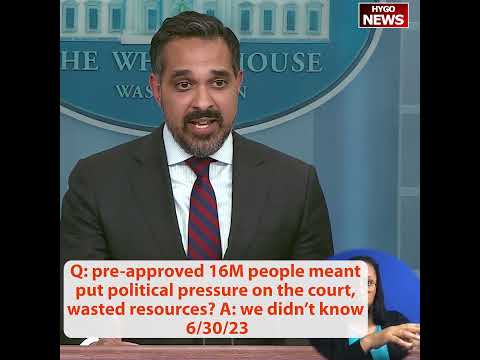
Reporter Asks If Pre-Approving 16 Million Was Meant to Pressure the Court — Ramamurti Says “We Didn’t Know”
On June 30, 2023, a reporter asked one of the sharpest questions of the day: was pre-approving 16 million people for student loan forgiveness while the case was still before the courts an attempt to put political pressure on the Supreme Court? And if so, were government resources wasted on the process? Deputy National Economic Council Director Bharat Ramamurti denied the political motivation but admitted that the administration “didn’t know” the courts would block them, even though the legal challenge was well underway when the approvals were processed. The reporter pressed back, pointing out that the administration processed those approvals while the court process was actively happening, without a final answer on legality.
The Reporter’s Two-Part Question
The reporter framed the question with surgical precision: “So the Department of Education has pre-approved 16 million people for the forgiveness program. Was that meant to put political pressure on the court? Because you knew that this was going through the court process. You didn’t have a decision yet. And were government resources then wasted on this?”
The question contained two distinct challenges. The first was whether the mass approval process was intended as a political tactic to influence the Court’s decision. By approving 16 million people before the legal challenge was resolved, the administration created a fait accompli: striking down the program would not merely invalidate a policy but would take away relief that millions of specific, identified individuals had been told they would receive. This created political pressure on the Court by raising the human cost of an adverse ruling.
The second part asked about waste. If the program was ultimately found unlawful, then the entire apparatus that processed 26 million applications, approved 16 million borrowers, and prepared to disburse billions of dollars had been a waste of taxpayer resources. The Department of Education had built and maintained a website, processed applications that took “less than five minutes” to complete, sent approval notifications, and geared up for disbursement — all for a program that the Supreme Court determined the President had no authority to implement.
Ramamurti’s Defense
Ramamurti began with a denial of the political pressure accusation: “No, I think we explained to borrowers what the process is going to be.”
He then offered a narrative in which the administration was simply doing its job: “The court, unfortunately — the lower court in this case — stepped in before we could actually take that final step and actually discharge debt for approved borrowers.”
The word “unfortunately” did significant work in this sentence. It framed the court’s intervention as an unwelcome interruption of a legitimate process rather than as a judicial check on executive overreach. Ramamurti was characterizing the court’s injunction as a procedural obstacle rather than a constitutional determination that the program was unlawful.
The Reporter Pushes Back
The reporter was not satisfied with this explanation and pressed the critical point: “But you took those approvals when the court process was happening. You didn’t have an answer.”
This was the heart of the matter. The administration had not waited for the legal challenge to be resolved before processing applications and issuing approvals. It had moved forward with the full implementation apparatus while the case was being litigated, knowing that a ruling against the program was a real possibility. The reporter was asking why the administration had created expectations it might not be able to fulfill.
Ramamurti’s response was revealing: “Right, but we didn’t know what — that the court was going to enjoin us from actually doing debt relief. That was still an open question at the time. We had an obligation to borrowers to keep moving with the process as long as we legally could.”
The admission “we didn’t know” was simultaneously true and insufficient. While the administration could not predict the exact outcome of the legal challenge, the possibility that the program would be blocked was well-known and widely discussed. Legal scholars, including some sympathetic to the policy goal, had warned from the outset that the HEROES Act did not clearly authorize mass debt cancellation. The 8th Circuit Court of Appeals had issued an injunction blocking the program in November 2022. The Supreme Court had agreed to hear the case. The idea that the administration “didn’t know” the program might be struck down strained credulity.
The Political Pressure Argument
The reporter’s suggestion that the pre-approvals were intended to pressure the Court deserved more serious engagement than Ramamurti gave it. The political dynamics were obvious: if 16 million people had been approved for debt relief, striking down the program would create 16 million disappointed voters. This created a political environment in which the Court’s decision would have immediate, visible consequences for millions of identifiable individuals.
Whether this was the administration’s deliberate intent or merely a foreseeable consequence of its decision to process applications during active litigation, the effect was the same. The approval process transformed the legal challenge from an abstract constitutional question into a concrete political event. It also gave Biden the ability to say, as he did later that day, that “the money was literally about to go out the door” before Republicans intervened — a far more powerful political message than “we proposed a program that was struck down before it started.”
The timing of the application process was also telling. Biden announced the program in August 2022, and the administration began accepting applications in October 2022. The midterm elections were held in November 2022. The 8th Circuit injunction came in November 2022, after the elections. By then, millions of applications had already been processed. The political benefit of the announcement had already been captured.
The Wasted Resources Question
Ramamurti’s answer did not address the reporter’s question about wasted resources at all. The Department of Education had devoted substantial staff time, technology infrastructure, and processing capacity to a program that the Supreme Court found was unlawful from its inception. The application portal, the review process, the approval notifications, and the preparation for disbursement all consumed government resources that could have been directed elsewhere.
From a fiscal responsibility standpoint, the decision to fully implement the application and approval process while the program’s legality was actively being challenged in court was difficult to justify. A more cautious approach would have been to delay processing until the legal questions were resolved. But such caution would have undermined the political benefits of the program, which depended on creating concrete expectations among millions of borrowers before the courts could intervene.
Ramamurti’s framing that the administration had “an obligation to borrowers to keep moving” inverted the actual situation. The administration’s obligation was first to operate within the law. Processing applications for a program whose legality was in active dispute was not an obligation to borrowers — it was a choice that created expectations the administration might not be able to fulfill.
Key Takeaways
- A reporter asked whether pre-approving 16 million borrowers while the case was being litigated was intended to pressure the Supreme Court, and whether government resources were wasted. Ramamurti denied political intent.
- Ramamurti admitted the administration “didn’t know” the courts would block the program, despite the legal challenge being well underway and legal scholars having warned about the program’s constitutional vulnerability.
- The reporter pressed back, noting the administration processed approvals while the court process was actively happening without a final legal answer.
- Ramamurti claimed the administration had “an obligation to borrowers to keep moving with the process,” a framing that prioritized political expectations over legal certainty.
- The question about wasted resources went unanswered, despite the Department of Education having devoted substantial capacity to a program the Supreme Court found was unlawful from its inception.