 HYGO News
 Poll after poll, most Dems don’t want Biden, no midterm red wave not because of Biden? part 3
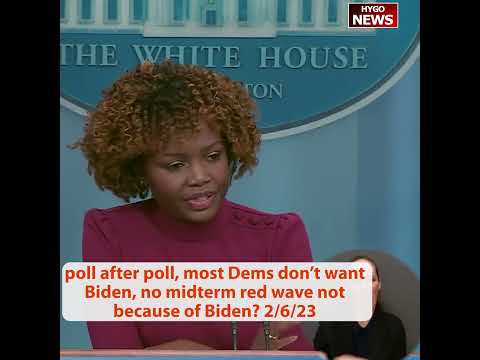
Reporter: Other Dems Communicate Better Than Biden? KJP: “I Get Where You’re Getting To”
In February 2023 during State of the Union week, a reporter pressed a sharp communication-focused question at White House Press Secretary Karine Jean-Pierre: “I guess does it suggest then that maybe the Democrats who were talking about the president’s agenda have been more successful at talking about the president’s agenda than the president himself has been? And does that make it all the more important tomorrow and whenever the president rolls out his reelection campaign if he does? But does it make it that much more important for the president to somehow find a way to communicate as effectively as I guess some of these other Democrats were? Because obviously however he’s communicating now isn’t translating.” KJP’s response acknowledged economic reality: “I’ll say this, we understand and it is true that the American people are feeling inflation. They’re going to have some feelings about the economy right now.” She continued: “I get where you’re getting to. But this is an incredibly complicated time what the president’s going to focus on.”
The Sophisticated Question
Question sophistication:
Communication failure — Biden’s.
Others more effective — Democrats.
Agenda same — Different messengers.
Upcoming speech — SOTU.
Reelection rollout — Implications.
The reporter’s question was sophisticated political communication analysis. If Democrats running on Biden’s agenda were more effective than Biden himself at that communication, what did that say about Biden’s personal effectiveness?
”More Successful at Talking About”
Communication analysis:
Same content — Biden agenda.
Different messengers — Democratic candidates.
Candidates better — At communication.
Biden worse — At his own message.
Implications — Obvious.
If Democrats could sell Biden’s agenda but Biden couldn’t sell his own agenda, the communication problem was personal rather than substantive. Biden’s delivery, not message content, was issue.
”Not Translating”
The clear framing:
Communication failing — Stated.
Evidence — Polling.
Pattern — Consistent.
Biden specifically — Not messaging well.
Observable reality — Accepted.
“However he’s communicating now isn’t translating” was direct statement of observable reality. The polling patterns the reporter had been citing showed communication wasn’t working. This was factual assessment.
The State of the Union Context
SOTU context:
Upcoming speech — That night.
Major opportunity — For Biden.
Communication challenge — Real.
Performance pressure — High.
Reelection implications — Significant.
The State of the Union speech that night was major communication opportunity. If Biden couldn’t communicate effectively at SOTU, reelection campaign would face serious challenges. The upcoming speech was important.
The Reelection Rollout Uncertainty
Rollout uncertainty:
“If he does” — Hedged.
Not announced yet — February 2023.
Expected — Yes.
Communication capacity — Question.
Campaign effectiveness — Related.
The “if he does” hedge about reelection showed reporter’s awareness that announcement hadn’t happened yet. But the question applied regardless — if Biden couldn’t communicate effectively, reelection campaign was harder.
”We Understand”
KJP’s opening:
“We understand” — Acknowledgment.
“It is true” — Confirmed.
Inflation felt — By Americans.
Reality acknowledged — Finally.
Pivot — To economy.
KJP’s “we understand and it is true” opening was rare direct acknowledgment of reality. Americans were feeling inflation. This was honest admission rather than dismissal. Strategic pivot to economy began.
”Have Some Feelings About the Economy”
Feelings framing:
“Feelings” — Subjective.
About economy — Specific.
Acknowledgment — Made.
Characterization — Measured.
Political reality — Accepted.
The “feelings about the economy” framing acknowledged public perception without fully accepting economic substance. Calling them “feelings” subtly suggested subjective rather than objective assessment. But acknowledgment was real.
”President Has Always Acknowledged”
Acknowledgment claimed:
Biden acknowledges — Challenges.
“Always” — Consistent.
More work needed — Admitted.
Accountability — Partial.
Framing — Sympathetic.
KJP’s framing that Biden “has always acknowledged” challenges and said “there’s always more work to do” was somewhat defensive. This claimed Biden had been honest about difficulties despite communication critique.
”No Easy Answer”
Complexity acknowledged:
“No easy answer” — Admitted.
Complexity — Real.
Simple solutions — Rejected.
Realistic — Framing.
Intellectually honest — Mostly.
The “no easy answer” acknowledgment was intellectually honest. Economic challenges were complex. Simple solutions didn’t exist. This was fair framing even if self-serving.
”I Get Where You’re Getting To”
The telling admission:
“I get” — Acknowledgment.
Reporter’s point — Understood.
Communication issue — Implied.
Admission — Partial.
Pivot — Attempted.
“I get where you’re getting to” was telling admission. KJP was acknowledging she understood the reporter’s implicit criticism that Biden’s communication was failing. This was rare partial admission.
”Incredibly Complicated Time”
Complication framing:
“Complicated time” — Framing.
Multiple challenges — Implied.
Focus justified — Strategically.
Evasion element — Present.
Transition — To deflection.
The “incredibly complicated time” framing was transition to deflection. Complicated times justified focus on substance rather than responding to communication critique. This was pivot away from direct question.
The Communication Problem Substantive
Communication problem:
Biden delivery — Often poor.
Age-related — Factor.
Mumbling — Sometimes.
Gaffes — Frequent.
Perception — Real.
The communication problem was substantive. Biden’s delivery was often poor. Age-related factors affected speech clarity. Mumbling and gaffes were frequent. Public perception reflected real delivery issues.
The Other Democrats’ Effectiveness
Others’ effectiveness:
Warnock — Smooth.
Shapiro — Polished.
Harris — Varied.
Fetterman — Authentic.
Various — Different styles.
Other Democrats had varied communication strengths. Some like Warnock and Shapiro were polished. Harris varied. Fetterman had authentic directness. Biden’s communication was more challenged than these colleagues.
The Age-Communication Nexus
Age-communication:
Biden 80 — Advanced.
Speech patterns — Affected.
Clarity — Sometimes lacking.
Energy — Variable.
Nexus — Real.
The age-communication nexus was real. At 80, Biden’s speech patterns were affected. Clarity sometimes lacked. Energy was variable. Voters observing these patterns formed impressions about capacity.
The State of the Union as Test
SOTU test:
Nationally televised — Major.
Performance evaluation — Public.
Messaging test — Comprehensive.
Communication assessment — Live.
Reelection implications — Clear.
State of the Union would be major test of Biden’s communication capability. Nationally televised performance evaluation under pressure. Direct messaging test. Live communication assessment. Reelection implications clear.
The Biden SOTU Performance
Actual performance:
Generally well — Received.
Responsive — To heckling.
Energetic — Mostly.
Scripted — Effective.
Off-script — Moments.
The actual SOTU performance was generally well received. Biden responded to Republican heckling effectively. He showed energy during most of speech. Scripted elements worked. Off-script moments had mixed results.
The Post-SOTU Polling
Post-SOTU polling:
Some improvement — Temporary.
Campaign factor — Standard.
Sustained change — Questionable.
Bump typical — After major speeches.
Numbers patterns — Returning.
Post-SOTU polling showed some improvement that was typical speech bump. Sustained change was questionable. After speech bumps usually faded. Numbers patterns would return to baseline.
The Democratic Communication Infrastructure
Infrastructure:
Party communications — Layered.
Individual members — Own platforms.
Social media — Active.
Messaging coordination — Variable.
Amplification — Through members.
Democratic Party communication infrastructure had multiple layers. Individual members communicated on own platforms. Social media was active. Coordination was variable. Amplification through members happened beyond Biden.
The Biden Communication Challenges Specifically
Specific challenges:
Extended remarks — Risk.
Improvised answers — Gaffes.
Whisper moments — Odd.
Shuffled pacing — Physical.
Mixed coverage — Result.
Biden’s specific communication challenges included extended remarks carrying gaffe risk, improvised answers causing problems, odd whisper moments, shuffled physical pacing. Mixed coverage resulted from these challenges.
The Media Coverage Balance
Coverage balance:
Gaffes reported — Extensively.
Successful moments — Also covered.
Horse race — Dominant frame.
Policy substance — Less.
Personal dynamics — High.
Media coverage balance included extensive gaffe reporting, also successful moment coverage, dominant horse-race framing, less policy substance coverage, high personal dynamics focus. This was standard political coverage.
The Communications Strategy Questions
Strategy questions:
Limit exposure — Protective.
More exposure — Retail.
Different venues — Explored.
Target audiences — Specific.
Approach evolution — Needed.
Communications strategy questions included whether to limit Biden exposure protectively or expose him more for retail politics, different venue exploration, targeted audience approaches, approach evolution needs.
The Reporter’s Professional Work
Reporter work:
Sharp analysis — Smart.
Honest framing — Direct.
Communication focus — Relevant.
Professional — Throughout.
Quality journalism — Displayed.
The reporter’s sharp analysis, honest framing, communication focus, professional approach throughout demonstrated quality journalism. This was substantive accountability work.
The Administrative Dilemma Real
Real dilemma:
Acknowledge failure — Can’t.
Defend record — Effort.
Change strategy — Needed.
Admit problems — Risky.
Difficult — Genuinely.
The administrative dilemma was real. Acknowledging communication failure was impossible publicly. Defending record required constant effort. Strategy change was needed. Admitting problems was risky. Genuinely difficult situation.
The Inflation Acknowledgment Importance
Inflation acknowledgment:
Rare admission — Of reality.
American feelings — Validated.
Political benefit — Some.
Risk factor — Contained.
Messaging option — Limited.
Acknowledging inflation reality was politically significant. Validating American feelings about economy was rare admission. Some political benefit from honesty. Risk factor contained. Messaging options were limited on economy.
The Economic Reality Context
Economic reality:
Inflation 6-8% — Still high.
Recession concerns — Real.
Housing affordability — Bad.
Gas prices — Variable.
Public perception — Negative.
Economic reality context was challenging. Inflation remained 6-8% range. Recession concerns were real. Housing affordability crisis continued. Gas prices were variable. Public perception was negative despite some improvements.
The 2024 Economic Messaging
Economic messaging:
Bidenomics — Eventually used.
Accomplishments — Highlighted.
Job creation — Emphasized.
Inflation decline — Claimed.
Success argument — Attempted.
The 2024 economic messaging would eventually embrace “Bidenomics” branding, highlight accomplishments, emphasize job creation, claim inflation decline, attempt success argument. Effectiveness of this messaging was debated.
The Eventual Campaign Strategy
Campaign strategy:
Limited exposure — Initially.
Careful rollout — Used.
Protected settings — Preferred.
Gaffes managed — Sometimes.
Reality — Caught up.
The eventual campaign strategy involved limited Biden exposure initially, careful rollout, preferred protected settings, gaffes managed when possible. Reality eventually caught up as 2024 general election approached.
The June 2024 Debate
June 2024:
Critical moment — Came.
Poor performance — By Biden.
Panic Democratic — Ensued.
Withdrawal pressure — Intense.
Eventual exit — From race.
The June 2024 debate would be critical moment when Biden’s poor performance triggered Democratic panic. Withdrawal pressure became intense. Eventual exit from race in July followed. February 2023 polling warnings proved prescient.
The Long-Term Communication Lessons
Communication lessons:
Delivery matters — Not just content.
Messenger affects — Message reception.
Age factors — Real politically.
Alternative voices — Valuable.
Strategy flexibility — Necessary.
Long-term communication lessons from this period included delivery mattering beyond just content, messenger affecting message reception, age factors being real political issues, alternative voices being valuable, strategy flexibility being necessary.
Key Takeaways
- A reporter asked whether other Democrats communicated Biden’s agenda better than Biden himself.
- The sharp framing: “Does it make it that much more important for the president to somehow find a way to communicate as effectively as I guess some of these other Democrats were?”
- The observation: “Because obviously however he’s communicating now isn’t translating.”
- KJP acknowledged reality: “We understand and it is true that the American people are feeling inflation.”
- She admitted partial understanding: “I get where you’re getting to.”
- She deflected: “This is an incredibly complicated time what the president’s going to focus on.”
Transcript Highlights
The following is transcribed from the video audio (unverified — AI-generated from audio).
- I guess does it suggest then that maybe the Democrats who were talking about the president’s agenda have been more successful at talking about the president’s agenda than the president himself has been?
- Does that make it all the more important tomorrow and whenever the president rolls out his reelection campaign if he does?
- But does it make it that much more important for the president to somehow find a way to communicate as effectively as I guess some of these other Democrats were? Because obviously however he’s communicating now isn’t translating.
- So I’ll say this, we understand and it is true that the American people are feeling inflation. They’re going to have some feelings about the economy right now.
- The president has always acknowledged and has said there’s always more work to do. There’s no easy answer there.
- I get where you’re getting to. But this is an incredibly complicated time what the president’s going to focus on.
Full transcript: 168 words transcribed via Whisper AI.