 HYGO News
 Poll after poll, most Dems don’t want Biden, no midterm red wave not because of Biden? part 2
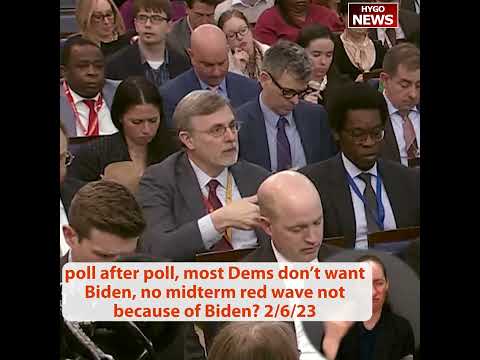
Reporter: Did Dems Win Despite Biden? KJP: Candidates Ran on Biden’s “Successes”
In February 2023, continuing a pointed exchange on polling, a reporter escalated the question to White House Press Secretary Karine Jean-Pierre. “I mean, given that poll which, you know, is not just a single poll, it’s been versions of that have been repeated in poll after poll, survey after survey, since the midterm elections and before. And I think one of my colleagues referenced a recent poll that said 60 something percent more Democrats don’t want President Biden to be their nominee than Republicans don’t want President Trump to be their nominee. So given all of that, why are you so convinced that it was President Biden that caused the Democratic success in the midterms and not that the Democrats had success in spite of the president?” KJP responded: “Well, I’ll say this because if you look at what candidates, senators and congressional members ran on, it was the successes that the president had. If you hear the message that was coming out of Democrats during the midterms, it was what we were able to deliver.”
The Reporter’s Escalation
Escalation:
“Not single poll” — Pattern.
“Poll after poll” — Repetition.
“Survey after survey” — Consistency.
Before and after midterms — Ongoing.
Pattern persistence — Emphasized.
The reporter’s escalation emphasized pattern persistence. These weren’t isolated polls — they were repeated measurements showing consistent results before and after midterms. Pattern recognition was strong.
”60 Something Percent”
Biden-Trump comparison:
Democrats rejecting Biden — More than.
Republicans rejecting Trump — Less than.
60+% Democrats — Against Biden.
Comparison — Unflattering.
Party base rejection — Biden greater.
The 60+% Democrats not wanting Biden as nominee, compared to smaller percentage of Republicans not wanting Trump, was striking data point. Biden faced greater base rejection within his own party than Trump did within his.
The Comparative Problem
Comparative problem:
Biden — More party rejection.
Trump — Less party rejection.
Democratic advantage — Eroded.
Head-to-head — Concerning.
Party enthusiasm — Gap.
This comparative data was particularly concerning because head-to-head general election would need base enthusiasm. If Democrats were more divided on Biden than Republicans on Trump, turnout advantage shifted.
”Despite the President” — The Alternative Hypothesis
Alternative hypothesis:
Democrats won — Some.
Biden drag — Real.
Success — Despite Biden.
Not because of — Biden.
Candidates — Carried own weight.
The “despite the president” alternative hypothesis was provocative framing. Maybe Democrats didn’t win because of Biden but in spite of him — overcoming Biden drag to succeed on individual candidate strength.
The Hypothesis Backing
Hypothesis backing:
Polling data — Supportive.
Base concerns — Real.
Ticket splitting — Evidence.
Candidate quality — Variable.
Dobbs mobilization — Independent.
Multiple data points supported “despite Biden” hypothesis. Polling data showed Biden problems, base concerns were real, ticket-splitting was evident, candidate quality varied, and Dobbs mobilization was independent of Biden.
”What Candidates Ran On”
KJP’s response:
Candidates — Running on.
“President’s successes” — Claimed.
Senators — Focused on this.
Congressional members — Same.
Unified message — Implied.
KJP’s response was that Democratic candidates ran on Biden’s successes. This framing tried to establish linkage between candidate messaging and Biden accomplishments. Whether accurate was debatable.
The Candidate Reality
Actual reality:
Many distanced — From Biden.
Local focus — Common.
State issues — Emphasized.
Biden invisible — Often.
Personal appeal — Primary.
The candidate reality was more complex than KJP’s claim. Many Democratic candidates distanced themselves from Biden, focused on local issues, didn’t invite Biden to campaign, and emphasized personal appeal over Biden connection.
The Swing State Behavior
Swing state:
Warnock — Georgia, own message.
Shapiro — Pennsylvania, own.
Fetterman — Pennsylvania, own.
Kelly — Arizona, own.
Biden absent — From campaigns.
Swing state Democratic winners generally ran campaigns based on their own message, not Biden’s. Warnock, Shapiro, Fetterman, Kelly won with personal appeal. Biden was often absent from their campaigns.
”What the Message Was”
Message attribution:
Democrats delivered — Claimed.
“We were able to” — Framing.
Collective credit — Biden-inclusive.
Actual focus — Varied.
Spin element — Present.
KJP’s claim that Democrats’ message was “what we were able to deliver” — meaning Biden accomplishments — was questionable spin. Actual Democratic campaign focus was often on different issues.
The Actual Democratic Messages
Actual messages:
Abortion rights — Central.
Democracy threats — Key.
Opposition to Trump — Persistent.
Specific state issues — Local.
Not Biden — Primarily.
Actual Democratic campaign messages centered on abortion rights, threats to democracy, opposition to Trump and extremism, and specific state-level issues. Biden accomplishments were often peripheral rather than central.
The Democratic Senate Winners
Senate winners:
Warnock — Georgia.
Fetterman — Pennsylvania.
Kelly — Arizona.
Masto — Nevada.
Hassan — New Hampshire.
Democratic Senate winners in 2022 included Warnock, Fetterman, Kelly, Masto, and Hassan. Each had individual campaigns and circumstances. Attribution to Biden was complicated.
The Democratic Gubernatorial Wins
Gubernatorial:
Shapiro — Pennsylvania.
Whitmer — Michigan.
Evers — Wisconsin.
Hobbs — Arizona.
Multiple — States.
Democratic gubernatorial victories in Pennsylvania, Michigan, Wisconsin, Arizona, and elsewhere showed base strength. But these were often local factors and weak Republican candidates more than Biden effect.
The Dobbs Mobilization Underestimated
Dobbs mobilization:
Abortion ruling — June 2022.
Base energy — Mobilized.
Independent voters — Moved.
Turnout — Elevated.
Major factor — Undeniable.
The Dobbs decision’s mobilization of Democratic base and moving of some independent voters on abortion was major midterm factor. This was Independent of Biden — it was Supreme Court driven.
The Trump Drag Factor
Trump drag:
Continuing presence — Felt.
Endorsed candidates — Often lost.
Election denial — Hurt Republicans.
Base enthusiasm — Issue.
Swing voters — Turned off.
Trump’s continuing political presence was drag on Republican candidates. His endorsed candidates often lost. Election denial message hurt swing voter appeal. Base enthusiasm was questionable. These factors helped Democrats.
The Candidate Quality Asymmetry
Candidate asymmetry:
Democrats generally — Stronger.
Republicans — Variable.
Trump selections — Weak often.
Walker, Oz, Masters — Struggled.
Democratic edge — Real.
Candidate quality asymmetry between parties was real factor. Democratic candidates were generally stronger. Trump-selected Republican candidates often struggled with swing voters. This asymmetry helped Democrats independent of Biden.
”So Yes, and So That’s What”
The cut-off:
Sentence incomplete — Recording ends.
Continuation likely — Elsewhere.
Response developing — Was.
Context limited — By clip.
Full exchange — In longer source.
The clip ending with “so yes, and so that’s what” suggested response was continuing beyond available transcript. The fuller exchange was likely in complete briefing recording. Clip captured key moments.
The “Spin” Element
Spin:
Claim constructed — Deliberately.
Reality tensioned — With claim.
Narrative — Positive for Biden.
Data — Less supportive.
Strategic — Messaging.
KJP’s response had clear spin element — constructing narrative that Democrats running on Biden successes when reality was more complex. This was strategic messaging rather than pure factual engagement.
The Professional Tension
Professional tension:
Reporter data — Strong.
KJP spin — Evident.
Audience — Watching.
Coverage — Resulting.
Patterns — Accumulating.
Professional tension between reporter data and KJP spin was evident. Audience watched. Coverage resulted from exchanges. Patterns accumulated over time affecting administrative credibility.
The Polling Dismissal Pattern Previously
Pattern:
“Rabbit hole” — Dismissal.
“Focus on delivering” — Deflection.
Template responses — Standard.
Substance avoidance — Pattern.
Transparency — Recognized.
The polling dismissal pattern from prior briefings was continuing. “Rabbit hole” characterizations, “focus on delivering” deflections, template responses avoided substance. The transparency of the pattern was recognized by reporters.
The Reporter’s Sustained Challenge
Sustained challenge:
Multiple angles — Used.
Data mounting — Presented.
Logical construction — Built.
Pressure maintained — Professional.
Quality — Journalism.
The reporter’s sustained challenge across multiple angles, mounting data, logical construction, and maintained pressure represented quality accountability journalism. This was professional work.
The Administrative Response Limits
Response limits:
Data contradicting — Claim.
Counter-argument — Weak.
Spin transparent — Somewhat.
Credibility cost — Accruing.
Path forward — Unclear.
The administrative response limits were evident. Counter-argument against mounting data was weak. Spin was transparent. Credibility cost was accruing. Clear path forward on this messaging was unclear.
The 2024 Strategic Implications
Strategic implications:
Messaging failure — Evident.
Alternative approaches — Needed.
Polling reality — Persistent.
Campaign challenge — Real.
Strategy reconsideration — Warranted.
The 2024 strategic implications of persistent polling showing Biden problems suggested need for different approaches. Messaging wasn’t moving numbers. Campaign challenge was real. Strategy reconsideration was warranted.
The Democratic Establishment Position
Establishment position:
Biden support — Public.
Private concerns — Growing.
Alternative preparation — Quiet.
Unity prioritized — Publicly.
Reality — Internally acknowledged.
Democratic establishment maintained public Biden support while private concerns grew. Quiet alternative preparation was happening. Unity was prioritized publicly while reality was internally acknowledged.
The Intra-Party Dynamics
Intra-party:
Loyalty — Publicly.
Concerns — Privately.
Polling discussion — Strategic.
Electability — Central.
Unity vs. reality — Tension.
Intra-party dynamics showed public loyalty with private concerns. Polling discussion was strategic matter. Electability was central concern. Tension between unity and reality was real.
The Historical Comparisons
Historical:
Carter 1980 — Primary challenge.
Johnson 1968 — Withdrew.
Incumbent struggles — Can happen.
Intervention — Rare but possible.
Biden parallel — Debated.
Historical comparisons to Carter 1980 (facing Kennedy primary challenge) and Johnson 1968 (withdrawing from race) showed incumbent struggles could lead to intervention or withdrawal. Parallels to Biden’s situation were debated.
The Eventual Political Development
Development:
Biden ran — April 2023.
Nomination secured — Mostly.
Debate disaster — June 2024.
Withdrawal — July 2024.
Harris replaced — August 2024.
The eventual political development would see Biden run starting April 2023, secure nomination mostly, experience debate disaster in June 2024, withdraw in July 2024, and be replaced by Harris in August 2024.
The Polling Reality Prescient
Prescient:
February 2023 polls — Warnings.
Patterns visible — Then.
Dismissed initially — By administration.
Eventually — Validated.
Hindsight — Clear.
The February 2023 polling patterns were warnings of political realities that would eventually validate. Initially dismissed by administration, they proved prescient. Hindsight clarity was painful.
The Press Briefing as Historical Record
Historical record:
Exchanges documented — On video.
Positions stated — Recorded.
Later evaluation — Possible.
Patterns visible — Retrospectively.
Transparency — Preserved.
Press briefings served as historical record with exchanges documented on video, positions stated and recorded. Later evaluation was possible. Patterns became visible retrospectively. Transparency was preserved through documentation.
Key Takeaways
- A reporter challenged KJP: polling showed “60 something percent” more Democrats rejected Biden than Republicans rejected Trump.
- The reporter asked whether Democrats won in midterms “in spite of” Biden rather than because of him.
- KJP’s response claimed Democrats ran on Biden’s successes: “If you look at what candidates, senators and congressional members ran on, it was the successes that the president had.”
- She claimed unified message: “If you hear the message that was coming out of Democrats during the midterms, it was what we were able to deliver.”
- Actual candidate behavior often differed — many distanced from Biden, focused on local issues, and emphasized personal appeal.
- The sustained polling challenge highlighted Biden’s political vulnerability that would eventually lead to his July 2024 withdrawal.
Transcript Highlights
The following is transcribed from the video audio (unverified — AI-generated from audio).
- I mean, given that poll which, you know, is not just a single poll, it’s been versions of that have been repeated in poll after poll, survey after survey, since the midterm elections and before.
- One of my colleagues referenced a recent poll that said 60 something percent more Democrats don’t want President Biden to be their nominee than Republicans don’t want President Trump to be their nominee.
- So given all of that, why are you so convinced that it was President Biden that caused the Democratic success in the midterms and not that the Democrats had success in spite of the president?
- Well, I’ll say this because if you look at what candidates, senators and congressional members ran on, it was the successes that the president had.
- If you hear the message that was coming out of Democrats during the midterms, it was what we were able to deliver.
- So yes, and so that’s what.
Full transcript: 161 words transcribed via Whisper AI.