 HYGO News
 King Charles Invites Trump for 'Unprecedented' Second State Visit; Starmer Thanks Trump for Ukraine Peace Push
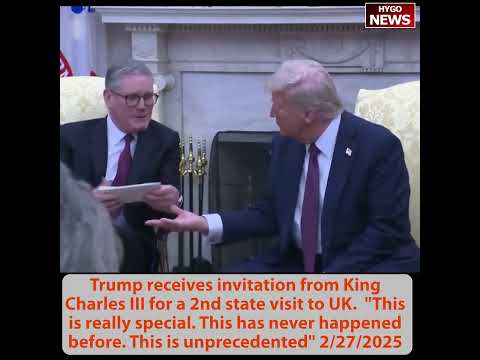
King Charles Invites Trump for “Unprecedented” Second State Visit; Starmer Thanks Trump for Ukraine Peace Push
In a historic diplomatic moment on February 27, 2025, UK Prime Minister Keir Starmer personally delivered a letter from King Charles III inviting President Trump for a second state visit to the United Kingdom — something Starmer described as “truly historic” and “unprecedented.” Trump accepted immediately, saying “our wonderful First Lady Melania and myself — the answer is yes.” Starmer thanked Trump “for changing the conversation to bring about the possibility that now we can have a peace deal” on Ukraine, and Trump described the UK as “a wonderful country” where he expected to be “getting along on every one” of the items on the agenda, including trade, Ukraine, and broader security matters.
The Royal Invitation: “This Has Never Happened Before”
The most symbolically significant moment of Starmer’s White House visit came when the Prime Minister presented a letter from King Charles III in the Oval Office.
Trump set up the moment with praise for the King. “He’s a beautiful man, a wonderful man, and we appreciate that,” Trump said of Charles. “I’ve gotten to know him very well, actually — first term and now second term.”
He then turned to Starmer: “Perhaps you’d like to say what that very important paragraph is.”
Starmer delivered the news with evident pride. “So this is a letter from His Majesty the King,” Starmer said. “It’s an invitation for a second state visit.”
He emphasized the historical significance: “This is really special. This has never happened before. This is unprecedented.”
Starmer elaborated: “And I think that just symbolizes the strength of the relationship between us. So this is a very special letter. I think the last state visit was a tremendous success. His Majesty the King wants to make this even better than that. So this is truly historic — an unprecedented second state visit.”
State visits to the United Kingdom are the highest form of diplomatic hospitality the British government and monarchy can extend. They involve a formal welcome by the sovereign, a state banquet at Buckingham Palace, and a series of ceremonial events that are carefully choreographed by the Royal Household. For a president to receive a second state visit invitation was indeed unprecedented in modern British diplomatic history — previous presidents had typically received one state visit per presidency, if any.
Trump’s first state visit to the UK had taken place in June 2019, during his first term. The visit had included a state banquet at Buckingham Palace hosted by Queen Elizabeth II, who had reportedly found Trump personally charming. The invitation from King Charles for a second visit reflected both the King’s desire to strengthen the U.S.-UK relationship and the British government’s recognition that engaging warmly with the Trump administration was in the national interest.
Trump Accepts Immediately
Starmer added a playful note: “What I haven’t got yet is your answer.”
Trump’s response was warm and decisive. “The answer is yes,” he said. “We have our wonderful First Lady, Melania, and myself. The answer is yes. And we look forward to being there and honoring the King and honoring really your country. Your country is a fantastic country, and it’ll be our honor to be there.”
Starmer responded with diplomatic satisfaction: “I shall happily take that back to His Majesty. Thank you.”
The exchange — the Prime Minister hand-delivering a royal invitation, the President accepting on the spot — was diplomatic theater at its finest. The personal delivery by Starmer rather than through standard diplomatic channels elevated the gesture and demonstrated that the UK was investing significant political capital in the Trump relationship.
Starmer: “Thank You for Changing the Conversation”
Starmer then delivered substantive remarks that went beyond the ceremonial, directly thanking Trump for his role in the Ukraine peace process.
“Our countries have been bound together for a very long time now,” Starmer said. “The closest alliance, I think, of any two countries when it comes to prosperity and security. And I know that together, we will strengthen that even further.”
He then offered what amounted to a public endorsement of Trump’s Ukraine diplomacy from a center-left European leader. “And on issues like Ukraine, thank you for changing the conversation to bring about the possibility that now we can have a peace deal,” Starmer said.
He added the UK’s commitment to the process: “And we want to work with you to make sure that peace deal is enduring, that it lasts, that it’s a deal that goes down as a historic deal that nobody breaches. And we’ll work with you to make sure that absolutely happens.”
Starmer’s praise was significant because he was a Labour Party prime minister — a leader from the political left who might have been expected to be skeptical of Trump’s diplomatic approach. Instead, he was publicly thanking Trump for achieving what three years of Biden-era diplomacy had not: creating the conditions for a peace deal. The endorsement provided bipartisan and international validation of Trump’s Ukraine strategy.
Trump: “Getting Along on Every One”
Trump offered his own warm remarks about the bilateral relationship and the day’s agenda.
“It’s a great honor to have Prime Minister Starmer in the Oval Office,” Trump said. “It’s a very special place and he’s a special man. And the United Kingdom is a wonderful country that I know very well. I’m there a lot.”
He previewed the discussions: “We’ll be discussing many things today. We’ll be discussing Russia-Ukraine. We’ll be discussing trade and lots of other items. And I think we can say that we’re going to be getting along on every one of them.”
Trump noted their personal rapport: “We’ve had a tremendous relationship. And frankly, the Prime Minister and I have met twice before and we get along very famously, as you would say.”
The “as you would say” — a nod to British English — drew smiles and captured the personal warmth that characterized the meeting. Despite the significant policy differences between a Republican American president and a Labour British prime minister, the two leaders projected genuine comfort with each other.
”Can You Get a Peace Deal Done?”
As reporters were ushered out, one shouted the question that was on everyone’s mind: “President Trump, can you get a peace deal done on Ukraine?”
“Yes,” Trump said.
“How confident are you, sir?”
“I think so,” Trump replied.
The exchange — two words of answer to the most consequential question in global affairs — captured Trump’s approach to the Ukraine negotiations. No hedging, no qualifications, no diplomatic ambiguity. Just confidence that the deal would get done.
The Diplomatic Context
Starmer’s visit came during a week of intense diplomatic activity. Trump had hosted Macron earlier in the week, was expecting Zelensky on Friday to sign the minerals deal, and was continuing phone diplomacy with Putin. Starmer’s visit added the United Kingdom to the coalition of nations actively supporting the peace process.
The UK brought specific value to the negotiations. As a permanent member of the UN Security Council, a nuclear power, and the leading European contributor to Ukraine’s defense after the United States, Britain’s participation in the peace framework gave it both credibility and leverage. Starmer’s public support for Trump’s approach signaled that the peace process had transatlantic backing from both sides of the political spectrum.
Key Takeaways
- PM Starmer delivered a letter from King Charles III inviting Trump for an “unprecedented” second state visit, calling it “truly historic” and something that “has never happened before.”
- Trump accepted immediately: “Our wonderful First Lady Melania and myself — the answer is yes. It’ll be our honor.”
- Starmer thanked Trump “for changing the conversation to bring about the possibility that now we can have a peace deal” on Ukraine, pledging UK support for “an enduring” agreement.
- Trump said he and Starmer would be “getting along on every one” of the items on the agenda, including Ukraine, trade, and security.
- When asked “Can you get a peace deal done on Ukraine?” Trump answered simply: “Yes.”