 HYGO News
 Netanyahu: 'Israel Will Eliminate the Trade Deficit -- Serve as a Model'; Trump: 'Direct Talks With Iran'; Hegseth: 'About to Get Worse' for Houthis
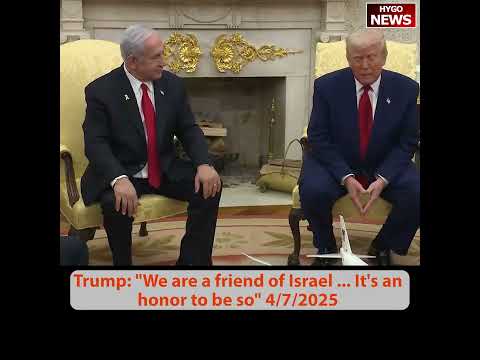
Netanyahu: “Israel Will Eliminate the Trade Deficit — Serve as a Model”; Trump: “Direct Talks With Iran”; Hegseth: “About to Get Worse” for Houthis
Israeli Prime Minister Benjamin Netanyahu visited the White House in April 2025 and delivered the response to Liberation Day that the Trump administration wanted every country to emulate: “We will eliminate the trade deficit with the United States. We intend to do it very quickly. I think Israel can serve as a model for many countries who ought to do the same.” Trump announced “direct talks with Iran” starting Saturday, saying “doing a deal would be preferable to doing the obvious.” Defense Secretary Hegseth warned the Houthis: “It’s been a bad three weeks. It’s about to get worse.”
Netanyahu: “We Will Eliminate the Trade Deficit”
Netanyahu opened his White House remarks with the most cooperative response any foreign leader had given to the Liberation Day tariffs.
“I can tell you that I said to the president a very simple thing,” Netanyahu said. “We will eliminate the trade deficit with the United States. We intend to do it very quickly. We think it’s the right thing to do.”
He expanded the commitment: “And we’re going to also eliminate trade barriers — a variety of trade barriers that have been put up unnecessarily.”
Netanyahu then offered Israel as a template: “And I think Israel can serve as a model for many countries who ought to do the same.”
He acknowledged the principle behind Trump’s position: “I recognize the position of the United States. It says, you know, we’re allowing other countries to put tariffs on us, but we don’t put tariffs on them.”
Netanyahu bridged his own economic philosophy with Trump’s: “I’m a free trade champion, and free trade has to be fair trade. And I think that’s basically the position that you have put forward, Mr. President.”
The commitment: “We are going to eliminate the tariffs and rapidly.”
Netanyahu’s response was the administration’s dream scenario. Rather than retaliating, complaining, or dragging negotiations out over months, the Israeli prime minister had simply agreed. He would eliminate the trade deficit, remove trade barriers, and do it quickly. If every country responded the way Israel did, the tariff regime would accomplish its goal without a prolonged trade war.
The “model for many countries” framing was strategically brilliant from Netanyahu’s perspective. By being the first major ally to fully cooperate, Israel positioned itself as Trump’s preferred trading partner — earning goodwill at a moment when the U.S.-Israel relationship was central to Middle East negotiations.
Trump: “By Far the Best President for Israel”
Trump provided the diplomatic context for Netanyahu’s visit.
“It’s an honor to have a very, very special person. I’ve dealt with him for a long time — Benjamin Netanyahu, Prime Minister of Israel,” Trump said.
He described the visit’s substance: “We had lunch together. We had meetings together. And I think we’ve come up to some pretty good solutions and conclusions.”
Trump stated the relationship: “We are a friend of Israel, as you know. I would say that I’m, by far, the best president that Israel has ever even thought of seeing. And it’s an honor to be so.”
He acknowledged the mutual benefit: “We are helping them. And likewise, they’ve been helping us very much.”
Trump then identified the two subjects discussed: “We had great discussions today on the obvious subject of Iran. And also the less obvious subject with respect to Israel — and that’s trade."
"Direct Talks With Iran”
Trump made the announcement that would dominate international headlines.
“We’re having direct talks with Iran,” he said. “And they’ve started. It’ll go on Saturday. We have a very big meeting, and we’ll see what can happen.”
He stated his preference: “And I think everybody agrees that doing a deal would be preferable to doing the obvious.”
Trump specified what “the obvious” meant: “And the obvious is not something that I want to be involved with, or frankly, that Israel wants to be involved with if they can avoid it. So we’re going to see if we can avoid it.”
He described the urgency: “But it’s getting to be very dangerous territory. And hopefully those talks will be successful. And I think it would be in Iran’s best interest if they are successful. We hope that’s going to happen.”
The confirmation of “direct talks” with Iran was the most significant diplomatic revelation since the Liberation Day tariffs. Previous administrations had engaged with Iran through intermediaries, back channels, and multilateral frameworks. Trump was confirming bilateral, direct negotiations — the format most likely to produce a decisive outcome.
The “obvious” alternative that Trump referenced without naming was military action against Iran’s nuclear facilities. By saying it was something neither he nor Israel wanted “if they can avoid it,” Trump was framing the talks as Iran’s opportunity to prevent a military confrontation that both the United States and Israel were prepared to execute but preferred to avoid.
Hegseth: “About to Get Worse”
Defense Secretary Pete Hegseth delivered the military update with characteristic directness.
“It’s been a bad three weeks for the Houthis,” Hegseth said. “And it’s about to get worse.”
He cataloged the targets: “It’s been a devastating campaign, whether it’s underground facilities, weapons manufacturing, bunkers, troops in the open, air defense assets.”
The commitment: “We are not going to relent. And it’s only going to get more unrelenting.”
The condition for cessation: “Until the Houthis declare they will stop.”
Hegseth’s statement was the military complement to Trump’s diplomatic remarks. While Trump was offering Iran negotiations, Hegseth was destroying Iran’s most active proxy. The message to Tehran was unmistakable: the diplomatic track was open, but the military track was accelerating. Iran could negotiate a deal while its Houthi proxy was being systematically dismantled, or it could refuse and watch its regional influence degrade further with each passing day.
The “about to get worse” warning suggested that the campaign was about to escalate — possibly to new target categories, increased strike frequency, or operations against Houthi leadership. The three weeks of operations had already been described as “devastating”; whatever came next would exceed what had already occurred.
Key Takeaways
- Netanyahu pledged to “eliminate the trade deficit with the United States very quickly” and remove trade barriers, calling Israel “a model for many countries.”
- He endorsed Trump’s principle: “I’m a free trade champion, and free trade has to be fair trade.”
- Trump announced “direct talks with Iran” starting Saturday: “Doing a deal would be preferable to doing the obvious.”
- He warned: “It’s getting to be very dangerous territory. I think it would be in Iran’s best interest if the talks are successful.”
- Hegseth on the Houthi campaign: “It’s been a bad three weeks. It’s about to get worse. We are not going to relent.”