 HYGO News
 PM Netanyahu: appreciation & admiration many admirers around world; Q: desire another strike on Iran?
PM Netanyahu: appreciation & admiration many admirers around world; Q: desire another strike on Iran?
The Trump-Netanyahu bilateral meeting produced wide-ranging remarks. Netanyahu expressed the appreciation of Israelis and “the Jewish people, many, many admirers around the world” for Trump’s leadership. Trump, asked what might prompt another strike on Iran, answered that Iran was now “very different” — willing to meet, willing to work something out. He characterized Mamdani as a “communist” rather than “socialist” and warned the New York Democratic nominee that federal funding for New York City flows through the White House. And in one of the more striking economic claims of the day, Trump noted that foreign investment announcements into the United States during his first six months exceeded “$15 trillion” — with Gulf leaders describing the United States as “the hottest country anywhere in the world.”
Netanyahu’s Opening
Netanyahu opened with formal appreciation. “I want to express the appreciation and admiration not only of all Israelis, but of the Jewish people, many, many admirers around the world for your leadership, your leadership of the free world, your leadership of the just cause, and the pursuit of peace and security that you are meeting in many lands, but now especially in the Middle East.”
The framing is expansive. “All Israelis” and “the Jewish people” provide the specific constituencies. “Many admirers around the world” extends beyond those specific groups to the broader international community that appreciates Trump’s leadership.
“Leadership of the free world” is the specific title. The “free world” is the traditional term for democracies and liberal societies broadly aligned against authoritarian alternatives. Trump, in Netanyahu’s framing, leads that free world.
“Leadership of the just cause” adds the moral framing. American foreign policy under Trump, in this characterization, is not merely strategically effective — it is morally correct.
”We Have Great Opportunities”
Netanyahu continued. “We have great opportunities. I present as an extraordinary team, and I think our teams together make an extraordinary combination to meet challenges and seize opportunities.”
The framing captures the working partnership. Israel’s team and America’s team, working together, can accomplish what neither could accomplish alone. The specific challenges — Iran, Gaza, regional integration — require the combined capabilities.
“Seize opportunities” is the forward-looking framing. The current moment has specific opportunities that the partnership can address. Whether those opportunities become actual outcomes depends on the continuing effectiveness of the bilateral coordination.
”Another Strike On Iran?”
The reporter’s question was direct. “But you can say what might make you have the desire to do another strike on Iran?”
The question captures the central ongoing policy uncertainty. The American strikes in June were substantial but not comprehensive. Iranian nuclear infrastructure is damaged but not fully destroyed. Iran could, in principle, rebuild. The question is whether and under what circumstances the administration would strike again.
”I Hope We’re Not Going To Have To Do That”
Trump’s response. “I hope you would not have to do that. I can’t imagine wanting to do that. I can’t imagine them wanting to do that. They want to meet. They want to meet. They want to work something out.”
The response is deliberately measured. Trump is not committing to additional strikes. He is not foreclosing them. He is expressing his preference — that additional strikes not be necessary because Iran chooses settlement over continued nuclear program development.
“They want to meet” is the specific observation. Iran has, through various channels, indicated willingness to negotiate. The negotiations include Iran’s willingness to accept constraints that would prevent the need for additional American action.
”Very Different Now”
Trump’s comparison. “Can you say one? They’re very different now than they were two weeks ago.”
The comparison is between Iran’s posture before the strikes and Iran’s posture after the strikes. Before the strikes, Iran had been stonewalling negotiations, pursuing nuclear development, and projecting confidence that American action was not imminent. After the strikes, Iran is reaching out for meetings, acknowledging damage, and signaling willingness to accept terms that it would not have accepted earlier.
“Very different” is the observation. The Iranian regime has changed its operating assumptions. American capability has been demonstrated. Iranian vulnerability has been established. The negotiation dynamic that follows is fundamentally different from what existed before.
Mamdani: “Not Socialist, A Communist”
Trump then pivoted to a different topic. “This is a communist. He’s not a socialist. He’s a communist.”
The distinction matters to Trump. Socialism is a broad category that includes many variants — democratic socialism, European-style social democracy, Nordic welfare states, and various other frameworks. Communism is the specific Marxist-Leninist tradition associated with the 20th-century totalitarian regimes.
Trump’s insistence on “communist” rather than “socialist” places Mamdani in the specific category of the 20th-century totalitarian tradition. Whether Mamdani accepts that characterization is separate from whether Trump deploys it. For Trump’s political purposes, the communist framing is more politically damaging than the socialist framing.
”Really Bad Things About Jewish People”
Trump added the specific Jewish-related criticism. “And he said some really bad things about Jewish people, and he said some really bad things about a lot of people.”
Mamdani’s record includes various statements about Israel, Jewish communities, and related topics. Specific statements have been characterized by critics as antisemitic or as hostile to Jewish interests. Trump’s specific critique of Mamdani on this dimension resonates with Jewish American voters, particularly those concerned about the Democratic Party’s handling of antisemitism.
The timing of the Mamdani critique during the Netanyahu visit is not accidental. Netanyahu, as the Israeli prime minister, has specific interest in American political figures who have been hostile to Jewish or Israeli interests. Trump’s framing of Mamdani ties the American domestic political question to the bilateral Israeli-American relationship.
”Honeymoon” And “Behave”
Trump’s political prediction. “I think he’s going through a little bit of a honeymoon right now, but he might make it. But you know, it all comes through the White House. He needs the money through the White House. He needs a lot. He’s going to behave. He’ll behave. You better behave. Otherwise you’re going to have big problems.”
“Honeymoon” captures the post-primary political moment. Mamdani, having won the Democratic primary, is experiencing the typical post-victory good feeling. The general election is months away. The specific political pressures that will test him have not yet arrived.
“But he might make it” is the general election prediction. New York City is heavily Democratic. Winning the Democratic primary, for most offices, is tantamount to winning the general. Mamdani “might make it” because the general election odds favor him.
“It all comes through the White House” is the leverage. Federal funding for New York City runs through federal channels that the White House can influence. A Mayor Mamdani who needs federal money will have to work with the White House to get it. The White House can condition that money on specific cooperation.
“He’s going to behave” is Trump’s specific prediction. Mamdani, despite his progressive positions during the campaign, will moderate his behavior once in office because he needs federal cooperation. The alternative — “you’re going to have big problems” — is the implicit threat.
Why Trump’s Mamdani Framing Matters
Trump’s framing is politically strategic. Rather than simply attacking Mamdani, Trump is signaling that Mamdani can operate successfully in office if he accepts specific constraints. That signaling accomplishes multiple purposes:
First, it reassures New York voters who are worried about electing Mamdani. The mayor, even a socialist mayor, cannot fully implement radical policies without federal cooperation. Federal leverage limits what Mamdani can actually do.
Second, it preempts Mamdani’s post-election positioning. If Mamdani behaves as Trump predicts, Trump gets credit for the restraint. If Mamdani does not behave, Trump has already set up the framework for federal sanction — the consequences Mamdani will face are presented as his own responsibility rather than as Trump imposition.
Third, it communicates to other Democratic mayors. Bass in LA. Johnson in Chicago. Mamdani in NYC. Each faces similar federal leverage dynamics. The specific message to Mamdani is a general message to all of them.
”A Philosophy This Country Is Not Ready For”
Trump’s ideological framing. “But it’s a philosophy that this country is not ready for, and it never will be.”
The claim is categorical. Communist-oriented governance is not a philosophy that America is going through a temporary rejection of. It is a philosophy that America will never accept. That framing positions the current electoral politics in the context of American national identity rather than just current policy debates.
Whether the framing is accurate depends on long-term political developments. Communist-oriented positions have gained some traction in specific demographic categories — particularly younger voters and certain academic environments. Whether those traction levels produce lasting political realignment or remain as fringe positions is the open question.
”The Biggest Tax Cuts Ever”
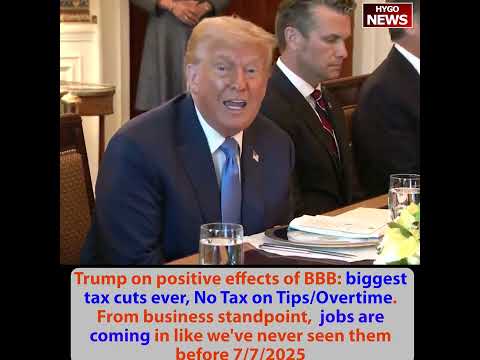
Trump then pivoted to the domestic policy agenda. “All they have to do now is talk about how good it is, the biggest tax cuts ever, no tax on tips, no tax on social security. Think of it, no tax on overtime. From a business standpoint, the jobs are coming in like we’ve never seen them before.”
The specific provisions Trump lists are the same as his repeated framing of the bill’s key provisions. The repetition creates specific political recognition — voters hearing these phrases frequently will associate them with the administration’s specific accomplishments.
“Jobs are coming in like we’ve never seen them before” is the economic outcome. Whether the specific job creation data matches Trump’s characterization depends on the actual employment reports. The data so far — the monthly BLS reports showing substantial job creation — supports the framing.
”Nine Factories” In One Day
Trump offered a specific data point. “As soon as that was signed, there were nine factories that announced that they were building the one-year deductibility, things that from a business standpoint you’d understand.”
Nine factories announced in the immediate aftermath of the bill signing represents substantial investment activity. The specific “one-year deductibility” reference is to the full expensing provision — companies can deduct 100% of capital investment in the year of the investment rather than depreciating over years.
The full expensing provision was specifically designed to produce this kind of outcome. Companies that had been planning capital investment but holding off because of tax timing issues could, with full expensing, accelerate their plans. The nine factories represent the immediate response to the changed incentives.
”$15 Trillion”
Trump’s extraordinary investment claim. “AI is the big thing. We have over 15 trillion dollars announced already. I mean really, I would say it’s been during the last three months, but we’re here for a short period of time. Some administrations never had anywhere near that number for a whole term, probably for a whole two terms.”
$15 trillion in announced investment is a staggering figure. American GDP is approximately $28 trillion. $15 trillion in investment announcements represents more than half of annual GDP in potential capital commitments.
“During the last three months” is the specific timeframe. That compression is extraordinary. Most administrations see substantial investment announcements over their full terms. Trump’s second administration has seen investment announcements exceeding what multi-term administrations have historically produced.
Whether the $15 trillion figure is accurate depends on what is being counted. Investment announcements often include multi-year commitments, contingent commitments, and commitments that may or may not materialize. The specific amount of actual committed capital may be smaller than the $15 trillion headline figure.
Why The Investment Number Matters
The investment claim matters because it validates the administration’s economic policy framework. If capital is flowing into the United States at the scale Trump describes, the administration’s policy environment — tariffs, tax provisions, deregulation, immigration enforcement — is producing the intended investment response.
The alternative — that Trump’s framework would produce capital flight rather than investment — has been the critical framing from progressive commentators. The $15 trillion figure, if accurate, refutes that framing. Capital is choosing the United States in the specific environment the administration has created.
”The Hottest Country In The World”
Trump offered the international validation. “I just told it to BB backstage. I was talking to him and I said, you know, the king of Saudi Arabia, smart guy, and also we went to Qatar and we went to UAE. Really three strong leaders, smart guys. They all told me the same thing and then I was reiterated at NATO just recently when we got back where they agreed to spend a trillion dollars a year by the way, which is about three times what they were spending. But they all said the same thing. We thought your country was dead. Horrible term, right? We thought the United States of America was dead and now you’re presiding over the hottest country anywhere in the world.”
The specific framing is remarkable. Gulf leaders had, a year before, characterized the United States as “dead.” Now the same leaders characterize it as “the hottest country anywhere in the world.”
The shift is substantial. Gulf Arab leaders make strategic decisions about where to deploy their vast sovereign wealth. They invest where they see opportunity. Their characterization of the United States as dead meant they were directing investment elsewhere. Their characterization of the United States as hot means they are directing investment here.
Why Gulf Arab Capital Matters
Gulf sovereign wealth funds — Saudi PIF, UAE ADIA, Qatar QIA, Kuwait KIA — collectively manage trillions of dollars. Their investment decisions shape global capital flows. When they shift their allocations toward the United States, American asset markets benefit.
The shift also provides specific validation. These sovereign investors have professional staff conducting rigorous due diligence. Their assessment of the United States as “hot” is not political commentary — it is professional investment judgment based on their analysis of expected returns.
”I Think BB Would Have Meant It Even Hotter Than Israel”
Trump’s playful reference. “With the hottest country in the world, I think BB would have meant it even hotter than Israel. Though Israel was pretty hot about a week ago, I can tell you for the wrong reasons. We are the hottest country in the world right now.”
The specific reference — “Israel was pretty hot about a week ago for the wrong reasons” — is to the Iranian missile strikes that affected Israeli territory during the active conflict phase. Israel was literally on fire in places as Iranian missiles landed. That kind of “hot” is not what one wants.
“We are the hottest country in the world right now” closes the framework. The American economy, foreign policy achievements, and broader trajectory position the country at the top of global attention. That position produces specific benefits — investment inflows, diplomatic leverage, cultural influence.
The Trump-Netanyahu Working Relationship
The bilateral meeting, taken in context, demonstrates the depth of the Trump-Netanyahu working relationship. Multiple hours of bilateral engagement. Multiple specific topics covered. Public ceremonial elements (the Nobel nomination) combined with substantive policy discussions (Iran, Gaza, regional integration).
That depth of engagement between leaders is unusual. Most bilateral meetings between major allies cover a fraction of the topics these two leaders addressed. The personal friendship between Trump and Netanyahu, built across multiple years, produces working efficiency that strangers could not match.
Key Takeaways
- Netanyahu’s opening: “I want to express the appreciation and admiration not only of all Israelis, but of the Jewish people, many, many admirers around the world for your leadership.”
- Trump on another Iran strike: “I hope we’re not going to have to do that. I can’t imagine wanting to do that. I can’t imagine them wanting to do that. They want to meet.”
- On Mamdani: “He’s not a socialist. He’s a communist…it all comes through the White House. He needs the money through the White House…He’s going to behave. He’ll behave. You better behave.”
- The investment claim: “We have over 15 trillion dollars announced already…I would say it’s been during the last three months…Some administrations never had anywhere near that number for a whole term.”
- Gulf leaders’ characterization: “We thought the United States of America was dead and now you’re presiding over the hottest country anywhere in the world.”