 HYGO News
 Pick most hungover person in the room; I don't drink, I don't drink
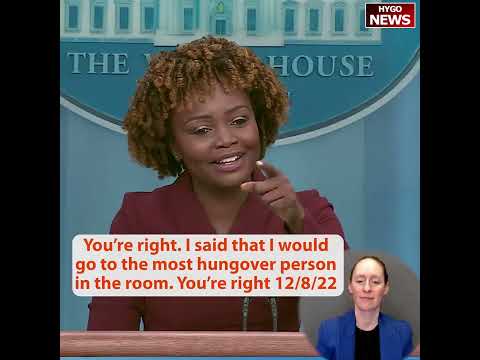
KJP’s Odd Briefing Moment: Promises to “Pick the Most Hungover Person in the Room” After White House Party — Reporter Repeatedly Says “I Don’t Drink”
On 12/9/2022, a White House press briefing featured an unusual moment when White House Press Secretary Karine Jean-Pierre referenced a promise she had made the previous night at a White House holiday event: that she would “go to the most hungover person in the room” for a question. When she called on a reporter apparently covered by the informal promise, she asked “Are you still hungover?” — a question the reporter repeatedly declined to confirm, saying “I don’t drink” multiple times. The bizarre exchange captured both the informal atmosphere of post-party White House briefings and the awkwardness of KJP attempting to engage in humor that the targeted reporter wasn’t interested in participating in. It also followed what appeared to be another contentious moment where KJP had declined to address campaign questions, telling a reporter “we’ve litigated this all week.”
The Context: Pre-Holiday Briefing
December 9, 2022 was near the end of the White House press year before the holiday break. White House holiday events had been happening, including various press-focused gatherings. The exchange occurred in the context of:
End-of-year press events — Traditional holiday receptions for the press corps.
Informal relationships — Press secretary and reporters interacting socially.
Year-end briefing fatigue — After a long political year.
Pre-vacation mood — Reporters and officials preparing for time off.
These factors created a somewhat more informal briefing atmosphere than usual. The “most hungover person” reference played on the idea that reporters at the previous night’s event might be experiencing aftereffects.
The “Off Limits” Question
The briefing had begun with what appeared to be a testy exchange. “What is telling you that that’s off limits?” KJP asked a reporter.
KJP continued: “I’ve already had that conversation with you, with your colleague, I believe yesterday. I’ve already addressed this multiple times this week, so I don’t have anything more to add. Again, we’ve litigated this all week. Don’t have anything to add.”
This exchange suggested a reporter had been asking about something KJP had repeatedly declined to address. The “we’ve litigated this all week” framing indicated that KJP was trying to close down a line of questioning that had been persistent throughout the week. The topic wasn’t specified in the transcript, but the pattern suggested it was something politically inconvenient.
”Not a Campaign Question”
KJP’s next statement was revealing. “So not a campaign question. I’m going to the back. I’m going to the back. I’m going to the back,” KJP said.
The “not a campaign question” reference suggested that the prior exchange had involved campaign-related questions — probably about the 2024 campaign or political positioning. KJP’s assertion that the next question should not be a campaign question indicated she was trying to steer the briefing away from political topics.
The repetition of “I’m going to the back” — said three times — was characteristic of KJP’s pattern of repeating herself during contentious moments. She was also signaling that she was moving on to a different reporter seated further back in the briefing room.
The Promise Reference
After attempting to move on, KJP appeared to remember a prior commitment. “Oh, are you? Okay. I’m coming back. You’re right. I said that I would go to the most hungover person in the room. You’re right. Go ahead. That was the promise I made last night,” KJP said.
The “promise I made last night” was evidently a social commitment made at the prior evening’s White House holiday event. KJP had apparently told a reporter — jokingly — that she would take his question first if he was the most hungover person the next day.
The context suggests:
Informal social event — Where such jokes were made.
Personal interaction — Between KJP and specific reporters.
Lighthearted moment — Intended as humor rather than serious commitment.
Follow-through — KJP remembering and honoring the informal promise.
The Briefing Interruption
The exchange disrupted KJP’s attempt to move on from the contentious earlier question. She had to:
Reverse course — Going to the originally-promised reporter.
Acknowledge the promise — Honoring social commitment.
Attempt humor — Engaging with the hungover joke.
Deal with reluctant participant — The reporter didn’t play along.
The pivot from “I’m going to the back” to “I’m coming back” reflected this reversal. KJP was visibly trying to balance a pre-existing social commitment with her preferred briefing management.
”Are You Still Hungover?”
KJP’s follow-through was awkward. “Are you still hungover?” KJP asked the reporter.
The question attempted to continue the previous night’s joke. If the reporter was still hungover, the joke would pay off, and they could share a lighthearted moment. If not, the joke would fall flat.
The reporter responded: “I don’t drink.”
This answer killed the joke. The reporter was apparently not a drinker and therefore couldn’t be hungover regardless of the prior night’s events. The “most hungover person in the room” framing didn’t apply to someone who didn’t drink.
The Repeated Denial
KJP repeated the question, and the reporter repeated the denial. “Are you still hungover? I don’t drink. I don’t drink. Are you still hungover? I don’t drink,” the exchange continued.
The repetition was striking. The reporter was persistently denying the premise. KJP was persistently asking as if expecting a different answer. This pattern continued through several exchanges.
Possible explanations for the repetition:
Genuine confusion — KJP might not have expected the “I don’t drink” answer.
Persistent joke attempt — Trying to extract the desired humorous response.
Miscommunication — The joke framework wasn’t translating properly.
Awkward stalling — Filling time with repetition while preparing for actual question.
Whatever the explanation, the exchange was uncomfortable. The reporter wasn’t participating in the joke, but KJP kept attempting to extract participation.
”I’m Just a Little Drunk”
A different voice at one point said “I’m just a little drunk” — presumably another reporter or someone in the room offering a self-deprecating alternative. This comment continued the light-hearted tone that KJP had been trying to create.
But the primary reporter was apparently unmoved. “I don’t drink” continued to be the response to “Are you still hungover?"
"Should Make Promises”
KJP’s closing comment suggested self-awareness about the awkward moment. “I just make you like this, but should make promises,” KJP said. (The transcript appears garbled — this may have been something like “I shouldn’t make promises I can’t keep” or similar.)
The self-deprecating acknowledgment at the end suggested that KJP recognized the joke hadn’t landed. Making promises at social events about specific reporters had backfired when the premise didn’t match reality.
The Cultural Context
The exchange reflected broader White House briefing culture:
Press-administration social events — Were common and expected.
Informal interactions — Created relationships that affected briefings.
Humor attempts — Sometimes worked, sometimes didn’t.
Personal interactions at briefings — Could make briefings more or less useful.
Press secretary personality — Showed through in exchanges like these.
KJP’s attempt to use the informal commitment for a humor moment at the briefing suggested her effort to humanize White House press relations. Whether this was helpful for the substantive work of briefings was debatable.
The Broader Briefing Implications
The exchange occurred during a week of contentious exchanges between KJP and reporters. The “we’ve litigated this all week” language at the start of the transcript suggested reporters had been pressing on topics KJP didn’t want to discuss.
The “most hungover person” moment could be read in different ways:
Deflection tactic — Using humor to defuse tension.
Genuine follow-through — Honoring a social commitment.
Brief respite — Moment of lightness in contentious week.
Social relationship priority — Preserving press relationships over briefing substance.
Regardless of interpretation, the moment was unusual enough to be captured on video and covered in various outlets. KJP’s briefings often generated moments that reflected the awkward balance between press secretary responsibilities and personal interactions.
”Thanks Everybody, Have a Great Weekend”
The exchange ended with KJP moving to conclude the briefing. “All right. Thanks, everybody. Have a great weekend,” KJP said.
The weekend reference suggested the briefing was ending before the weekend — common practice for Friday briefings. The holiday season context meant that many reporters would be off for the next few weeks. The final moment of the week was being concluded with the awkward hungover exchange rather than with substantive policy content.
The Awkward Journalism Moment
For journalism, the exchange was awkward but not substantively damaging. No major policy questions had been avoided because of the hungover conversation. The earlier campaign question deflection had already happened. The hungover moment was essentially off-topic conversation that delayed moving to the next substantive question.
The reporter’s persistent “I don’t drink” responses were themselves a form of journalism. By refusing to play along with KJP’s joke, the reporter was maintaining professional distance. They weren’t there to joke — they were there for briefing content. The repeated denial signaled that social bonding wasn’t the priority.
This kind of interaction — where reporters maintain professional distance even in social contexts — was standard for beat reporters covering specific administrations. Getting too friendly with sources could compromise objectivity. Being ready with “I don’t drink” responses protected against that concern.
The Viral Moment
The bizarre exchange became a minor viral moment online. Clips of KJP repeatedly asking if the reporter was hungover while the reporter repeatedly said “I don’t drink” circulated on social media. Various commentators treated it as:
Characteristic KJP awkwardness — Another example of her uncomfortable briefing style.
Legitimate humor — An amusing moment that humanized briefings.
Awkward workplace dynamics — Raising questions about the professionalism.
Pre-holiday lightness — A forgivable end-of-year moment.
The range of interpretations reflected the ambiguity of the moment itself. It wasn’t clearly terrible or clearly fine — it was just awkward in ways that depended on viewer perspective.
Key Takeaways
- At the end of a contentious White House press briefing on December 9, 2022, KJP referenced a promise she had made the previous night at a White House holiday event.
- The promise had been to call first on “the most hungover person in the room” for a question.
- When she called on the apparent recipient, she asked “Are you still hungover?” — a question the reporter repeatedly declined to engage with, saying “I don’t drink.”
- The awkward exchange lasted several rounds of the same question and same denial.
- The moment captured both the informal atmosphere of post-party White House briefings and the mismatched expectations between KJP’s attempted humor and the reporter’s professional distance.
Transcript Highlights
The following is transcribed from the video audio (unverified — AI-generated from audio).
- I’ve already addressed this multiple times this week, so I don’t have anything more to add.
- We’ve litigated this all week. Don’t have anything to add. So not a campaign question. I’m going to the back.
- I said that I would go to the most hungover person in the room. That was the promise I made last night.
- Are you still hungover? — I don’t drink. I don’t drink. I don’t drink.
- Are you still hungover? — I’m just a little drunk.
- Are you still hungover? — I don’t drink. I just make you like this, but should make promises.
Full transcript: 191 words transcribed via Whisper AI.