 HYGO News
 Pelosi signs Impeachment and McConnell slams House impeachment process ahead of Senate trial (Jan 15, 2020)
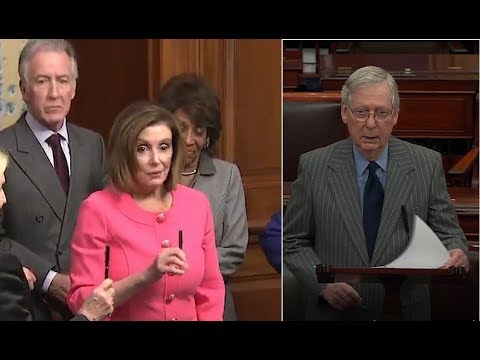
Pelosi signs Impeachment and McConnell slams House impeachment process ahead of Senate trial (Jan 15, 2020)
On January 15, 2020, House Speaker Nancy Pelosi formally signed the articles of impeachment against President Donald Trump and transmitted them to the Senate, ending a 28-day delay. Senate Majority Leader Mitch McConnell responded from the Senate floor with a lengthy attack on the House impeachment process, arguing that Democrats had conducted “the least thorough and most unfair impeachment inquiry in American history.”
Pelosi Signs the Articles of Impeachment
Pelosi signed the two articles of impeachment — abuse of power and obstruction of Congress — in a ceremony at the Capitol. She used ceremonial pens during the signing, a gesture that drew criticism from Republicans who viewed it as treating a solemn constitutional process as a celebratory occasion.
Along with the signing, Pelosi announced the appointment of seven House impeachment managers who would prosecute the case in the Senate trial: Adam Schiff, Jerry Nadler, Zoe Lofgren, Hakeem Jeffries, Val Demings, Jason Crow, and Sylvia Garcia. The managers would serve as the equivalent of prosecutors, presenting the House’s evidence and arguments to the Senate.
The transmission of the articles came after a nearly month-long standoff. Pelosi had withheld the articles following the December 18, 2019, House vote, seeking to pressure the Senate into agreeing to call witnesses during the trial. Though the delay did not produce the concessions Pelosi had sought regarding witness testimony, new evidence did emerge during the intervening weeks, including emails about the freeze on Ukraine military aid and former National Security Advisor John Bolton’s announcement that he would be willing to testify if subpoenaed by the Senate.
McConnell’s Attack on the House Process
From the Senate floor, McConnell delivered a point-by-point dismantling of the House impeachment process. He opened by arguing that the inquiry had been rushed compared to every prior presidential impeachment in American history.
“Last year, the House of Representatives rushed through the least thorough and most unfair impeachment inquiry in American history. They took just 12 weeks,” McConnell said. “There was more than a year of hearings before the impeachment of President Nixon. There were multiple years of investigation for President Clinton. When people are serious about compiling evidence and proving a case, these things take time.”
McConnell accused House Democrats of cutting procedural corners: “House Democrats performed a pale imitation of a real inquiry. They did not pursue their own subpoenas through the courts. They declined to litigate potential questions of privilege. They pulled the plug as soon as Speaker Pelosi realized she had enough Democrat votes to achieve a political outcome.”
McConnell Argues Impeachment Was Predetermined
A central theme of McConnell’s speech was that Democrats had decided to impeach Trump long before the Ukraine events that formed the basis of the articles. He cited several pieces of evidence for this claim.
“Prominent Democrats were promising to impeach President Trump years, years before those events even happened,” McConnell told the Senate. “The day this president was inaugurated, the Washington Post said the campaign to impeach President Trump has begun. That was the day he was inaugurated.”
McConnell pointed to Jerry Nadler’s campaign to become the top Democrat on the House Judiciary Committee specifically because he was “an impeachment expert,” suggesting that Democratic leaders had been positioning themselves for impeachment proceedings well in advance of the Ukraine call.
He also seized on a comment from Pelosi herself: “When a reporter asked Speaker Pelosi why the Democrats were in such a hurry, here was her response: ‘Speed? It’s been going on for 22 months, two and a half years, actually.’” McConnell dissected the timeline: “The events over which the Democrats want to impeach happened just six months ago. Not two and a half years ago. So how has impeachment been underway for two and a half years?”
McConnell noted that the House had initially pursued the Mueller investigation as grounds for impeachment but pivoted to Ukraine “because the facts let them down.”
McConnell on the Partisan Nature of the Proceedings
McConnell accused Senate Democratic Leader Chuck Schumer of confirming the partisan motivations behind the impeachment. He quoted Schumer telling reporters that as long as the trial could be used to hurt Republican senators’ reelection chances, “whatever happens is a win-win.”
“Presidential impeachment may be the gravest process our Constitution contemplates. It undoes the people’s decision in a national election,” McConnell said. “Going about it in this subjective, unfair, and rushed way is corrosive to our institutions. It hurts the national unity. And it virtually guarantees that future houses of either party will feel free to impeach any future president because they don’t like him.”
McConnell emphasized what he called a historic first: “They passed the first presidential impeachment that does not even allege an actual crime under our laws. We had a 230-year tradition of rejecting purely political impeachments, and it died last month in this House of Representatives.”
McConnell’s Warning to the Senate
McConnell closed his remarks with a direct appeal to his Senate colleagues. He warned that if the Senate endorsed the House process, it would “almost guarantee the impeachment of every future president of either party when the House doesn’t like that person.”
“This great process of last constitutional resort will be watered down into the kind of anti-Democratic recall measure that the Founding Fathers explicitly did not want,” McConnell argued. “The Senate was designed to stabilize our institutions, to break partisan fevers, to stop short-term passions from destroying our long-term future.”
He concluded: “House Democrats may have descended into pure factionalism, but the United States Senate must not. This is the only body that can consider all factors presented by the House, decide what has or has not been proven, and choose what outcome best serves the nation.”
Key Takeaways
- Speaker Pelosi signed the articles of impeachment on January 15, 2020, ending a 28-day delay and appointing seven House managers to prosecute the case in the Senate trial.
- McConnell argued the House conducted “the least thorough and most unfair impeachment inquiry in American history,” taking just 12 weeks compared to over a year for Nixon and multiple years for Clinton, while failing to pursue subpoenas through the courts.
- McConnell warned that if the Senate blessed the House process, it would “almost guarantee the impeachment of every future president” and destroy a 230-year tradition of rejecting purely political impeachments.